




Four point charges –q, +q, +q and –q are placed on the y-axis at y=-2d, y=-d, y=+d and y=+2d respectively. The magnitude of the electric field E at a point on the x-axis at x=D, with D>>d, will behave as
$
(a){\text{ E}} \propto \dfrac{1}{D} \\
(b){\text{ E}} \propto \dfrac{1}{{{D^3}}} \\
(c){\text{ E}} \propto \dfrac{1}{{{D^2}}} \\
(d){\text{ E}} \propto \dfrac{1}{{{D^4}}} \\
$
Answer
 Verified
264.3k+ views
Hint: In this question first plot 4 charges on y axis considering O as the origin, take a random point P on the direction of positive x-axis at a distance D from the origin, consider ${\theta _1}$be the angle that point P makes with the charge –q at positive y axis and ${\theta _2}$be the angle that point P makes with the +q change on the positive y axis. Then use the direct formula for electric fields at a point due to a point charge. Use this to find the net electric field at this point. This will help approaching the problem.
Complete step-by-step solution -
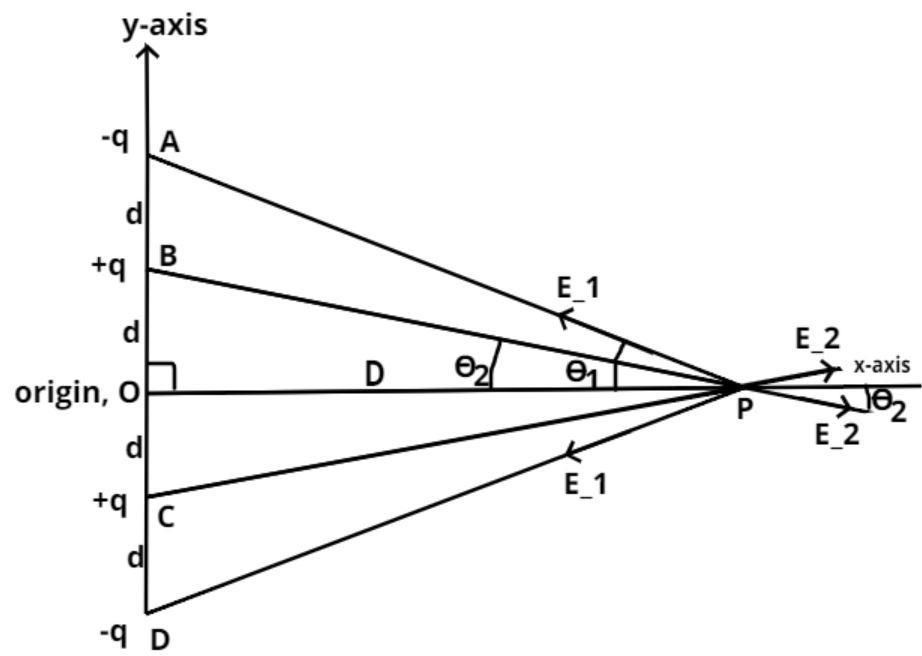
Four point charges –q, +q, +q and –q are placed on y-axis at A, B, C and D point as shown in the figure, which are at the distances, y = 2d, y = d, y = -d and y= -2d i.e. all points are at equal distance w.r.t the previous point as shown in the figure.
Now we have to find out the electric field E at a point (P) on the x-axis at X = D.
Let us suppose point P makes an angle ${\theta _1}$ with point A and D as shown in the figure.
And angle ${\theta _2}$ with point B and C as shown in the figure.
Now due to negative charge at point A and D electric field ${E_1}$ is pointed inwards as shown in the figure.
And due to positive charge at point B and C electric field ${E_2}$ is pointed outwards as shown in the figure.
Now resolve the components of electric field on the x-axis the electric field at point P is given as,
$ \Rightarrow E = 2{E_2}\cos {\theta _2} - 2{E_1}\cos {\theta _1}$.................. (1)
Now in triangle AOP apply Pythagoras theorem we have,
$ \Rightarrow {\left( {{\text{Hypotenuse}}} \right)^2} = {\left( {{\text{perpendicular}}} \right)^2} + {\left( {{\text{base}}} \right)^2}$
$ \Rightarrow {\left( {{\text{AP}}} \right)^2} = {\left( {{\text{OA}}} \right)^2} + {\left( {{\text{OP}}} \right)^2}$
$ \Rightarrow {\left( {{\text{AP}}} \right)^2} = {\left( {{\text{2d}}} \right)^2} + {\left( D \right)^2}$
Now take square root on both sides we have,
\[ \Rightarrow \left( {{\text{AP}}} \right) = \sqrt {{{\left( {{\text{2d}}} \right)}^2} + {{\left( D \right)}^2}} \].............. (2)
Similarly
$ \Rightarrow \left( {{\text{BP}}} \right) = \sqrt {{{\left( {\text{d}} \right)}^2} + {{\left( D \right)}^2}} $.................. (3)
Now electric field at point at point P due to point charge at A is given as
$ \Rightarrow {E_1} = \dfrac{1}{{4\pi {\xi _o}}}\dfrac{{\left( q \right)}}{{{{\left( {AP} \right)}^2}}}$
Now from equation (2) we have,
$ \Rightarrow {E_1} = \dfrac{{kq}}{{{{\left( {{\text{2d}}} \right)}^2} + {{\left( D \right)}^2}}}$, where $k = \dfrac{1}{{4\pi {\xi _o}}}$
And electric field at point at point P due to point charge at B is given as
$ \Rightarrow {E_2} = \dfrac{1}{{4\pi {\xi _o}}}\dfrac{{\left( q \right)}}{{{{\left( {BP} \right)}^2}}}$
Now from equation (3) we have,
$ \Rightarrow {E_2} = \dfrac{{kq}}{{{{\left( {\text{d}} \right)}^2} + {{\left( D \right)}^2}}}$, where $k = \dfrac{1}{{4\pi {\xi _o}}}$
Now in triangle AOP cosine is the ratio of base to hypotenuse so we have,
$ \Rightarrow \cos {\theta _1} = \dfrac{{OP}}{{AP}} = \dfrac{D}{{\sqrt {{{\left( {{\text{2d}}} \right)}^2} + {{\left( D \right)}^2}} }}$
Similarly in triangle BOP
$ \Rightarrow \cos {\theta _2} = \dfrac{{OP}}{{BP}} = \dfrac{D}{{\sqrt {{{\left( {\text{d}} \right)}^2} + {{\left( D \right)}^2}} }}$
Now from equation (1) we have,
$ \Rightarrow E = 2\dfrac{{kq}}{{{{\left( {\text{d}} \right)}^2} + {{\left( D \right)}^2}}}\dfrac{D}{{\sqrt {{{\left( {\text{d}} \right)}^2} + {{\left( D \right)}^2}} }} - 2\dfrac{{kq}}{{{{\left( {{\text{2d}}} \right)}^2} + {{\left( D \right)}^2}}}\dfrac{D}{{\sqrt {{{\left( {{\text{2d}}} \right)}^2} + {{\left( D \right)}^2}} }}$
Now simplify this we have,
\[ \Rightarrow E = \dfrac{{2kqD}}{{{{\left[ {{{\left( {\text{d}} \right)}^2} + {{\left( D \right)}^2}} \right]}^{\dfrac{3}{2}}}}} - \dfrac{{2kqD}}{{{{\left[ {{{\left( {{\text{2d}}} \right)}^2} + {{\left( D \right)}^2}} \right]}^{\dfrac{3}{2}}}}}\]
Now take ${D^2}$ common from the denominator we have,
\[ \Rightarrow E = \dfrac{1}{{{{\left( {{D^2}} \right)}^{\dfrac{3}{2}}}}}\left\{ {\dfrac{{2kqD}}{{{{\left[ {1 + {{\left( {\dfrac{d}{D}} \right)}^2}} \right]}^{\dfrac{3}{2}}}}} - \dfrac{{2kqD}}{{{{\left[ {1 + {{\left( {\dfrac{{2d}}{D}} \right)}^2}} \right]}^{\dfrac{3}{2}}}}}} \right\}\]
\[ \Rightarrow E = \dfrac{{2kq}}{{{D^2}}}\left\{ {{{\left[ {1 + {{\left( {\dfrac{d}{D}} \right)}^2}} \right]}^{ - \dfrac{3}{2}}} - {{\left[ {1 + 4{{\left( {\dfrac{d}{D}} \right)}^2}} \right]}^{ - \dfrac{3}{2}}}} \right\}\]
Now according to binomial expansion approximation (we use this approximation because it is given that D>>>d,$\dfrac{d}{D} < < 1 \Rightarrow \dfrac{{{d^2}}}{{{D^2}}} < < < 1 \Rightarrow \dfrac{{{d^3}}}{{{D^3}}} \simeq 0$ and so on, so higher terms are neglected) which is given as ${\left( {1 + x} \right)^{ - n}} = 1 - nx$ so use this property in above equation we have,
\[ \Rightarrow E = \dfrac{{2kq}}{{{D^2}}}\left\{ {\left[ {1 - \dfrac{3}{2}\dfrac{{{d^2}}}{{{D^2}}}} \right] - \left[ {1 - 4 \times \dfrac{3}{2}\dfrac{{{d^2}}}{{{D^2}}}} \right]} \right\}\]
Now simplify this we have,
\[ \Rightarrow E = \dfrac{{2kq}}{{{D^2}}}\left\{ {1 - \dfrac{3}{2}\dfrac{{{d^2}}}{{{D^2}}} - 1 + 6\dfrac{{{d^2}}}{{{D^2}}}} \right\}\]
\[ \Rightarrow E = \dfrac{{2kq}}{{{D^2}}}\left\{ { - \dfrac{3}{2}\dfrac{{{d^2}}}{{{D^2}}} + 6\dfrac{{{d^2}}}{{{D^2}}}} \right\} = \dfrac{{2kq}}{{{D^2}}}\left[ {\dfrac{{9{d^2}}}{{2{D^2}}}} \right] = \dfrac{{9kq{d^2}}}{{{D^4}}}\]
So as we see that the electric field at point P is behaves as,
$ \Rightarrow E \propto \dfrac{1}{{{D^4}}}$
So this is the required answer.
Hence option (D) is the correct answer.
Note – Electric field is considered as a region around a charged particle in which when another particle is placed than this particle experiences a force. The electric field intensity is simply the strength of the force that is being experienced by this placed object within the region of one charged particle. The electric field is composed of electric lines of forces depicting the region of electric field. For a positive charge these are generally radially outwards and for a negative charge these are radially inwards.
Complete step-by-step solution -
Four point charges –q, +q, +q and –q are placed on y-axis at A, B, C and D point as shown in the figure, which are at the distances, y = 2d, y = d, y = -d and y= -2d i.e. all points are at equal distance w.r.t the previous point as shown in the figure.
Now we have to find out the electric field E at a point (P) on the x-axis at X = D.
Let us suppose point P makes an angle ${\theta _1}$ with point A and D as shown in the figure.
And angle ${\theta _2}$ with point B and C as shown in the figure.
Now due to negative charge at point A and D electric field ${E_1}$ is pointed inwards as shown in the figure.
And due to positive charge at point B and C electric field ${E_2}$ is pointed outwards as shown in the figure.
Now resolve the components of electric field on the x-axis the electric field at point P is given as,
$ \Rightarrow E = 2{E_2}\cos {\theta _2} - 2{E_1}\cos {\theta _1}$.................. (1)
Now in triangle AOP apply Pythagoras theorem we have,
$ \Rightarrow {\left( {{\text{Hypotenuse}}} \right)^2} = {\left( {{\text{perpendicular}}} \right)^2} + {\left( {{\text{base}}} \right)^2}$
$ \Rightarrow {\left( {{\text{AP}}} \right)^2} = {\left( {{\text{OA}}} \right)^2} + {\left( {{\text{OP}}} \right)^2}$
$ \Rightarrow {\left( {{\text{AP}}} \right)^2} = {\left( {{\text{2d}}} \right)^2} + {\left( D \right)^2}$
Now take square root on both sides we have,
\[ \Rightarrow \left( {{\text{AP}}} \right) = \sqrt {{{\left( {{\text{2d}}} \right)}^2} + {{\left( D \right)}^2}} \].............. (2)
Similarly
$ \Rightarrow \left( {{\text{BP}}} \right) = \sqrt {{{\left( {\text{d}} \right)}^2} + {{\left( D \right)}^2}} $.................. (3)
Now electric field at point at point P due to point charge at A is given as
$ \Rightarrow {E_1} = \dfrac{1}{{4\pi {\xi _o}}}\dfrac{{\left( q \right)}}{{{{\left( {AP} \right)}^2}}}$
Now from equation (2) we have,
$ \Rightarrow {E_1} = \dfrac{{kq}}{{{{\left( {{\text{2d}}} \right)}^2} + {{\left( D \right)}^2}}}$, where $k = \dfrac{1}{{4\pi {\xi _o}}}$
And electric field at point at point P due to point charge at B is given as
$ \Rightarrow {E_2} = \dfrac{1}{{4\pi {\xi _o}}}\dfrac{{\left( q \right)}}{{{{\left( {BP} \right)}^2}}}$
Now from equation (3) we have,
$ \Rightarrow {E_2} = \dfrac{{kq}}{{{{\left( {\text{d}} \right)}^2} + {{\left( D \right)}^2}}}$, where $k = \dfrac{1}{{4\pi {\xi _o}}}$
Now in triangle AOP cosine is the ratio of base to hypotenuse so we have,
$ \Rightarrow \cos {\theta _1} = \dfrac{{OP}}{{AP}} = \dfrac{D}{{\sqrt {{{\left( {{\text{2d}}} \right)}^2} + {{\left( D \right)}^2}} }}$
Similarly in triangle BOP
$ \Rightarrow \cos {\theta _2} = \dfrac{{OP}}{{BP}} = \dfrac{D}{{\sqrt {{{\left( {\text{d}} \right)}^2} + {{\left( D \right)}^2}} }}$
Now from equation (1) we have,
$ \Rightarrow E = 2\dfrac{{kq}}{{{{\left( {\text{d}} \right)}^2} + {{\left( D \right)}^2}}}\dfrac{D}{{\sqrt {{{\left( {\text{d}} \right)}^2} + {{\left( D \right)}^2}} }} - 2\dfrac{{kq}}{{{{\left( {{\text{2d}}} \right)}^2} + {{\left( D \right)}^2}}}\dfrac{D}{{\sqrt {{{\left( {{\text{2d}}} \right)}^2} + {{\left( D \right)}^2}} }}$
Now simplify this we have,
\[ \Rightarrow E = \dfrac{{2kqD}}{{{{\left[ {{{\left( {\text{d}} \right)}^2} + {{\left( D \right)}^2}} \right]}^{\dfrac{3}{2}}}}} - \dfrac{{2kqD}}{{{{\left[ {{{\left( {{\text{2d}}} \right)}^2} + {{\left( D \right)}^2}} \right]}^{\dfrac{3}{2}}}}}\]
Now take ${D^2}$ common from the denominator we have,
\[ \Rightarrow E = \dfrac{1}{{{{\left( {{D^2}} \right)}^{\dfrac{3}{2}}}}}\left\{ {\dfrac{{2kqD}}{{{{\left[ {1 + {{\left( {\dfrac{d}{D}} \right)}^2}} \right]}^{\dfrac{3}{2}}}}} - \dfrac{{2kqD}}{{{{\left[ {1 + {{\left( {\dfrac{{2d}}{D}} \right)}^2}} \right]}^{\dfrac{3}{2}}}}}} \right\}\]
\[ \Rightarrow E = \dfrac{{2kq}}{{{D^2}}}\left\{ {{{\left[ {1 + {{\left( {\dfrac{d}{D}} \right)}^2}} \right]}^{ - \dfrac{3}{2}}} - {{\left[ {1 + 4{{\left( {\dfrac{d}{D}} \right)}^2}} \right]}^{ - \dfrac{3}{2}}}} \right\}\]
Now according to binomial expansion approximation (we use this approximation because it is given that D>>>d,$\dfrac{d}{D} < < 1 \Rightarrow \dfrac{{{d^2}}}{{{D^2}}} < < < 1 \Rightarrow \dfrac{{{d^3}}}{{{D^3}}} \simeq 0$ and so on, so higher terms are neglected) which is given as ${\left( {1 + x} \right)^{ - n}} = 1 - nx$ so use this property in above equation we have,
\[ \Rightarrow E = \dfrac{{2kq}}{{{D^2}}}\left\{ {\left[ {1 - \dfrac{3}{2}\dfrac{{{d^2}}}{{{D^2}}}} \right] - \left[ {1 - 4 \times \dfrac{3}{2}\dfrac{{{d^2}}}{{{D^2}}}} \right]} \right\}\]
Now simplify this we have,
\[ \Rightarrow E = \dfrac{{2kq}}{{{D^2}}}\left\{ {1 - \dfrac{3}{2}\dfrac{{{d^2}}}{{{D^2}}} - 1 + 6\dfrac{{{d^2}}}{{{D^2}}}} \right\}\]
\[ \Rightarrow E = \dfrac{{2kq}}{{{D^2}}}\left\{ { - \dfrac{3}{2}\dfrac{{{d^2}}}{{{D^2}}} + 6\dfrac{{{d^2}}}{{{D^2}}}} \right\} = \dfrac{{2kq}}{{{D^2}}}\left[ {\dfrac{{9{d^2}}}{{2{D^2}}}} \right] = \dfrac{{9kq{d^2}}}{{{D^4}}}\]
So as we see that the electric field at point P is behaves as,
$ \Rightarrow E \propto \dfrac{1}{{{D^4}}}$
So this is the required answer.
Hence option (D) is the correct answer.
Note – Electric field is considered as a region around a charged particle in which when another particle is placed than this particle experiences a force. The electric field intensity is simply the strength of the force that is being experienced by this placed object within the region of one charged particle. The electric field is composed of electric lines of forces depicting the region of electric field. For a positive charge these are generally radially outwards and for a negative charge these are radially inwards.
Recently Updated Pages
JEE Main 2025-26 Experimental Skills Mock Test – Free Practice

JEE Main 2025-26 Electronic Devices Mock Test: Free Practice Online
JEE Main 2025-26 Mock Tests: Free Practice Papers & Solutions
JEE Main 2025-26: Magnetic Effects of Current & Magnetism Mock Test
JEE Main 2025-26 Atoms and Nuclei Mock Test – Free Practice Online
JEE Main Mock Test 2025-26: Experimental Skills Chapter Online Practice
Trending doubts
JEE Main 2026: Exam Dates, Session 2 Updates, City Slip, Admit Card & Latest News
JEE Main Participating Colleges 2026 - A Complete List of Top Colleges
Kinematics Mock Test for JEE Main 2025-26: Comprehensive Practice
Kinematics Mock Test for JEE Main 2025-26: Practice & Ace the Exam
Hybridisation in Chemistry – Concept, Types & Applications
Understanding the Electric Field of a Uniformly Charged Ring
Other Pages
CBSE Class 12 Physics Question Paper 2026: Download SET-wise PDF with Answer Key & Analysis
JEE Advanced 2026 Notification Out with Exam Date, Registration (Extended), Syllabus and More
JEE Advanced Percentile vs Marks 2026: JEE Main Cutoff, AIR & IIT Admission Guide
JEE Advanced Weightage Chapter Wise 2026 for Physics, Chemistry, and Mathematics
JEE Advanced Marks vs Rank 2025 - Predict Your IIT Rank Based on Score
Derivation of Equation of Trajectory Explained for Students