




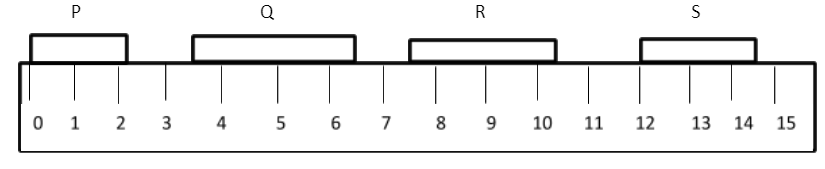
Four pieces of wooden sticks P, Q, R and S are placed along the length of 15 cm long scale as shown in the figure. What is the average length of these sticks?
A) 2.0 cm
B) 2.5 cm
C) 2.6 cm
D) 2.9 cm
Answer
 Verified
242.7k+ views
Hint In this question we are going to find the average length of sticks P, Q, R and S. The total length of scale is given and in the diagram we can see the approximate lengths of these sticks.
Complete step by step solution:
Given,
The length of scale $L = 15{\text{ cm}}$
From figure, we can see that the length of sticks P, Q, R and S are as follows,
P=2.1 cm
Q= 3 cm
R= 3.1 cm
S= 2.5 cm
Now using the formula for average length of sticks,
\[\Rightarrow {\text{Average length of sticks = }}\dfrac{{P + Q + R + S}}{4}\]
Putting the values of P, Q, R and S
\[\Rightarrow {\text{Average length of sticks = }}\dfrac{{2.1 + 3 + 3.1 + 2.5}}{4}\]
\[\Rightarrow {\text{Average length of sticks = }}\dfrac{{10.7}}{4}\]
\[\Rightarrow {\text{Average length of sticks = }}2.675{\text{ cm}}\]
\[\Rightarrow {\text{Average length of sticks = }}2.6{\text{ cm}}\]
Result- the average length of sticks P, Q, R and S is \[2.6{\text{ cm}}\].
Hence, option (C) is correct.
Note: In this question we have to be careful while finding the lengths of sticks P, Q, R and S by taking the reference of the given scale. This is a question of general knowledge of finding average. If there are N number of elements and the elements are ${N_1},{N_2},{N_3}..........$.Then the general formula of average is as follows,
${\text{Average = }}\dfrac{{{\text{sum of all the elements}}}}{{{\text{total number of elements}}}}$
${\text{Average = }}\dfrac{{{{\text{N}}_1} + {{\text{N}}_2} + {{\text{N}}_3} + ........}}{N}$
It is an important topic of qualitative aptitude. A set of elements can be considered as a sequence of numbers. This sequence can have unevenly spaced numbers. The average of numbers present in a set of elements can be considered as the mean of these elements. We can say one more thing about average that average is a single number that we use to present a set of numbers. A very common formula to find average of numbers of set can be written as follows,
${\text{Average = }}\dfrac{{{\text{sum}}}}{{{\text{count}}}}$
Complete step by step solution:
Given,
The length of scale $L = 15{\text{ cm}}$
From figure, we can see that the length of sticks P, Q, R and S are as follows,
P=2.1 cm
Q= 3 cm
R= 3.1 cm
S= 2.5 cm
Now using the formula for average length of sticks,
\[\Rightarrow {\text{Average length of sticks = }}\dfrac{{P + Q + R + S}}{4}\]
Putting the values of P, Q, R and S
\[\Rightarrow {\text{Average length of sticks = }}\dfrac{{2.1 + 3 + 3.1 + 2.5}}{4}\]
\[\Rightarrow {\text{Average length of sticks = }}\dfrac{{10.7}}{4}\]
\[\Rightarrow {\text{Average length of sticks = }}2.675{\text{ cm}}\]
\[\Rightarrow {\text{Average length of sticks = }}2.6{\text{ cm}}\]
Result- the average length of sticks P, Q, R and S is \[2.6{\text{ cm}}\].
Hence, option (C) is correct.
Note: In this question we have to be careful while finding the lengths of sticks P, Q, R and S by taking the reference of the given scale. This is a question of general knowledge of finding average. If there are N number of elements and the elements are ${N_1},{N_2},{N_3}..........$.Then the general formula of average is as follows,
${\text{Average = }}\dfrac{{{\text{sum of all the elements}}}}{{{\text{total number of elements}}}}$
${\text{Average = }}\dfrac{{{{\text{N}}_1} + {{\text{N}}_2} + {{\text{N}}_3} + ........}}{N}$
It is an important topic of qualitative aptitude. A set of elements can be considered as a sequence of numbers. This sequence can have unevenly spaced numbers. The average of numbers present in a set of elements can be considered as the mean of these elements. We can say one more thing about average that average is a single number that we use to present a set of numbers. A very common formula to find average of numbers of set can be written as follows,
${\text{Average = }}\dfrac{{{\text{sum}}}}{{{\text{count}}}}$
Recently Updated Pages
WBJEE 2026 Registration Started: Important Dates Eligibility Syllabus Exam Pattern

Dimensions of Charge: Dimensional Formula, Derivation, SI Units & Examples
How to Calculate Moment of Inertia: Step-by-Step Guide & Formulas
Circuit Switching vs Packet Switching: Key Differences Explained
Dimensions of Pressure in Physics: Formula, Derivation & SI Unit
JEE Extractive Metallurgy Important Concepts and Tips for Exam Preparation
Trending doubts
JEE Main 2026: Session 1 Results Out and Session 2 Registration Open, City Intimation Slip, Exam Dates, Syllabus & Eligibility
Ideal and Non-Ideal Solutions Explained for Class 12 Chemistry
JEE Main Participating Colleges 2026 - A Complete List of Top Colleges
Understanding the Angle of Deviation in a Prism
Hybridisation in Chemistry – Concept, Types & Applications
Understanding the Electric Field of a Uniformly Charged Ring
Other Pages
JEE Advanced Marks vs Ranks 2025: Understanding Category-wise Qualifying Marks and Previous Year Cut-offs
Important Questions For Class 11 Physics Chapter 1 Units and Measurement - 2025-26
CBSE Notes Class 11 Physics Chapter 4 - Laws of Motion - 2025-26
CBSE Notes Class 11 Physics Chapter 14 - Waves - 2025-26
JEE Advanced 2026 - Exam Date (Released), Syllabus, Registration, Eligibility, Preparation, and More
CBSE Notes Class 11 Physics Chapter 9 - Mechanical Properties of Fluids - 2025-26