




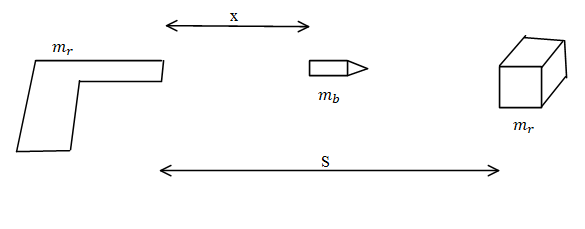
A revolver of mass ${m_r}$ fires a bullet of mass ${m_b}$ in a free space. The bullet is hit a resting block mass ${m_r}$ at a distance S away from the revolver. Distance travelled by the centre of mass of the bullet and block system when the bullet travels through a distance x towards the block is:
A) $\dfrac{{{m_b}x}}{{{m_r} + {m_b}}}$.
B) $\dfrac{{{m_b}x + {m_r}s}}{{{m_r} + {m_b}}}$.
C) $\dfrac{{{m_r}\left( {s - x} \right)}}{{{m_r} + {m_b}}}$.
D) All of the above
Answer
 Verified
243k+ views
Hint: The centre of mass of a system is the point where the mass of the whole system can be assumed to be concentrated. Whenever the bullet is fired by the rifle then the rifle moves a bit back side because of the recoil.
Formula used:
The momentum of any body is equal to,
$ \Rightarrow p = m \times v$
Where mass is m and velocity is v.
Complete step by step solution:
It is given in the problem that a revolver of mass ${m_r}$fires a bullet of mass ${m_b}$ in a free space the bullet is a hit a resting block mass ${m_r}$ at a distance S away from the revolver and we need to find the distance travelled by the centre of mass of the bullet and block system when the bullet travels through a distance x towards the block.
The centre of mass system before the bullet is fired is given by,
$ \Rightarrow {X_{com}} = \dfrac{{{m_r} \times 0 + \left( {{m_b} \times s} \right)}}{{{m_r} + {m_b}}}$
$ \Rightarrow {X_{com}} = \dfrac{{{m_r} \times 0 + \left( {{m_b} \times s} \right)}}{{{m_r} + {m_b}}}$
$ \Rightarrow {X_{com}} = \dfrac{{{m_b} \times s}}{{{m_r} + {m_b}}}$………eq. (1)
The centre of mass of the system after the bullet is fired.
$ \Rightarrow {X_{com}} = \dfrac{{\left( {{m_r} \times 0} \right) + {m_b} \times \left( {s - x} \right)}}{{{m_r} + {m_b}}}$
$ \Rightarrow {X_{com}} = \dfrac{{{m_b} \times \left( {s - x} \right)}}{{{m_r} + {m_b}}}$………eq. (2)
Let d be the distance travelled by the centre of mass.
Subtracting equation (1) by equation (2) we get,
$ \Rightarrow d = \dfrac{{{m_b} \times s}}{{{m_r} + {m_b}}} - \dfrac{{{m_b} \times \left( {s - x} \right)}}{{{m_r} + {m_b}}}$
$ \Rightarrow d = \dfrac{{\left( {{m_b} \times s} \right) - {m_b} \times \left( {s - x} \right)}}{{{m_r} + {m_b}}}$
$ \Rightarrow d = \dfrac{{\left( {{m_b} \times s} \right) - \left( {{m_b} \times s} \right) + \left( {{m_b} \times x} \right)}}{{{m_r} + {m_b}}}$
$ \Rightarrow d = \dfrac{{\left( {{m_b} \times x} \right)}}{{{m_r} + {m_b}}}$.
Option A is the correct answer for this problem.
Note: The students are advised to remember the formula of the centre of the mass as it is very useful in solving the problem like these. The position of the block does not change in both the cases but the bullet moves a distance x.
Formula used:
The momentum of any body is equal to,
$ \Rightarrow p = m \times v$
Where mass is m and velocity is v.
Complete step by step solution:
It is given in the problem that a revolver of mass ${m_r}$fires a bullet of mass ${m_b}$ in a free space the bullet is a hit a resting block mass ${m_r}$ at a distance S away from the revolver and we need to find the distance travelled by the centre of mass of the bullet and block system when the bullet travels through a distance x towards the block.
The centre of mass system before the bullet is fired is given by,
$ \Rightarrow {X_{com}} = \dfrac{{{m_r} \times 0 + \left( {{m_b} \times s} \right)}}{{{m_r} + {m_b}}}$
$ \Rightarrow {X_{com}} = \dfrac{{{m_r} \times 0 + \left( {{m_b} \times s} \right)}}{{{m_r} + {m_b}}}$
$ \Rightarrow {X_{com}} = \dfrac{{{m_b} \times s}}{{{m_r} + {m_b}}}$………eq. (1)
The centre of mass of the system after the bullet is fired.
$ \Rightarrow {X_{com}} = \dfrac{{\left( {{m_r} \times 0} \right) + {m_b} \times \left( {s - x} \right)}}{{{m_r} + {m_b}}}$
$ \Rightarrow {X_{com}} = \dfrac{{{m_b} \times \left( {s - x} \right)}}{{{m_r} + {m_b}}}$………eq. (2)
Let d be the distance travelled by the centre of mass.
Subtracting equation (1) by equation (2) we get,
$ \Rightarrow d = \dfrac{{{m_b} \times s}}{{{m_r} + {m_b}}} - \dfrac{{{m_b} \times \left( {s - x} \right)}}{{{m_r} + {m_b}}}$
$ \Rightarrow d = \dfrac{{\left( {{m_b} \times s} \right) - {m_b} \times \left( {s - x} \right)}}{{{m_r} + {m_b}}}$
$ \Rightarrow d = \dfrac{{\left( {{m_b} \times s} \right) - \left( {{m_b} \times s} \right) + \left( {{m_b} \times x} \right)}}{{{m_r} + {m_b}}}$
$ \Rightarrow d = \dfrac{{\left( {{m_b} \times x} \right)}}{{{m_r} + {m_b}}}$.
Option A is the correct answer for this problem.
Note: The students are advised to remember the formula of the centre of the mass as it is very useful in solving the problem like these. The position of the block does not change in both the cases but the bullet moves a distance x.
Recently Updated Pages
WBJEE 2026 Registration Started: Important Dates Eligibility Syllabus Exam Pattern

Dimensions of Charge: Dimensional Formula, Derivation, SI Units & Examples
How to Calculate Moment of Inertia: Step-by-Step Guide & Formulas
Circuit Switching vs Packet Switching: Key Differences Explained
Dimensions of Pressure in Physics: Formula, Derivation & SI Unit
JEE Extractive Metallurgy Important Concepts and Tips for Exam Preparation
Trending doubts
JEE Main 2026: Session 1 Results Out and Session 2 Registration Open, City Intimation Slip, Exam Dates, Syllabus & Eligibility
Ideal and Non-Ideal Solutions Explained for Class 12 Chemistry
JEE Main Participating Colleges 2026 - A Complete List of Top Colleges
Understanding the Angle of Deviation in a Prism
Hybridisation in Chemistry – Concept, Types & Applications
Understanding the Electric Field of a Uniformly Charged Ring
Other Pages
JEE Advanced Marks vs Ranks 2025: Understanding Category-wise Qualifying Marks and Previous Year Cut-offs
Important Questions For Class 11 Physics Chapter 1 Units and Measurement - 2025-26
CBSE Notes Class 11 Physics Chapter 4 - Laws of Motion - 2025-26
CBSE Notes Class 11 Physics Chapter 14 - Waves - 2025-26
JEE Advanced 2026 - Exam Date (Released), Syllabus, Registration, Eligibility, Preparation, and More
CBSE Notes Class 11 Physics Chapter 9 - Mechanical Properties of Fluids - 2025-26