




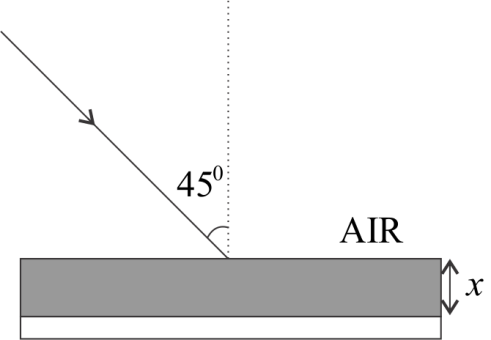
A ray of light into a transparent liquid from as shown in Fig. The Refractive Index of the liquid varies with depth $x$ from the topmost surface as $\mu = \sqrt {2 - } \dfrac{1}{{\sqrt 2 }}x$ where $x$ is in meter. The depth of the liquid medium is sufficiently large. The maximum depth reached by the ray inside the liquid will be:
Answer
 Verified
259.8k+ views
Hint: As the rays are going from lighter medium to denser medium it bends towards normal, as the refractive is changing continuously with the distance, and it is decreases when the rays are traveling down the slab the ray will refract at ${90^ \circ }$ at Critical angle. Hence by using Snell’s law we can calculate the maximum depth.
Formula Used:
Snell’s law
${\mu _1}\sin {\theta _1} = {\mu _2}\sin {\theta _2}$
${\mu _1}$ is the refractive index of incident ray
${\theta _1}$ is the angle of incident
${\mu _2}$ is the refractive index of refracted rays,
${\theta _2}$ is the angle of refraction.
Complete step by step answer:
Here, the angle of incident is given i.e.
${\theta _1} = {45^ \circ }$
And refractive index of water decreases continuously & ${\mu _2} = \sqrt 2 - \dfrac{1}{{\sqrt 2 }}x$
By Figure, we can say that
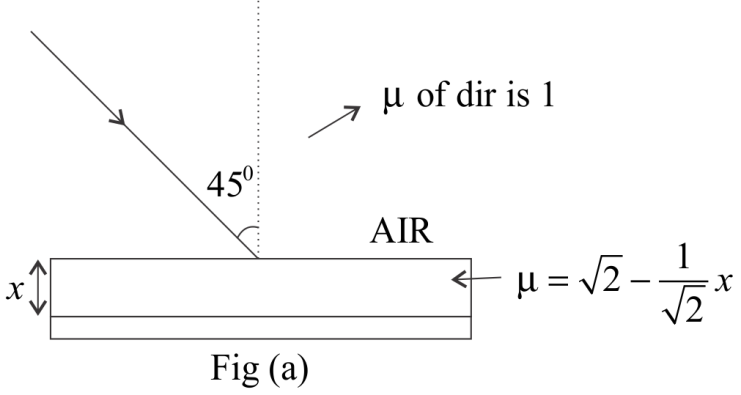
And as we know the surrounding medium is Air.
${\mu _{(Air)}} = 1$
By Applying Snell’s law, we can solve it.
When the ray travels from top to bottom of the slab, the refractive Index of the slab decreases as ${\mu _2} = \sqrt 2 - \dfrac{1}{{\sqrt 2 }}x$ and at last the will refract at ${90^ \circ }$ at Critical angle, so angle of refraction will become ${\mu _i} = {90^ \circ }$.
So, by applying Snell’s law, we get
${\mu _1} \times \sin 45 = \mu (x) \times \sin 90$
$1 \times \dfrac{1}{{\sqrt 2 }} = \left( {\sqrt 2 - \dfrac{1}{{\sqrt 2 }}x} \right) \times 1$ $[\because {\mu _1}$ = $1 \& \mu \left( x \right) = \sqrt 2 - \dfrac{1}{{\sqrt 2 }}x$ & $\sin {90^o} = 1]$
$\dfrac{1}{{\sqrt 2 }} - \dfrac{{\sqrt 2 }}{1} = - \dfrac{1}{{\sqrt 2 }}x$
$\dfrac{{1 - 2}}{{\sqrt 2 }} = - \dfrac{1}{{\sqrt 2 }}x$ or $ - \dfrac{1}{{\sqrt 2 }} = - \dfrac{1}{{\sqrt 2 }}x$
So, $x = 1$
Hence, the maximum depth of the slab is $1 meter$.
Additional Information:
Snell’s law:
Snell’s law (also called Snell-Descartes law and law of refraction) is a formula used to describe the relationship between the angle of incident and refraction, when referring to light or other waves passing through a boundary between two different isotropic media, such as water, glass or air.
Snell’s law states that the ratio of the sines of the angles of incidence and refraction is equivalent to the ratio of phase of velocities in the two media, or equivalent to the reciprocal of the ratio of the indices of refraction.
$\dfrac{{\sin {\theta _2}}}{{\sin {\theta _1}}} = \dfrac{{{V_2}}}{{{V_1}}} = \dfrac{{{n_1}}}{{{n_2}}}$
Each $\theta $ is measured with the normal of the boundary.
Note: As the Rays are passing from air (lighter ) to liquid (denser) it will bends towards the normal as the refractive index of $x$ & is decreases towards downward direction, So, at light it will come out at ${90^ \circ }$. So, the angle of refraction is ${90^ \circ }$, by Applying Snell’s we can calculate the distance $x$.
Formula Used:
Snell’s law
${\mu _1}\sin {\theta _1} = {\mu _2}\sin {\theta _2}$
${\mu _1}$ is the refractive index of incident ray
${\theta _1}$ is the angle of incident
${\mu _2}$ is the refractive index of refracted rays,
${\theta _2}$ is the angle of refraction.
Complete step by step answer:
Here, the angle of incident is given i.e.
${\theta _1} = {45^ \circ }$
And refractive index of water decreases continuously & ${\mu _2} = \sqrt 2 - \dfrac{1}{{\sqrt 2 }}x$
By Figure, we can say that
And as we know the surrounding medium is Air.
${\mu _{(Air)}} = 1$
By Applying Snell’s law, we can solve it.
When the ray travels from top to bottom of the slab, the refractive Index of the slab decreases as ${\mu _2} = \sqrt 2 - \dfrac{1}{{\sqrt 2 }}x$ and at last the will refract at ${90^ \circ }$ at Critical angle, so angle of refraction will become ${\mu _i} = {90^ \circ }$.
So, by applying Snell’s law, we get
${\mu _1} \times \sin 45 = \mu (x) \times \sin 90$
$1 \times \dfrac{1}{{\sqrt 2 }} = \left( {\sqrt 2 - \dfrac{1}{{\sqrt 2 }}x} \right) \times 1$ $[\because {\mu _1}$ = $1 \& \mu \left( x \right) = \sqrt 2 - \dfrac{1}{{\sqrt 2 }}x$ & $\sin {90^o} = 1]$
$\dfrac{1}{{\sqrt 2 }} - \dfrac{{\sqrt 2 }}{1} = - \dfrac{1}{{\sqrt 2 }}x$
$\dfrac{{1 - 2}}{{\sqrt 2 }} = - \dfrac{1}{{\sqrt 2 }}x$ or $ - \dfrac{1}{{\sqrt 2 }} = - \dfrac{1}{{\sqrt 2 }}x$
So, $x = 1$
Hence, the maximum depth of the slab is $1 meter$.
Additional Information:
Snell’s law:
Snell’s law (also called Snell-Descartes law and law of refraction) is a formula used to describe the relationship between the angle of incident and refraction, when referring to light or other waves passing through a boundary between two different isotropic media, such as water, glass or air.
Snell’s law states that the ratio of the sines of the angles of incidence and refraction is equivalent to the ratio of phase of velocities in the two media, or equivalent to the reciprocal of the ratio of the indices of refraction.
$\dfrac{{\sin {\theta _2}}}{{\sin {\theta _1}}} = \dfrac{{{V_2}}}{{{V_1}}} = \dfrac{{{n_1}}}{{{n_2}}}$
Each $\theta $ is measured with the normal of the boundary.
Note: As the Rays are passing from air (lighter ) to liquid (denser) it will bends towards the normal as the refractive index of $x$ & is decreases towards downward direction, So, at light it will come out at ${90^ \circ }$. So, the angle of refraction is ${90^ \circ }$, by Applying Snell’s we can calculate the distance $x$.
Recently Updated Pages
JEE Main Mock Test 2025-26: Electromagnetic Induction & Alternating Currents

JEE Main Mock Test 2025-26: Optics Chapter Practice Online
JEE Main 2025-26 Mock Test: Properties of Solids and Liquids
JEE Main Mock Test 2025-26: Dual Nature of Matter & Radiation
JEE Main 2025-26 Electromagnetic Waves Mock Test with Solutions
JEE Main 2025-26 Mock Test: Electronic Devices Chapter Practice
Trending doubts
JEE Main 2026: Exam Dates, Session 2 Updates, City Slip, Admit Card & Latest News
JEE Main Participating Colleges 2026 - A Complete List of Top Colleges
Hybridisation in Chemistry – Concept, Types & Applications
Understanding the Electric Field of a Uniformly Charged Ring
Derivation of Equation of Trajectory Explained for Students
Understanding Atomic Structure for Beginners
Other Pages
CBSE Class 12 Physics Question Paper 2026: Download SET-wise PDF with Answer Key & Analysis
JEE Advanced 2026 Notification Out with Exam Date, Registration (Extended), Syllabus and More
JEE Advanced Marks vs Ranks 2025: Understanding Category-wise Qualifying Marks and Previous Year Cut-offs
JEE Advanced Weightage Chapter Wise 2026 for Physics, Chemistry, and Mathematics
How to Convert a Galvanometer into an Ammeter or Voltmeter
Electron Gain Enthalpy and Electron Affinity Explained