




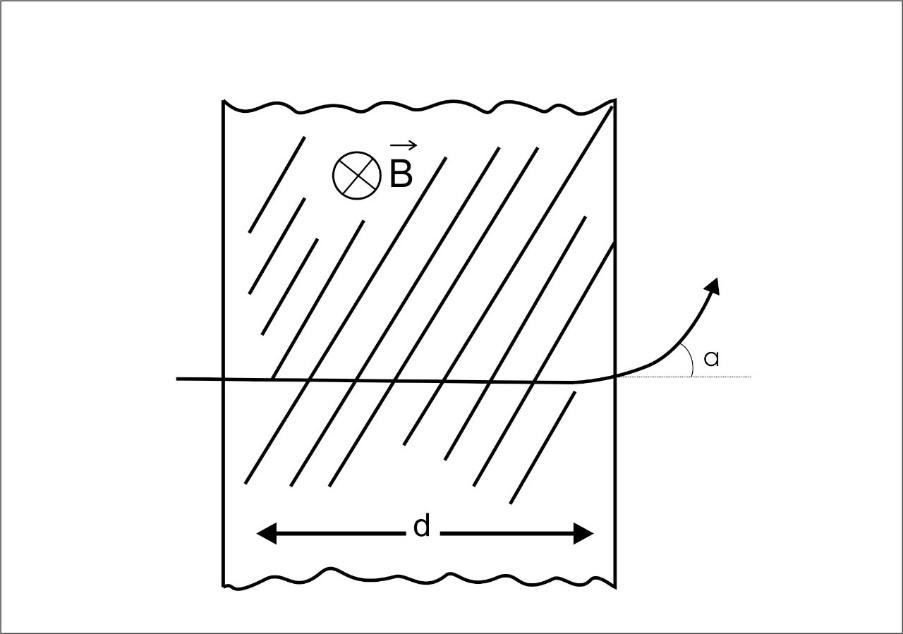
A proton (mass m) accelerated by a potential difference V files through a uniform transverse magnetic field B. The field occupies a region of space by width ‘d’. If $\alpha $ be the angle of deviations of proton from initial direction of motion (see fig), the value of $\sin \alpha $ will be:
A) $Bd\sqrt {\dfrac{q}{{2mV}}} $
B) $\dfrac{B}{d}\sqrt {\dfrac{{qd}}{{mV}}} $
C) $qV\sqrt {\dfrac{{Bd}}{{2m}}} $
D) $\dfrac{B}{d}\sqrt {\dfrac{q}{{2mV}}} $
Answer
 Verified
303.9k+ views
Hint: In this question, first we have to calculate energy of proton $E$ in the term of $v$ , and then have to find the magnetic force $F$. From the given figure we can easily find that $\sin \alpha = \dfrac{d}{R}$ . After putting the value of $R$ we can easily find the value of $\sin \alpha $.
Complete step by step answer:
In this question, A proton (mass m) is accelerated by a potential difference V files through a uniform transverse magnetic field B, and the field occupies a region of space by width ‘$d$ ’. Here, $\alpha $ be the angle of deviation of proton from initial direction of motion .we need to calculate, the value of $\sin \alpha $.
Given that,
$m = $ Mass of proton
$V = $ Potential difference
$v = $ Velocity of proton
$e = $ Charge on proton
$d = $ The field occupies a region of space of width.
$R = $ The radius of circle
$\alpha = $ Angle of deviation
Now, first we have to find the energy of proton,
We know that,
$ E = \dfrac{1}{2}m{v^2} = eV$
Hence,
$\Rightarrow v = \sqrt {\dfrac{{2eV}}{m}} $
Now find the magnetic force, we know that magnetic force can be written as,
\[\Rightarrow F = e\left( {\overrightarrow v \times \overrightarrow B } \right)\]
$ \Rightarrow \dfrac{{m{v^2}}}{R} \\
\Rightarrow R = \dfrac{{mv}}{{eB}} \\ $
We know that,
$\Rightarrow \sin \alpha = \dfrac{d}{R}$
On putting the value of$R$, we get
$\Rightarrow \sin \alpha = \dfrac{{deB}}{{mv}} \\
\Rightarrow \sin \alpha = \dfrac{{deB}}{m}\sqrt {\dfrac{m}{{2eV}}} \\
\Rightarrow \sin \alpha = Bd\sqrt {\dfrac{e}{{2mV}}} \\ $
$e$ can be written as $q$, which is the symbol of charge, thus the equation become, $\sin \alpha = Bd\sqrt {\dfrac{q}{{2mV}}} $
Therefore, the correct option is A.
Note: As we know that the force is the vector quantity and the cross product of the velocity and the magnetic field provide the vector quantity. And we know the correct value of $R$ is obtained as $\sin \alpha = \dfrac{d}{R}$.
Complete step by step answer:
In this question, A proton (mass m) is accelerated by a potential difference V files through a uniform transverse magnetic field B, and the field occupies a region of space by width ‘$d$ ’. Here, $\alpha $ be the angle of deviation of proton from initial direction of motion .we need to calculate, the value of $\sin \alpha $.
Given that,
$m = $ Mass of proton
$V = $ Potential difference
$v = $ Velocity of proton
$e = $ Charge on proton
$d = $ The field occupies a region of space of width.
$R = $ The radius of circle
$\alpha = $ Angle of deviation
Now, first we have to find the energy of proton,
We know that,
$ E = \dfrac{1}{2}m{v^2} = eV$
Hence,
$\Rightarrow v = \sqrt {\dfrac{{2eV}}{m}} $
Now find the magnetic force, we know that magnetic force can be written as,
\[\Rightarrow F = e\left( {\overrightarrow v \times \overrightarrow B } \right)\]
$ \Rightarrow \dfrac{{m{v^2}}}{R} \\
\Rightarrow R = \dfrac{{mv}}{{eB}} \\ $
We know that,
$\Rightarrow \sin \alpha = \dfrac{d}{R}$
On putting the value of$R$, we get
$\Rightarrow \sin \alpha = \dfrac{{deB}}{{mv}} \\
\Rightarrow \sin \alpha = \dfrac{{deB}}{m}\sqrt {\dfrac{m}{{2eV}}} \\
\Rightarrow \sin \alpha = Bd\sqrt {\dfrac{e}{{2mV}}} \\ $
$e$ can be written as $q$, which is the symbol of charge, thus the equation become, $\sin \alpha = Bd\sqrt {\dfrac{q}{{2mV}}} $
Therefore, the correct option is A.
Note: As we know that the force is the vector quantity and the cross product of the velocity and the magnetic field provide the vector quantity. And we know the correct value of $R$ is obtained as $\sin \alpha = \dfrac{d}{R}$.
Recently Updated Pages
If the magnetizing field on a ferromagnetic material class 12 physics JEE_Main

A point charge is placed at the corner of a cube The class 12 physics JEE_Main
What changes occur if the monochromatic light used class 12 physics JEE_Main
The unit of specific conductance is A Ohm B Ohmmetre class 12 physics JEE_Main
Which lens is used in magnifying glass A Concave lens class 12 physics JEE_Main
Sir C V Raman won the Nobel Prize in which year A 1928 class 12 physics JEE_Main
Trending doubts
JEE Main 2026: Exam Dates, Session 2 Updates, City Slip, Admit Card & Latest News
Understanding the Electric Field of a Uniformly Charged Ring
Derivation of Equation of Trajectory Explained for Students
Understanding Atomic Structure for Beginners
How to Convert a Galvanometer into an Ammeter or Voltmeter
Electron Gain Enthalpy and Electron Affinity Explained
Other Pages
CBSE Class 12 Physics Question Paper 2026: Download SET-wise PDF with Answer Key & Analysis
JEE Advanced Percentile vs Marks 2026: JEE Main Cutoff, AIR & IIT Admission Guide
JEE Advanced 2026 Notification Out with Exam Date, Registration (Extended), Syllabus and More
Hybridisation in Chemistry – Concept, Types & Applications
What Are Elastic Collisions in One Dimension?
Understanding Uniform Acceleration in Physics