




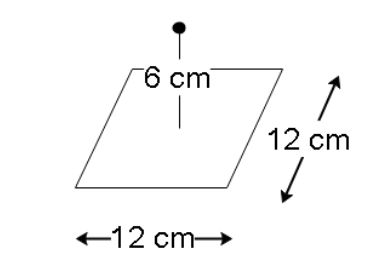
A point charge \[ + 20\mu C\] is at a distance \[6\,cm\] directly above the centre of a square of the side \[12\,cm\] as shown in the figure. The magnitude of electric flux through the square is
A) $2.5 \times {10^6}\,N{m^2}{C^{ - 1}}$
B) $3.8 \times {10^6}\,N{m^2}{C^{ - 1}}$
C) $4.2 \times {10^6}\,N{m^2}{C^{ - 1}}$
D)$2.9 \times {10^6}\,N{m^2}{C^{ - 1}}$
Answer
 Verified
243k+ views
Hint: In this solution, we will use the relation of Gauss’s law to determine the flux through the surface given to us. The surface gives us one of the sides of a cube through which the entire flux will pass.
Formula used: In this solution, we will use the following formula:
Flux due to a charge $q$: $\phi = \dfrac{q}{{{\varepsilon _0}}}$
Complete step by step answer:
In the configuration given to us, a charge $q$ is placed above a surface given to us. The flux given from this charge will be determined from Gauss’s law as:
$\phi = \dfrac{q}{{{\varepsilon _0}}}$
Now, this flux will be emitted in all directions equally. To find the flux through the surface given to us, we can think of the charge being surrounded by a cube of side 12 centimeters. Then the flux through the cube will be
$\phi = \dfrac{q}{{{\varepsilon _0}}}$
Since the flux is equally distributed, the flux through the one surface will be $1/6th$ of the total flux as the cube has six sides.
This implies that the flux through one surface will be
$\phi = \dfrac{q}{{6{\varepsilon _0}}}$
Substituting the value of charge \[q = 20\,\mu C = 20 \times {10^{ - 6}}C\] and ${\varepsilon _0} = 8.85 \times {10^{ - 12}}$, we get
$\phi = \dfrac{{20 \times {{10}^{ - 6}}}}{{6\left( {8.85 \times {{10}^{ - 12}}} \right)}}$
This can be simplified to:
$\phi = 3.8 \times {10^5}\,N{m^2}{C^{ - 1}}$ which corresponds to option (B).
Note: To take the flux surface as a cube, the charge must lie at the centre of the cube. In this case, the charge is 6 centimeters away from one of the surfaces of the cube which is where the centre of the cube lies. Gauss’s law enables us to use this symmetry to directly calculate the flux through the surface as $1/6th$ of the total flux.
Formula used: In this solution, we will use the following formula:
Flux due to a charge $q$: $\phi = \dfrac{q}{{{\varepsilon _0}}}$
Complete step by step answer:
In the configuration given to us, a charge $q$ is placed above a surface given to us. The flux given from this charge will be determined from Gauss’s law as:
$\phi = \dfrac{q}{{{\varepsilon _0}}}$
Now, this flux will be emitted in all directions equally. To find the flux through the surface given to us, we can think of the charge being surrounded by a cube of side 12 centimeters. Then the flux through the cube will be
$\phi = \dfrac{q}{{{\varepsilon _0}}}$
Since the flux is equally distributed, the flux through the one surface will be $1/6th$ of the total flux as the cube has six sides.
This implies that the flux through one surface will be
$\phi = \dfrac{q}{{6{\varepsilon _0}}}$
Substituting the value of charge \[q = 20\,\mu C = 20 \times {10^{ - 6}}C\] and ${\varepsilon _0} = 8.85 \times {10^{ - 12}}$, we get
$\phi = \dfrac{{20 \times {{10}^{ - 6}}}}{{6\left( {8.85 \times {{10}^{ - 12}}} \right)}}$
This can be simplified to:
$\phi = 3.8 \times {10^5}\,N{m^2}{C^{ - 1}}$ which corresponds to option (B).
Note: To take the flux surface as a cube, the charge must lie at the centre of the cube. In this case, the charge is 6 centimeters away from one of the surfaces of the cube which is where the centre of the cube lies. Gauss’s law enables us to use this symmetry to directly calculate the flux through the surface as $1/6th$ of the total flux.
Recently Updated Pages
JEE Main 2026 Session 2 City Intimation Slip & Exam Date: Expected Date, Download Link

JEE Main 2026 Session 2 Application Form: Reopened Registration, Dates & Fees
JEE Main 2026 Session 2 Registration (Reopened): Last Date, Fees, Link & Process
WBJEE 2026 Registration Started: Important Dates Eligibility Syllabus Exam Pattern
JEE Main 2025-26 Mock Tests: Free Practice Papers & Solutions
JEE Main 2025-26 Experimental Skills Mock Test – Free Practice
Trending doubts
JEE Main 2026: Session 1 Results Out and Session 2 Registration Open, City Intimation Slip, Exam Dates, Syllabus & Eligibility
Ideal and Non-Ideal Solutions Explained for Class 12 Chemistry
Understanding the Angle of Deviation in a Prism
Understanding Differential Equations: A Complete Guide
Hybridisation in Chemistry – Concept, Types & Applications
Understanding the Electric Field of a Uniformly Charged Ring
Other Pages
CBSE Class 12 Physics Question Paper 2026: Download SET-wise PDF with Answer Key & Analysis
JEE Advanced Marks vs Ranks 2025: Understanding Category-wise Qualifying Marks and Previous Year Cut-offs
JEE Advanced 2026 - Exam Date (Released), Syllabus, Registration, Eligibility, Preparation, and More
Dual Nature of Radiation and Matter Class 12 Physics Chapter 11 CBSE Notes - 2025-26
JEE Advanced Weightage 2025 Chapter-Wise for Physics, Maths and Chemistry
Understanding the Block and Tackle System