




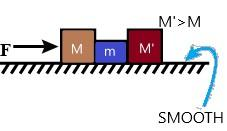
A constant force F is applied in horizontal direction as shown. The contact force between M and m is N and between m and M’ is N’ then:
A) N = N’
B) N>N’
C) N’>N
D) Cannot be determined
Answer
 Verified
259.8k+ views
Hint: In the diagram given above since there is no frictional force between the ground and the three objects. The force which is applied will only be opposed by the objects and not by the frictional force of the ground. So, the object will move.
Complete step by step solution:
Here we apply the second law of Newton i.e.
$F = ma$;
Here:
F = Force;
m = Mass;
a = Acceleration
Here we would consider the force on the middle object ‘m’ which is in blue color. We have been given that the contact force between mass M and m is N and between m and M’ is N’ so the mass m has two horizontal forces one form M and another from M’. Here the two horizontal forces are acting opposite to each other.
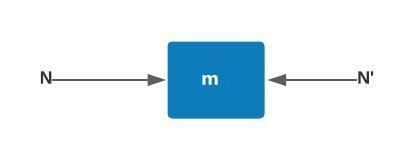
Here the N force is between objects of Mass M and m and force N’ is between m and M’.
According to Newton’s second law the net force on the object of mass m would be:
${F_{Net}} = ma$;
Here the net force on the mass is:
${F_{Net}} = N - N'$;
Put the above value in the equation ${F_{Net}} = ma$:
$N - N' = ma$;
Since the objects are moving as there is no friction between the surface and the object $\therefore $ N>N’.
Final Answer: Option “B” is correct.
Note: Here we need to resolve the horizontal forces between the objects. Here we are considering the object ‘m’ because the other two masses ‘M and M’ are indirectly applying the force on each other through mass ‘m’. Resolve the forces on mass m and apply Newton’s second law. Since, the objects are moving the force N is greater than N’.
Complete step by step solution:
Here we apply the second law of Newton i.e.
$F = ma$;
Here:
F = Force;
m = Mass;
a = Acceleration
Here we would consider the force on the middle object ‘m’ which is in blue color. We have been given that the contact force between mass M and m is N and between m and M’ is N’ so the mass m has two horizontal forces one form M and another from M’. Here the two horizontal forces are acting opposite to each other.
Here the N force is between objects of Mass M and m and force N’ is between m and M’.
According to Newton’s second law the net force on the object of mass m would be:
${F_{Net}} = ma$;
Here the net force on the mass is:
${F_{Net}} = N - N'$;
Put the above value in the equation ${F_{Net}} = ma$:
$N - N' = ma$;
Since the objects are moving as there is no friction between the surface and the object $\therefore $ N>N’.
Final Answer: Option “B” is correct.
Note: Here we need to resolve the horizontal forces between the objects. Here we are considering the object ‘m’ because the other two masses ‘M and M’ are indirectly applying the force on each other through mass ‘m’. Resolve the forces on mass m and apply Newton’s second law. Since, the objects are moving the force N is greater than N’.
Recently Updated Pages
Circuit Switching vs Packet Switching: Key Differences Explained

Dimensions of Pressure in Physics: Formula, Derivation & SI Unit
JEE General Topics in Chemistry Important Concepts and Tips
JEE Extractive Metallurgy Important Concepts and Tips for Exam Preparation
JEE Atomic Structure and Chemical Bonding important Concepts and Tips
JEE Amino Acids and Peptides Important Concepts and Tips for Exam Preparation
Trending doubts
JEE Main 2026: Exam Dates, Session 2 Updates, City Slip, Admit Card & Latest News
JEE Main Participating Colleges 2026 - A Complete List of Top Colleges
Hybridisation in Chemistry – Concept, Types & Applications
Understanding the Electric Field of a Uniformly Charged Ring
Derivation of Equation of Trajectory Explained for Students
Understanding Atomic Structure for Beginners
Other Pages
JEE Advanced 2026 Notification Out with Exam Date, Registration (Extended), Syllabus and More
JEE Advanced Marks vs Ranks 2025: Understanding Category-wise Qualifying Marks and Previous Year Cut-offs
CBSE Notes Class 11 Physics Chapter 1 - Units And Measurements - 2025-26
NCERT Solutions For Class 11 Physics Chapter 1 Units And Measurements - 2025-26
Important Questions For Class 11 Physics Chapter 1 Units and Measurement - 2025-26
JEE Advanced Weightage Chapter Wise 2026 for Physics, Chemistry, and Mathematics