






Why International Translation Day Matters for Students and Global Communication
International Translation Day is observed every year on 30 September to recognize the work of translators and language professionals across the world. The day highlights the importance of translation in promoting peace, understanding, cooperation, and development among nations. It also celebrates linguistic diversity and the role of translators in connecting people, cultures, and ideas beyond language barriers.
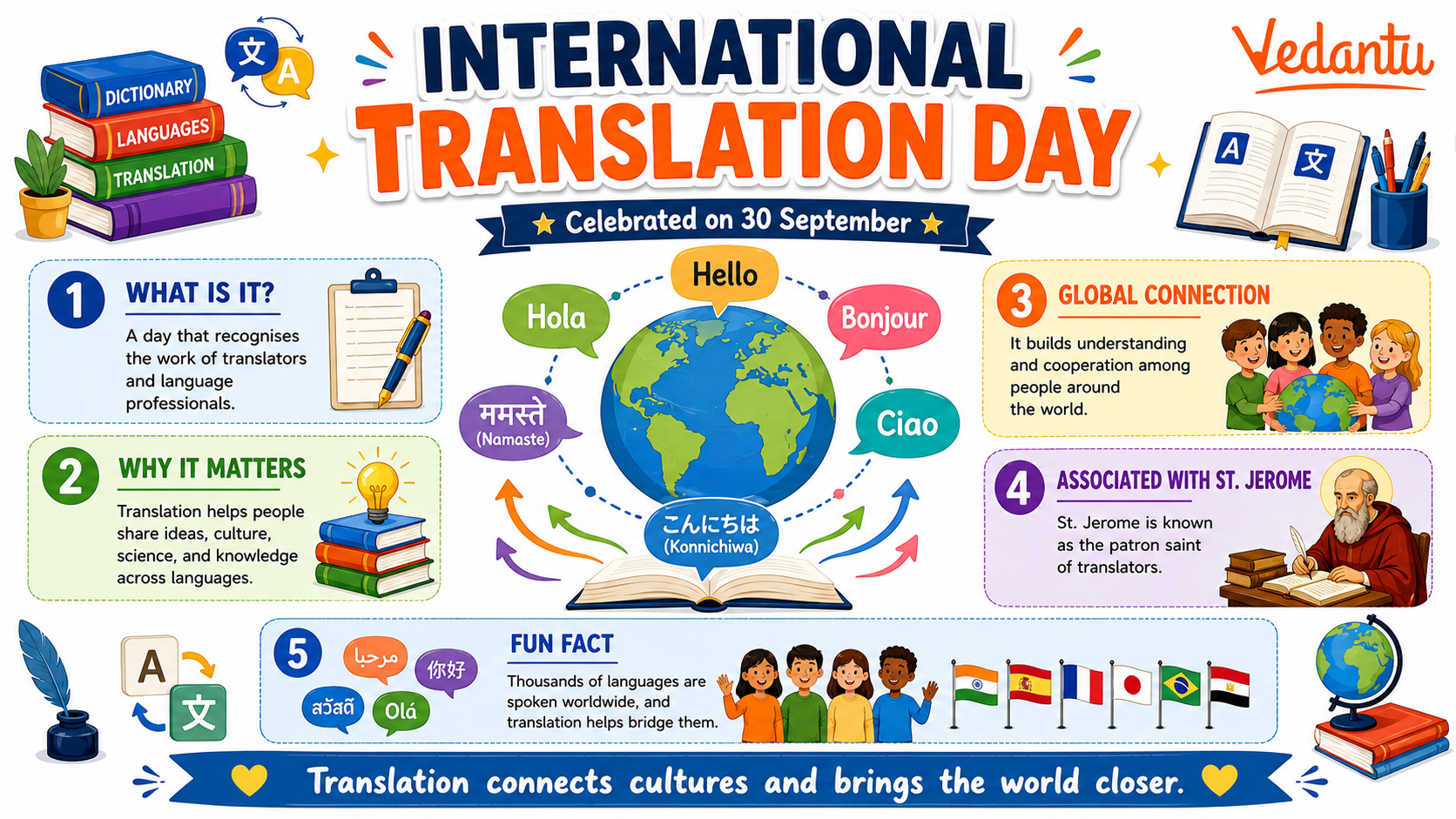
Overview of International Translation Day
| Event Name | Date | Organized By |
|---|---|---|
| International Translation Day | 30 September | United Nations |
| First Official Recognition | 2017 | UN General Assembly |
The United Nations officially declared 30 September as International Translation Day in 2017. The date was chosen to honor Saint Jerome, the patron saint of translators, who translated the Bible into Latin in the 4th century.
Why 30 September is Celebrated
30 September marks the feast day of Saint Jerome. He is widely known for translating a large part of the Bible into Latin, known as the Vulgate. His work played a significant role in spreading religious knowledge across Europe. Therefore, the day honors his contribution and recognizes the broader importance of translation in society.
Importance of International Translation Day
Translation plays a key role in global communication. In a world with thousands of languages, translators ensure that information is accessible to people regardless of linguistic differences.
- Promotes cultural exchange and mutual understanding among nations.
- Supports international diplomacy and global cooperation.
- Ensures access to knowledge in science, medicine, law, and education.
- Encourages preservation of linguistic diversity.
- Helps businesses expand globally through multilingual communication.
Role of Translators in Society
Translators and interpreters act as bridges between languages and cultures. They work in various fields and contribute significantly to global development.
Key Areas Where Translators Work
- United Nations and international organizations.
- Legal and judicial systems.
- Healthcare and medical research.
- Media, literature, and publishing industries.
- Business, trade, and technology sectors.
Themes of International Translation Day
Each year, International Translation Day is celebrated with a specific theme chosen by the United Nations. The theme highlights the evolving role of language professionals in global communication, peacebuilding, sustainable development, and digital transformation.
Themes often focus on unity, cultural diversity, inclusion, multilingualism, and the power of language in shaping international relations.
How International Translation Day is Celebrated
Various activities and events are organized worldwide to celebrate this day. Educational institutions, language organizations, and international bodies participate actively.
- Seminars and webinars on translation and multilingualism.
- Workshops for aspiring translators and interpreters.
- Awards and recognition for outstanding translators.
- Cultural exchange programs and language exhibitions.
International Translation Day and the United Nations
The United Nations operates in six official languages - Arabic, Chinese, English, French, Russian, and Spanish. Translation services are essential for ensuring equal participation of member states. International Translation Day acknowledges the work of language professionals who make UN proceedings accessible to all.
Interesting Facts About Translation
- There are over 7000 languages spoken worldwide.
- The Bible is one of the most translated books in history.
- Machine translation tools are widely used, but human translators remain essential for accuracy and cultural sensitivity.
- Interpretation and translation are different - interpretation deals with spoken language, while translation focuses on written text.
Conclusion
International Translation Day celebrates the vital role of translators and interpreters in building bridges between languages and cultures. Observed on 30 September, it recognizes the importance of multilingual communication in diplomacy, education, healthcare, and global development. By promoting linguistic diversity and cultural understanding, this day reminds us that language is a powerful tool for unity and cooperation in an interconnected world.
FAQs on International Translation Day: History, Theme, and Importance
1. What is International Translation Day?
International Translation Day is a global observance that celebrates the role of translators and language professionals in connecting cultures and nations.
- Celebrated every year on 30 September
- Honors translation, interpretation, and linguistic diversity
- Recognized by the United Nations (UN) in 2017
- Promotes multilingualism, cross-cultural communication, and global understanding
People also ask: What is Translation Day? Why is International Translation Day important?
2. Why is International Translation Day celebrated on 30 September?
International Translation Day is celebrated on 30 September to honor the death anniversary of Saint Jerome, the patron saint of translators.
- Saint Jerome translated the Bible into Latin (the Vulgate)
- He is considered a pioneer in biblical translation
- The date recognizes the historical importance of translators in preserving knowledge
People also search: Who was Saint Jerome? Why is 30 September important?
3. Who declared International Translation Day officially?
The United Nations General Assembly (UNGA) officially declared International Translation Day in 2017.
- Resolution adopted in May 2017
- Recognizes professional translators working in UN official languages
- Promotes linguistic diversity and multilingual communication
People also ask: When did the UN recognize Translation Day? Who started International Translation Day?
4. What is the importance of International Translation Day?
International Translation Day highlights the crucial role of translators in global communication and cultural exchange.
- Ensures smooth international diplomacy and global cooperation
- Preserves literature, history, and knowledge
- Supports education, trade, and media
- Promotes peace and mutual understanding
People also search: Importance of translation in globalization, role of translators in society.
5. What is the theme of International Translation Day?
Each year, International Translation Day is celebrated with a specific theme focusing on language and communication.
- Themes are announced by the International Federation of Translators (FIT)
- Focus areas include multilingualism, indigenous languages, and digital communication
- Themes change annually to address current global challenges
People also ask: What is this year’s Translation Day theme? Who decides the theme?
6. What is translation and why is it important?
Translation is the process of converting text or speech from one language into another while preserving its meaning.
- Enables cross-cultural communication
- Helps in international business and diplomacy
- Preserves literature and scientific knowledge
- Supports global education and media
People also search: Definition of translation, benefits of translation.
7. What is the difference between translation and interpretation?
Translation deals with written text, while interpretation focuses on spoken language.
- Translation: Written documents, books, articles
- Interpretation: Speeches, meetings, conferences
- Translators work with texts; interpreters work in real-time communication
People also ask: Is translation the same as interpretation? What does an interpreter do?
8. How is International Translation Day celebrated worldwide?
International Translation Day is celebrated through events that promote language diversity and translation skills.
- Workshops and seminars for translators
- Language competitions in schools and colleges
- Cultural programs promoting multilingualism
- Social media campaigns highlighting translation careers
People also search: How to celebrate Translation Day? Activities for International Translation Day.
9. What are the official languages of the United Nations?
The United Nations has six official languages used for translation and interpretation.
- Arabic
- Chinese
- English
- French
- Russian
- Spanish
People also ask: How many official UN languages are there? Why does the UN need translators?
10. How can students participate in International Translation Day?
Students can participate in International Translation Day by engaging in language-learning and cultural activities.
- Take part in translation competitions
- Learn a new foreign language
- Organize essay writing or speech contests
- Explore careers in linguistics, translation, and interpretation
People also search: Careers in translation, how to become a translator.
