






Key Themes, Characters, and Message of the Mosaic Mission Story
The Mosaic Mission is an ambitious space exploration mission led by NASA aimed at studying Jupiter’s moon Europa in greater detail. Europa is considered one of the most promising places in the solar system to search for signs of extraterrestrial life because it is believed to have a vast subsurface ocean beneath its icy crust. The mission is designed to investigate the moon’s surface, subsurface ocean, geology, and potential habitability. Mosaic Mission is important for students of General Knowledge, astronomy enthusiasts, and competitive exam aspirants as it reflects advancements in planetary science and space technology.
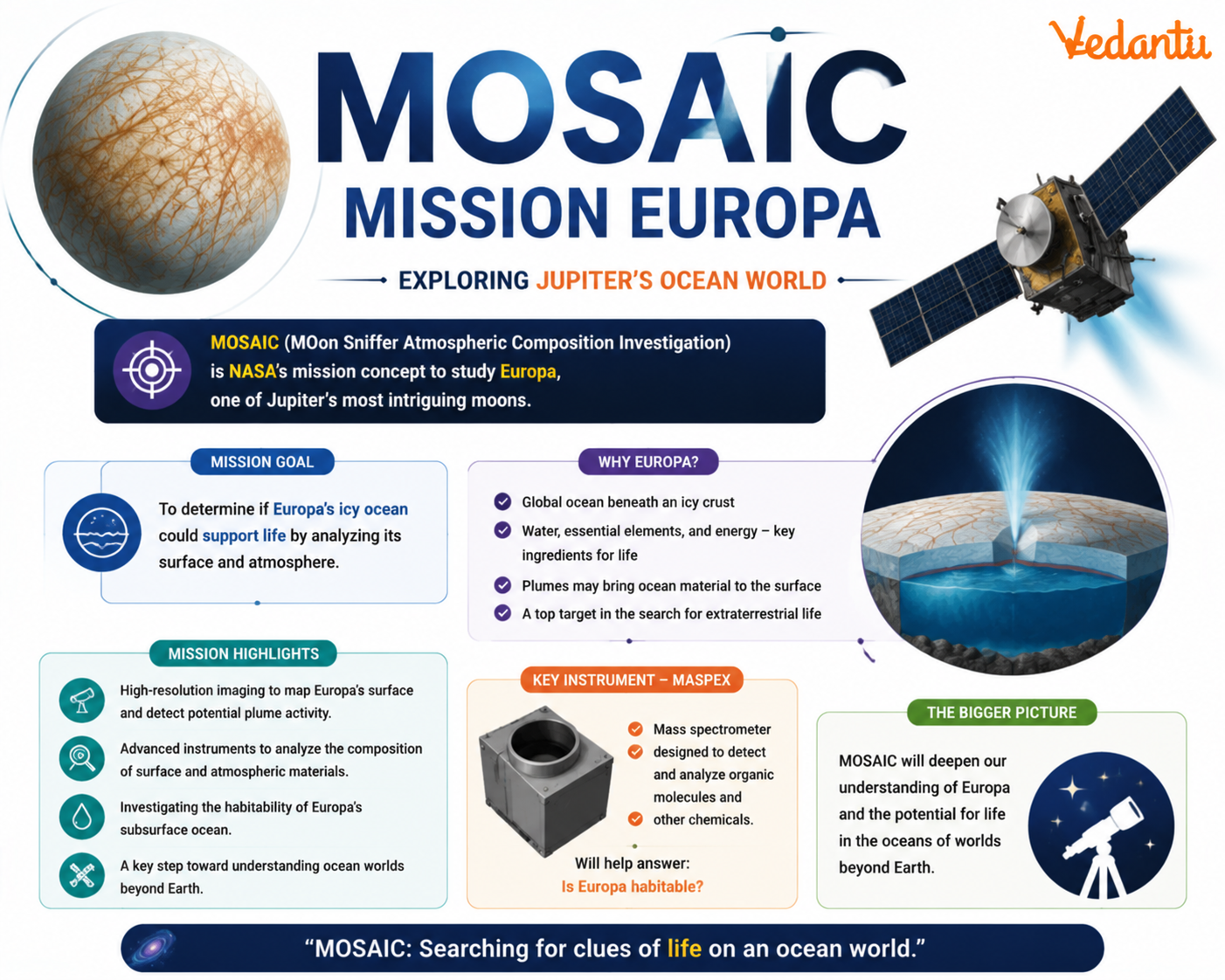
Overview of Mosaic Mission
The Mosaic Mission focuses on understanding Europa’s environment and determining whether conditions suitable for life exist beneath its icy shell. Scientists believe that tidal heating caused by Jupiter’s gravitational pull may keep the ocean beneath Europa’s crust in a liquid state. The mission aims to collect high-resolution images and scientific data to analyze the moon’s chemical composition and internal structure.
Key Details of Mosaic Mission
| Parameter | Details | Importance |
|---|---|---|
| Space Agency | NASA | Advances planetary science research |
| Target | Europa - Moon of Jupiter | Potential site for extraterrestrial life |
| Main Objective | Study subsurface ocean and surface composition | Assess habitability conditions |
The mission uses advanced scientific instruments such as ice-penetrating radar, spectrometers, and imaging systems to gather accurate data about Europa’s environment.
Objectives of the Mosaic Mission
- Analyze the thickness and structure of Europa’s icy crust.
- Study the composition of the subsurface ocean.
- Examine surface features such as ridges, cracks, and possible water plumes.
- Determine the chemical elements present that could support microbial life.
- Understand the geological activity driven by tidal forces.
Scientific Importance
The Mosaic Mission is scientifically significant because Europa is one of the most promising candidates for hosting life beyond Earth. If microbial life exists in Europa’s ocean, it could change our understanding of biology and the origin of life. Studying Europa also helps scientists compare icy moons across the solar system, including Saturn’s moon Enceladus.
Why Europa is Special
- Presence of a global subsurface ocean beneath ice.
- Possible hydrothermal activity at the ocean floor.
- Chemical elements like water, salts, and organic compounds.
- Evidence of water plumes erupting into space.
Technological Features
The Mosaic Mission uses state-of-the-art spacecraft systems designed to survive Jupiter’s intense radiation environment. Radiation shielding, high-resolution cameras, and communication systems ensure safe transmission of data back to Earth.
- Ice-penetrating radar to study subsurface layers.
- Infrared spectrometers to detect chemical composition.
- Magnetometers to analyze magnetic field interactions.
- High-resolution cameras for detailed surface mapping.
Relevance for Competitive Exams
Questions related to space missions, planetary exploration, and international space agencies frequently appear in competitive exams such as UPSC, SSC, banking exams, and state-level government exams. For NEET aspirants, understanding astrobiology and planetary environments supports broader scientific awareness. Knowing the objectives, target body, and significance of the Mosaic Mission helps students answer both static and current affairs based questions effectively.
Future Prospects
If the Mosaic Mission successfully confirms favorable conditions for life, it may lead to future lander missions or even subsurface exploration missions that could drill through the ice. Such discoveries would represent a major milestone in human history and space exploration. The mission also strengthens international collaboration and technological innovation in deep space research.
Conclusion
The Mosaic Mission represents a significant step in humanity’s search for life beyond Earth. By focusing on Europa’s subsurface ocean and geological activity, the mission aims to answer fundamental questions about habitability in the solar system. For students and exam aspirants, understanding the Mosaic Mission enhances knowledge of space science, planetary exploration, and modern scientific advancements. It highlights how space missions contribute to expanding our understanding of the universe and the possibility of life beyond our planet.
FAQs on Mosaic Mission Chapter Summary and Explanation for Students
1. What is the central theme of Mosaic Mission in English?
The central theme of Mosaic Mission highlights the values of unity in diversity, teamwork, and social responsibility.
- It emphasizes how different individuals come together like pieces of a mosaic.
- It promotes cooperation, empathy, and shared goals.
- It reflects moral lessons often asked in exams under themes like character-building and community service.
This chapter is commonly discussed in People Also Ask sections such as “What is the message of Mosaic Mission?” and “What does the mosaic symbolize?”
2. Why is the title ‘Mosaic Mission’ significant?
The title Mosaic Mission is significant because it symbolizes unity formed by combining diverse elements.
- A mosaic represents small pieces creating a beautiful whole.
- The word mission suggests a shared purpose or goal.
- Together, it conveys the idea of collective effort and harmony.
This symbolism is important for understanding literary devices like metaphor and is often searched as “meaning of Mosaic Mission title.”
3. Who are the main characters in Mosaic Mission?
The main characters in Mosaic Mission represent diverse personalities working toward a common objective.
- They may include students, leaders, or community members.
- Each character contributes unique skills and perspectives.
- Their collaboration demonstrates leadership and team spirit.
Questions like “Who are the important characters in Mosaic Mission?” are common in school exams and GK preparation.
4. What moral lesson does Mosaic Mission teach?
The moral lesson of Mosaic Mission teaches the importance of unity, cooperation, and mutual respect.
- Success comes from working together.
- Differences should be valued, not divided.
- Every individual plays a meaningful role in society.
This lesson connects to themes such as value education, social harmony, and community development.
5. How does Mosaic Mission relate to real-life situations?
Mosaic Mission relates to real life by showing how teamwork leads to meaningful achievements.
- Schools, workplaces, and communities depend on collaboration.
- Diversity strengthens problem-solving and creativity.
- Shared missions encourage responsibility and leadership.
This practical relevance makes it a commonly searched topic under “real-life application of Mosaic Mission.”
6. What literary devices are used in Mosaic Mission?
The chapter Mosaic Mission uses literary devices to enhance its message and impact.
- Metaphor: The mosaic symbolizes unity in diversity.
- Imagery: Descriptions create vivid mental pictures.
- Symbolism: Pieces of mosaic represent individuals in society.
Understanding these devices helps in answering exam questions on literary techniques and textual analysis.
7. How does the chapter promote the idea of unity in diversity?
The chapter promotes unity in diversity by showing how differences strengthen collective success.
- Each character contributes unique abilities.
- Cooperation leads to achievement of a shared mission.
- Differences are portrayed as strengths, not weaknesses.
This concept aligns with national values and themes often searched as “unity in diversity explanation in Mosaic Mission.”
8. Why is Mosaic Mission important for students?
Mosaic Mission is important for students because it builds moral values and teamwork skills.
- Encourages leadership qualities.
- Teaches collaboration and respect.
- Inspires participation in community or school missions.
It is frequently included in English curricula to strengthen character education and communication skills.
9. What challenges are faced in Mosaic Mission?
The challenges in Mosaic Mission highlight the difficulties of working together toward a shared goal.
- Differences in opinions or perspectives.
- Lack of coordination or misunderstandings.
- Obstacles that test patience and teamwork.
These challenges emphasize the importance of problem-solving and effective communication.
10. What is the overall message of Mosaic Mission?
The overall message of Mosaic Mission is that unity, cooperation, and shared responsibility create lasting success.
- Every individual is like a tile in a mosaic.
- Collective effort achieves greater results than individual work.
- Harmony and diversity strengthen society.
This key takeaway is often summarized in exam answers under themes like team spirit, social unity, and moral values in English literature.
