






World Economic Outlook 2021 – Major Findings on Global Growth and Policy Response
The World Economic Outlook 2021 is a flagship report published by the International Monetary Fund (IMF). It provides detailed analysis and projections about global economic growth, inflation, trade, employment, and financial stability. The 2021 report was particularly significant because it assessed the global economic impact of the COVID-19 pandemic and outlined recovery prospects for advanced, emerging, and developing economies. For students preparing for competitive exams and general readers, understanding the key details of the IMF’s World Economic Outlook 2021 is essential for grasping global economic trends and policy responses.
About the International Monetary Fund (IMF)
The International Monetary Fund is an international organization established in 1944 at the Bretton Woods Conference. It aims to ensure global monetary cooperation, financial stability, international trade growth, and sustainable economic development. The IMF publishes the World Economic Outlook report twice a year, generally in April and October.
- Headquarters - Washington, D.C., USA
- Founded - 1944
- Purpose - Promote global financial stability and economic growth
- Member Countries - 190 plus nations
Context of World Economic Outlook 2021
The 2021 edition of the World Economic Outlook focused on the economic disruptions caused by the COVID-19 pandemic. The global economy experienced one of the deepest recessions since the Great Depression in 2020. The 2021 report examined recovery patterns, vaccination progress, fiscal stimulus measures, and economic risks.
Global Growth Projections 2021
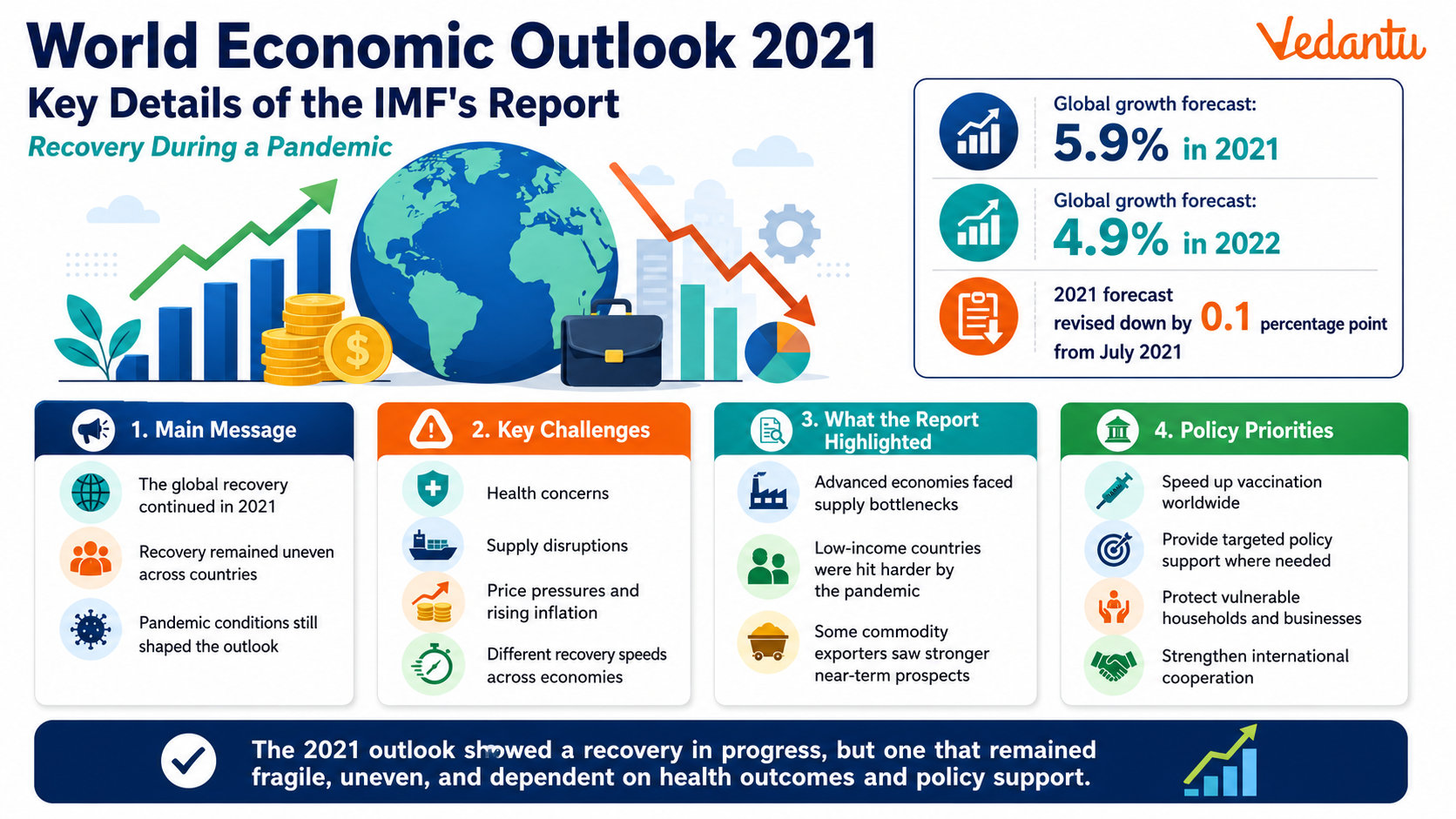
According to the IMF World Economic Outlook 2021, the global economy was projected to recover strongly after a severe contraction in 2020. However, the recovery was uneven across countries depending on vaccine access, healthcare systems, and fiscal support measures.
Global Economic Growth Estimates
| Year | Global Growth Rate | Remarks |
|---|---|---|
| 2020 | -3.3 percent | Global recession due to pandemic |
| 2021 | 6.0 percent | Strong rebound supported by policy stimulus |
The IMF projected a significant rebound in 2021 driven by large fiscal stimulus packages, especially in advanced economies like the United States, and gradual reopening of economies.
Advanced Economies vs Emerging Markets
Advanced Economies
Advanced economies were expected to recover faster due to better vaccine availability and stronger fiscal responses. The United States experienced a robust recovery due to large stimulus packages.
Emerging and Developing Economies
Emerging and developing economies faced slower recovery because of limited healthcare infrastructure, lower vaccine access, and financial constraints. Some countries experienced rising debt levels and fiscal pressures.
- Higher poverty rates
- Increased unemployment
- Widening income inequality
- Debt sustainability challenges
Inflation and Financial Stability
The World Economic Outlook 2021 also highlighted rising inflation risks due to supply chain disruptions and increased demand during economic reopening. While inflation was expected to be temporary in many advanced economies, emerging markets faced higher inflationary pressures due to currency depreciation and food price increases.
Policy Recommendations by IMF
The IMF emphasized coordinated global action to ensure a sustainable recovery. The report suggested that policy support should not be withdrawn prematurely.
- Accelerate global vaccination programs
- Maintain accommodative monetary policies
- Provide targeted fiscal support to vulnerable groups
- Strengthen international cooperation
- Address long-term structural reforms and climate change risks
Risks Highlighted in the Report
Despite optimistic projections, the IMF warned about significant downside risks. These risks could slow or reverse the global recovery if not managed effectively.
- New COVID-19 variants
- Unequal vaccine distribution
- Financial market volatility
- Rising public and private debt
Importance of World Economic Outlook 2021
The World Economic Outlook 2021 served as a crucial guide for governments, policymakers, investors, and researchers. It helped countries understand the scale of the economic shock caused by the pandemic and provided insights into recovery strategies. For competitive exam aspirants, the report is important for topics related to international organizations, global economy, inflation trends, and fiscal policy.
Key Takeaways
- Global economy contracted sharply in 2020 but projected strong rebound in 2021
- Recovery was uneven across advanced and developing economies
- Vaccination and fiscal stimulus were key drivers of recovery
- Inflation and debt risks remained concerns
- Global cooperation was emphasized for sustainable growth
In conclusion, the World Economic Outlook 2021 by the IMF highlighted both hope and caution. While the global economy showed signs of strong recovery after the pandemic-induced recession, significant risks remained. Understanding the key details of this report helps students and readers stay informed about global economic dynamics and policy measures shaping the modern world economy.
FAQs on World Economic Outlook 2021: Key Insights from the IMF Report
1. What is the World Economic Outlook 2021 report by the IMF?
The World Economic Outlook (WEO) 2021 is a flagship report published by the International Monetary Fund (IMF) that analyzes global economic trends and growth projections. Key highlights include:
- Assessment of global GDP growth after the COVID-19 pandemic
- Economic forecasts for advanced and emerging economies
- Policy recommendations on fiscal stimulus and monetary policy
- Risks related to inflation, debt, and inequality
2. What were the key global growth projections in the IMF World Economic Outlook 2021?
The IMF World Economic Outlook 2021 projected a strong but uneven global recovery after the pandemic shock. Major projections included:
- Global GDP growth of around 6% in 2021
- Faster recovery in advanced economies like the USA
- Slower growth in developing and low-income countries
- Warning of medium-term scarring due to COVID-19
3. How did COVID-19 impact the global economy according to the IMF 2021 report?
According to the IMF WEO 2021, COVID-19 caused one of the deepest global recessions since the Great Depression. Key impacts were:
- Sharp contraction in global output in 2020
- Massive job losses and rising unemployment
- Increase in public debt levels
- Widening inequality between nations
4. What did the IMF say about inflation in the World Economic Outlook 2021?
The IMF 2021 report warned that rising demand and supply disruptions could increase inflationary pressures. Important points included:
- Temporary rise in consumer prices in advanced economies
- Supply chain bottlenecks affecting production
- Need for cautious monetary policy normalization
5. What were the IMF’s recommendations for economic recovery in 2021?
The World Economic Outlook 2021 recommended coordinated global action for recovery. Key suggestions included:
- Accelerating global vaccination programs
- Continuing targeted fiscal stimulus measures
- Maintaining supportive monetary policies
- Structural reforms for inclusive and green growth
6. How did emerging and developing economies perform in the IMF 2021 report?
The IMF World Economic Outlook 2021 noted that emerging markets and developing economies faced slower recovery compared to advanced nations. Key observations were:
- Limited fiscal space for stimulus spending
- Lower vaccination coverage
- Higher risk of debt distress
- Dependence on global trade recovery
7. What does the IMF World Economic Outlook 2021 say about global inequality?
The WEO 2021 highlighted that the pandemic increased income and wealth inequality across and within countries. Important points included:
- Disproportionate impact on low-income workers
- Educational and employment disruptions
- Digital divide between nations
8. Why is the World Economic Outlook 2021 important for competitive exams?
The IMF World Economic Outlook 2021 is important for competitive exams like UPSC, SSC, and banking exams because it provides updated data on global economic growth. It helps in:
- Understanding global financial trends
- Preparing for questions on IMF reports and projections
- Analyzing economic recovery post-COVID-19
- Studying inflation, GDP, and fiscal policies
9. How does the IMF prepare the World Economic Outlook report?
The International Monetary Fund (IMF) prepares the World Economic Outlook using global data analysis and economic modeling. The process includes:
- Collecting macroeconomic data from member countries
- Consultations with governments and central banks
- Forecasting using economic indicators like GDP, inflation, and trade
- Risk assessment and scenario analysis
10. What were the major risks identified in the IMF World Economic Outlook 2021?
The IMF WEO 2021 identified several downside risks to global recovery. These included:
- New waves of COVID-19 variants
- Financial market volatility
- Rising sovereign debt levels
- Trade disruptions and geopolitical tensions
