






Key Objectives and Outcomes of the WTO 7th Trade Policy Assessment
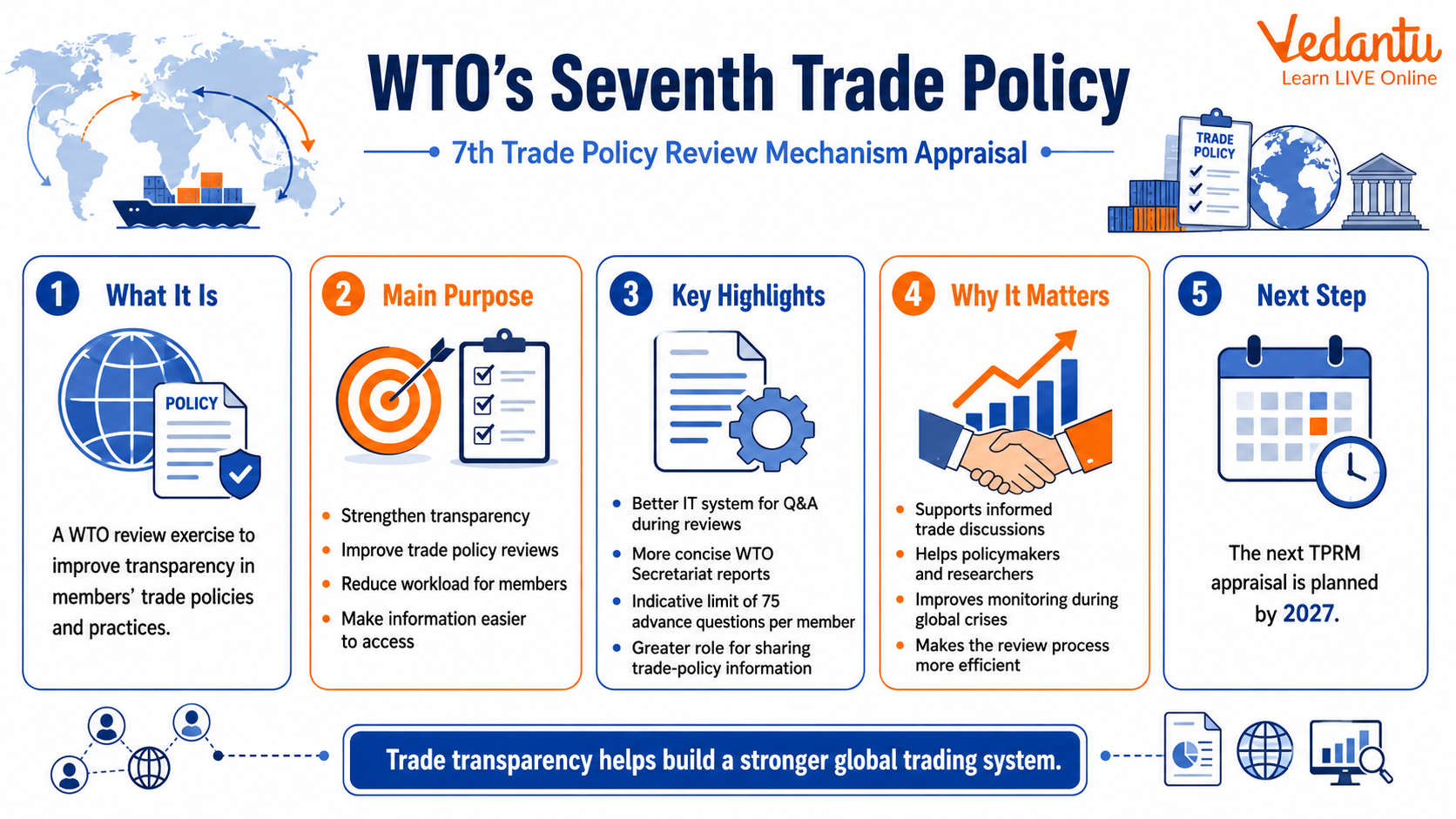
The Seventh Trade Policy Review of the World Trade Organization - WTO is an important evaluation of a member country's trade policies and practices. Under the WTO Trade Policy Review Mechanism - TPRM, each member is periodically reviewed to ensure transparency and adherence to global trade rules. The Seventh Trade Policy Review generally refers to the seventh scheduled assessment of a specific member country by the WTO. These reviews play a crucial role in strengthening the multilateral trading system by promoting openness, predictability, and accountability in international trade.
What is the WTO Trade Policy Review Mechanism - TPRM?
The Trade Policy Review Mechanism was established in 1989 under the General Agreement on Tariffs and Trade - GATT and later became part of the WTO framework in 1995. Its main objective is to enhance the transparency of trade policies and improve members' understanding of each other's trade practices.
- Promotes transparency in trade and economic policies.
- Encourages adherence to WTO agreements.
- Provides a platform for peer review and constructive discussion.
- Improves predictability and stability in the global trading system.
Purpose of the Seventh Trade Policy Review
The Seventh Trade Policy Review focuses on examining changes in a country's trade and related policies since its previous review. It assesses developments in tariffs, trade facilitation, subsidies, investment policies, services trade, intellectual property rights, and other regulatory measures.
- Evaluation of tariff structures and customs procedures.
- Assessment of trade in goods and services.
- Review of agricultural and industrial policies.
- Analysis of trade remedies such as anti-dumping and safeguards.
- Examination of regional and bilateral trade agreements.
Frequency of WTO Trade Policy Reviews
The frequency of trade policy reviews depends on a country's share in global trade. Larger trading nations are reviewed more frequently than smaller economies.
WTO Trade Policy Review Frequency
| Share in World Trade | Review Frequency | Example Category |
|---|---|---|
| Top 4 Trading Members | Every 2 Years | Major Economies |
| Next 16 Members | Every 4 Years | Large and Emerging Economies |
| Other Members | Every 6 Years | Developing and Small Economies |
The Seventh Trade Policy Review therefore represents the seventh cycle of assessment, reflecting long term trends and policy evolution within the member country concerned.
Key Components of the Seventh Trade Policy Review Report
1. Secretariat Report
Prepared independently by the WTO Secretariat, this report provides a detailed analysis of the country's trade policies, economic environment, and institutional framework.
2. Government Report
The reviewed country submits its own report outlining policy objectives, reforms undertaken, and future strategies related to trade and development.
3. Peer Discussion
WTO members discuss the findings, raise questions, and provide comments during the Trade Policy Review Body meeting.
Significance of the Seventh Trade Policy Review
The Seventh Trade Policy Review is significant because it offers a comprehensive understanding of how a country's trade policy has evolved over time. It highlights reforms, identifies challenges, and encourages alignment with global trade norms.
- Strengthens credibility in international markets.
- Enhances investor confidence through policy transparency.
- Encourages domestic reforms and policy consistency.
- Supports rule based multilateral trading system.
Challenges Highlighted in Trade Policy Reviews
During the Seventh Trade Policy Review, several common challenges may be identified depending on the country being reviewed.
- Rising protectionist measures.
- Complex regulatory frameworks affecting trade.
- Dependence on specific export sectors.
- Implementation gaps in WTO commitments.
Importance for Competitive Exams and General Knowledge
The WTO Seventh Trade Policy Review is important for students preparing for competitive examinations such as UPSC, State PSC, SSC, banking exams, and other government tests. Questions may focus on the WTO structure, the Trade Policy Review Mechanism, frequency of reviews, objectives, and the significance of transparency in global trade governance.
- Understand the purpose and structure of the TPRM.
- Remember the review frequency based on trade share.
- Focus on the objectives and significance of periodic reviews.
- Stay updated with the latest country specific review in current affairs.
Conclusion
The WTO Seventh Trade Policy Review is a structured and systematic evaluation of a member country's trade policies under the Trade Policy Review Mechanism. It promotes transparency, strengthens the multilateral trading system, and encourages compliance with global trade rules. By understanding its objectives, structure, and importance, students and general readers can gain valuable insight into how international trade governance operates and why periodic policy reviews are essential for global economic stability.
FAQs on WTO’s Seventh Trade Policy Review Explained for Students
1. What is the WTO’s Seventh Trade Policy Review?
The WTO’s Seventh Trade Policy Review (TPR) is an official assessment of a member country’s trade policies conducted under the World Trade Organization (WTO) framework to ensure transparency and compliance with global trade rules.
• Conducted under the Trade Policy Review Mechanism (TPRM)
• Evaluates trade reforms, tariffs, subsidies, and import-export regulations
• Promotes transparency in the multilateral trading system
• Helps member nations understand policy changes and economic direction
2. What is the purpose of the WTO Trade Policy Review Mechanism (TPRM)?
The Trade Policy Review Mechanism (TPRM) aims to enhance transparency and predictability in international trade policies among WTO members.
• Monitors national trade policies and practices
• Encourages adherence to WTO agreements
• Improves accountability in global trade governance
• Strengthens confidence in the rules-based trading system
3. How often is a country reviewed under the WTO Trade Policy Review?
The frequency of WTO Trade Policy Reviews depends on a country’s share in global trade.
• Every 2 years – Major trading economies (e.g., EU, USA, China)
• Every 4 years – Medium-sized economies
• Every 6 years – Smaller economies
• Least-developed countries (LDCs) may have longer intervals
This system ensures fair monitoring within the global trade framework.
4. What key areas are examined in the Seventh Trade Policy Review?
The Seventh Trade Policy Review examines multiple aspects of a country’s trade regime and economic reforms.
• Tariff structures and customs procedures
• Export-import policies and trade facilitation
• Subsidies, anti-dumping, and safeguard measures
• Services trade and investment policies
• Intellectual property rights (IPR) and digital trade
These areas reflect compliance with WTO trade agreements.
5. Why is the Seventh Trade Policy Review important for students and competitive exams?
The Seventh Trade Policy Review is important for GK and competitive exams because it highlights current trade developments and global economic trends.
• Frequently asked in UPSC, SSC, Banking, and State PCS exams
• Covers topics like WTO functions, global trade policies, and economic reforms
• Helps understand international economic relations
• Connects with topics like globalization and trade liberalization
6. How does the WTO ensure transparency during the Trade Policy Review?
The WTO ensures transparency by publishing detailed reports and conducting peer reviews among member nations.
• Secretariat prepares an independent report
• Reviewed country submits its own policy statement
• Member countries ask questions and provide feedback
• Final reports are publicly available for global access
This promotes openness in the international trading system.
7. What are the outcomes of a WTO Trade Policy Review?
The outcome of a WTO Trade Policy Review includes greater policy clarity and constructive recommendations.
• Identification of trade barriers and reforms
• Suggestions for improving market access
• Strengthening compliance with WTO norms
• Enhanced investor and business confidence
It does not impose penalties but encourages cooperative improvement.
8. How does the Seventh Trade Policy Review impact global trade relations?
The Seventh Trade Policy Review impacts global trade relations by promoting stability and trust among WTO members.
• Reduces uncertainty in cross-border trade
• Encourages policy reforms aligned with free trade principles
• Strengthens multilateral cooperation
• Supports sustainable and inclusive economic growth
9. What challenges are commonly highlighted in WTO Trade Policy Reviews?
WTO Trade Policy Reviews often highlight challenges related to protectionism and trade restrictions.
• High tariff barriers and complex customs rules
• Trade disputes and anti-dumping measures
• Subsidy-related concerns
• Issues in digital trade and services regulation
These challenges affect the efficiency of the global trading system.
10. How does the WTO’s Seventh Trade Policy Review support economic growth?
The Seventh Trade Policy Review supports economic growth by encouraging transparent and predictable trade policies.
• Promotes fair competition in international markets
• Encourages foreign direct investment (FDI)
• Enhances export competitiveness
• Aligns national policies with global trade standards
This contributes to long-term development and integration into the world economy.
