






Important GK Quiz on Sardar Vallabhbhai Patel with Facts and MCQs
Sardar Vallabhbhai Patel was one of the most important leaders of India’s freedom struggle and is popularly known as the Iron Man of India. He played a crucial role in uniting the country after independence and served as India’s first Deputy Prime Minister and Home Minister. General Knowledge questions about Sardar Vallabhbhai Patel are frequently asked in competitive exams such as SSC, UPSC, State PSC, Banking, Railways, and various school level exams. This page provides comprehensive GK questions and answers on Sardar Vallabhbhai Patel to help students and aspirants prepare effectively.
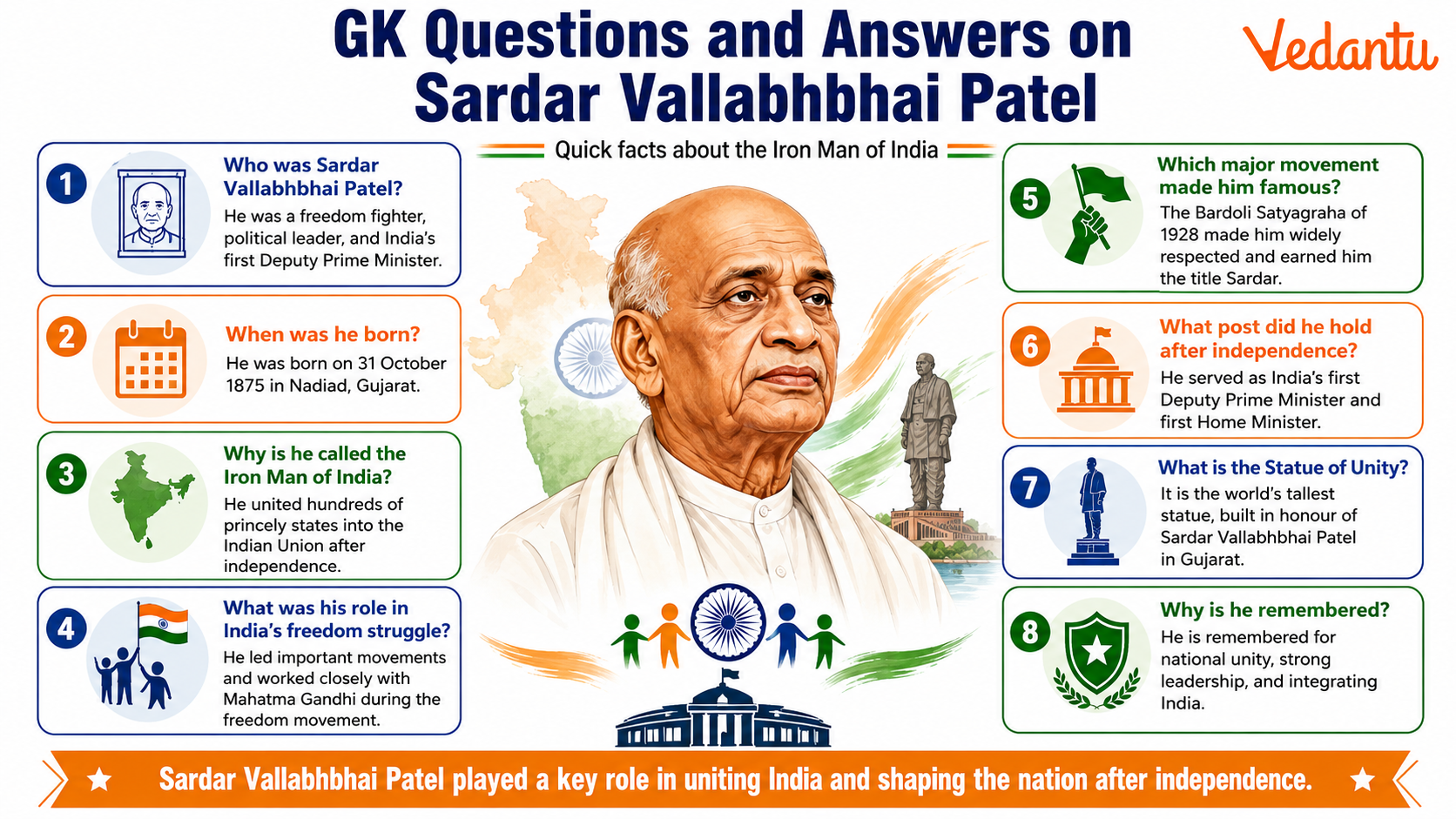
Basic Information About Sardar Vallabhbhai Patel
Key Facts About Sardar Vallabhbhai Patel
| Particular | Details | Importance |
|---|---|---|
| Full Name | Vallabhbhai Jhaverbhai Patel | National Leader of India |
| Date of Birth | 31 October 1875 | National Unity Day is celebrated on this date |
| Place of Birth | Nadiad, Gujarat | Belonged to a farming family |
| Major Role | First Deputy Prime Minister and Home Minister of India | Integrated 562 princely states |
| Date of Death | 15 December 1950 | Awarded Bharat Ratna in 1991 |
Sardar Vallabhbhai Patel is remembered for his strong leadership and administrative skills. His contribution to the political integration of India makes him one of the most respected leaders in Indian history.
GK Questions And Answers On Sardar Vallabhbhai Patel
Basic Level Questions
- Who was Sardar Vallabhbhai Patel?
Answer: He was a senior leader of the Indian National Congress and the first Deputy Prime Minister and Home Minister of India. - Why is Sardar Patel called the Iron Man of India?
Answer: He is called the Iron Man of India because of his strong determination and leadership in uniting princely states. - When is National Unity Day celebrated?
Answer: National Unity Day is celebrated on 31 October every year. - Which movement was led by Sardar Patel in 1928?
Answer: The Bardoli Satyagraha. - Which title was given to Vallabhbhai Patel after Bardoli Satyagraha?
Answer: The title Sardar was given to him.
Intermediate Level Questions
- How many princely states were integrated into the Indian Union by Sardar Patel?
Answer: 562 princely states. - Who assisted Sardar Patel in the integration of princely states?
Answer: V. P. Menon. - In which year did Sardar Patel become the first Home Minister of India?
Answer: In 1947. - Which princely state required police action in 1948 for integration?
Answer: Hyderabad. - From which profession did Sardar Patel begin his career?
Answer: He was a barrister and lawyer.
Advanced Level Questions
- Which committee was headed by Sardar Patel in the Constituent Assembly?
Answer: The Advisory Committee on Fundamental Rights, Minorities, and Tribal and Excluded Areas. - Which states were integrated through diplomatic negotiation rather than military action?
Answer: Most princely states were integrated through negotiation and Instrument of Accession. - When was Sardar Patel awarded the Bharat Ratna?
Answer: In 1991, posthumously. - Where is the Statue of Unity located?
Answer: In Kevadia, Gujarat. - What is the height of the Statue of Unity?
Answer: 182 meters.
Major Contributions of Sardar Vallabhbhai Patel
- Led the Bardoli Satyagraha successfully in 1928.
- Played a key role in the Civil Disobedience Movement and Quit India Movement.
- Integrated 562 princely states into the Indian Union after independence.
- Strengthened the administrative structure of independent India.
- Laid the foundation of the All India Services such as IAS and IPS.
Important Points for Competitive Exams
- Nickname: Iron Man of India.
- Title Sardar was given after the success of Bardoli Satyagraha.
- Statue of Unity is the world’s tallest statue at 182 meters.
- National Unity Day is observed on his birth anniversary.
- Played a crucial role in Hyderabad, Junagadh, and other princely state integrations.
Conclusion
Sardar Vallabhbhai Patel was a visionary leader whose efforts ensured the political unity of India after independence. His determination, leadership, and administrative capabilities earned him the title Iron Man of India. GK questions and answers on Sardar Vallabhbhai Patel are highly relevant for school exams and competitive examinations. By understanding his life, achievements, and contributions, students can strengthen their General Knowledge and appreciate his vital role in shaping modern India.
FAQs on GK Questions and Answers on Sardar Vallabhbhai Patel for Students
1. Who was Sardar Vallabhbhai Patel?
Sardar Vallabhbhai Patel was a key leader of India’s freedom struggle and the first Deputy Prime Minister of independent India.
• Born on 31 October 1875 in Nadiad, Gujarat
• Popularly known as the Iron Man of India
• Played a major role in the Indian National Congress
• Led the integration of over 560 princely states into the Indian Union
• Close associate of Mahatma Gandhi during the freedom movement
2. Why is Sardar Patel called the Iron Man of India?
Sardar Patel is called the Iron Man of India because of his strong leadership and firm decisions in uniting the country.
• Successfully integrated princely states after independence
• Handled sensitive regions like Hyderabad, Junagadh, and Kashmir
• Known for his determination, discipline, and administrative strength
• Ensured national unity during a politically unstable period
3. What was the role of Sardar Vallabhbhai Patel in the Indian freedom struggle?
Sardar Vallabhbhai Patel played a significant role in India’s independence movement under the guidance of Mahatma Gandhi.
• Led the Bardoli Satyagraha (1928) successfully
• Participated in the Non-Cooperation Movement and Civil Disobedience Movement
• Organized peasants and farmers against British policies
• Became a prominent leader in the Indian National Congress
4. What is the Statue of Unity and why was it built?
The Statue of Unity is the world’s tallest statue built in honor of Sardar Vallabhbhai Patel.
• Located in Kevadia, Gujarat
• Height: 182 meters
• Inaugurated on 31 October 2018
• Built to commemorate Patel’s contribution to national integration and Indian unity
5. When did Sardar Vallabhbhai Patel become the Deputy Prime Minister of India?
Sardar Vallabhbhai Patel became India’s first Deputy Prime Minister in 1947 after independence.
• Also served as the first Home Minister of India
• Worked under Prime Minister Jawaharlal Nehru
• Strengthened India’s administrative framework
• Established the foundation of the All India Services (IAS, IPS)
6. What was the Bardoli Satyagraha?
The Bardoli Satyagraha (1928) was a successful farmers’ movement led by Sardar Patel against British tax policies.
• Protested unfair increase in land revenue
• Organized peasants in Bardoli, Gujarat
• Forced the British government to reduce taxes
• Earned Patel the title "Sardar", meaning leader
7. How did Sardar Patel unite the princely states of India?
Sardar Patel united India by integrating more than 560 princely states after independence in 1947.
• Used diplomacy and persuasion through the Instrument of Accession
• Took firm action in states like Hyderabad and Junagadh
• Worked closely with V.P. Menon
• Ensured political unity and territorial integrity of India
8. When did Sardar Vallabhbhai Patel die?
Sardar Vallabhbhai Patel passed away on 15 December 1950 in Mumbai.
• Served independent India for three years after 1947
• Remembered as a champion of national unity
• Awarded the Bharat Ratna posthumously in 1991
9. What are some important facts about Sardar Vallabhbhai Patel?
Sardar Vallabhbhai Patel is remembered for his leadership, patriotism, and administrative reforms.
• Born: 31 October 1875
• Title: Iron Man of India
• Key Movement: Bardoli Satyagraha
• Position: First Deputy Prime Minister and Home Minister of India
• Honored with the Statue of Unity, the world’s tallest statue
10. Why is National Unity Day celebrated on 31 October?
National Unity Day (Rashtriya Ekta Diwas) is celebrated on 31 October to mark the birth anniversary of Sardar Vallabhbhai Patel.
• Observed to promote national integration and unity
• Honors Patel’s role in unifying India
• Celebrated with pledge ceremonies and awareness programs across India
