






Five-Year Plans in India – Objectives, Achievements and Major Phases Explained
The Five Year Plans of India were centralized economic planning programs launched by the Government of India to promote economic growth, reduce poverty, and ensure balanced regional development. Inspired by the Soviet model of planning, these plans were implemented from 1951 to 2017 under the supervision of the Planning Commission. Each plan focused on specific national priorities such as agriculture, industrialization, employment generation, poverty alleviation, and modernization. The Five Year Plans played a crucial role in shaping India's economic structure after independence and remain an important topic in General Knowledge and competitive examinations.
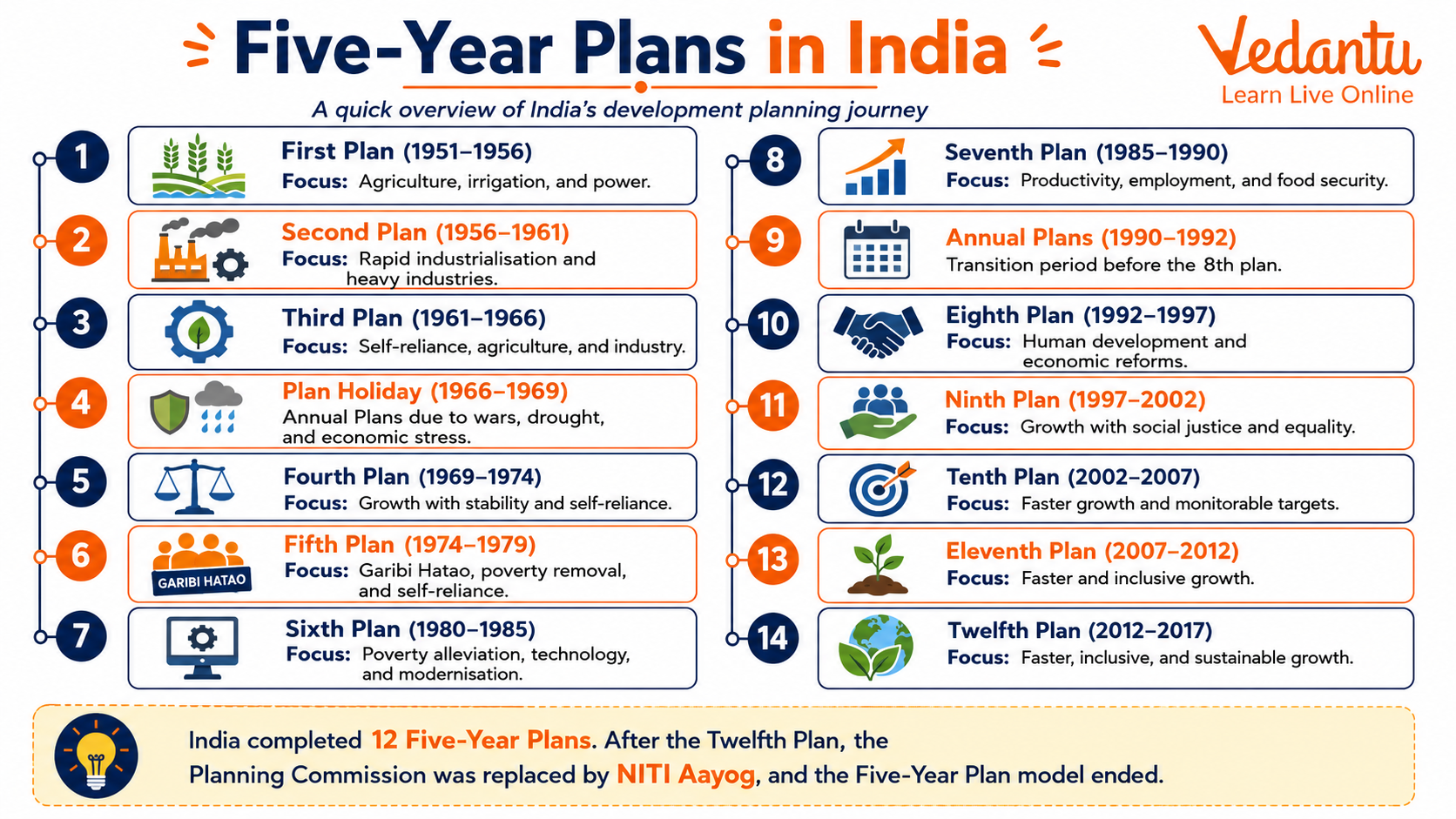
What Are the Five Year Plans?
Five Year Plans were structured development programs formulated by the Planning Commission of India to guide the country’s economic and social development for five-year periods. The main objective was to allocate resources efficiently and promote rapid economic growth with social justice.
- Launched in 1951 after independence
- Based on centralized economic planning
- Focused on sector-wise development such as agriculture, industry, energy, and infrastructure
- Implemented by the Planning Commission until 2014
- Replaced by NITI Aayog in 2015
Objectives of Five Year Plans
The Five Year Plans were designed to achieve long-term economic stability and social progress. Though objectives varied across plans, the core goals remained consistent.
- Economic growth and national income increase
- Poverty reduction
- Employment generation
- Self-reliance in agriculture and industry
- Balanced regional development
- Modernization of the economy
Chronological List of Five Year Plans of India
List of Five Year Plans (1951-2017)
| Plan | Period | Main Focus |
|---|---|---|
| First Plan | 1951-1956 | Agriculture and Irrigation |
| Second Plan | 1956-1961 | Industrialization and Heavy Industries |
| Third Plan | 1961-1966 | Self-reliant Economy |
| Fourth Plan | 1969-1974 | Growth with Stability |
| Fifth Plan | 1974-1979 | Poverty Removal and Self-reliance |
| Sixth Plan | 1980-1985 | Technology and Infrastructure |
| Seventh Plan | 1985-1990 | Productivity and Employment |
| Eighth Plan | 1992-1997 | Human Development |
| Ninth Plan | 1997-2002 | Growth with Social Justice |
| Tenth Plan | 2002-2007 | Targeted Growth Rate of 8 percent |
| Eleventh Plan | 2007-2012 | Inclusive Growth |
| Twelfth Plan | 2012-2017 | Faster, Sustainable and More Inclusive Growth |
There were also three Annual Plans between 1966 and 1969 due to economic instability caused by wars and drought. The Five Year Plan model officially ended after the Twelfth Plan in 2017, and India adopted a new planning framework under NITI Aayog.
Major Highlights of Important Plans
First Five Year Plan (1951-1956)
Focused primarily on agriculture, irrigation projects, and community development. It was successful in achieving its growth target and laid the foundation for future development.
Second Five Year Plan (1956-1961)
Based on the Mahalanobis Model, it emphasized heavy industries and industrial development. Public sector expansion was a major feature of this plan.
Fifth Five Year Plan (1974-1979)
Introduced the slogan Garibi Hatao. It aimed at poverty eradication and economic self-reliance.
Eighth Five Year Plan (1992-1997)
Launched after economic liberalization in 1991. It focused on human resource development, employment generation, and modernization of industries.
Twelfth Five Year Plan (2012-2017)
Focused on faster, sustainable, and more inclusive growth. It aimed at reducing poverty, improving infrastructure, and enhancing skill development.
Role of Planning Commission
The Planning Commission was established in 1950 and was responsible for formulating, implementing, and monitoring the Five Year Plans. It assessed resources, set targets, and ensured coordination between central and state governments. In 2015, it was replaced by NITI Aayog to promote cooperative federalism and policy innovation.
Achievements of Five Year Plans
- Green Revolution increased agricultural production
- Expansion of public sector industries
- Development of infrastructure such as dams, roads, and power plants
- Reduction in poverty levels over time
- Improvement in literacy and life expectancy
Limitations of Five Year Plans
- Targets were not always achieved
- Inefficient implementation and bureaucratic delays
- Overdependence on public sector
- Regional disparities continued
Importance for Competitive Exams
The Five Year Plans of India are an important topic in General Knowledge, UPSC, SSC, Banking, Railways, and other competitive exams. Questions are commonly asked about the years of each plan, main objectives, key features, and major achievements. Understanding the chronological order and focus areas helps in scoring well in static GK sections.
Conclusion
The Five Year Plans of India played a significant role in shaping the country’s economic and social development after independence. From focusing on agriculture to promoting industrial growth and inclusive development, these plans laid the foundation for modern India. Although the centralized planning model ended in 2017, its impact continues to influence India’s economic policies. A clear understanding of the Five Year Plans helps students and aspirants grasp the evolution of India’s development strategy over the decades.
FAQs on Five-Year Plans in India: Objectives, History and Impact on Development
1. What are the Five Year Plans of India?
The Five Year Plans of India were centralized economic planning programs launched to promote balanced economic growth and national development.
- Started in 1951 under Jawaharlal Nehru
- Inspired by the Soviet economic planning model
- Focused on agriculture, industry, poverty removal, employment, and infrastructure
- Implemented by the Planning Commission of India
- Continued until 2017, when replaced by NITI Aayog
These plans aimed at economic development, resource allocation, and long-term national growth.
2. When was the First Five Year Plan launched in India?
The First Five Year Plan was launched in 1951 to rebuild the Indian economy after Independence.
- Duration: 1951–1956
- Priority sector: Agriculture and irrigation
- Major projects: Bhakra Nangal Dam, Hirakud Dam
- Target growth rate: 2.1% (achieved 3.6%)
It focused on food production, rural development, and economic stability.
3. What was the main objective of the Second Five Year Plan?
The Second Five Year Plan (1956–1961) aimed at rapid industrialization and development of heavy industries.
- Based on the Mahalanobis Model
- Emphasis on steel plants, machine tools, and heavy industries
- Establishment of Bhilai, Rourkela, and Durgapur steel plants
- Promoted public sector growth
It marked a shift from agriculture to industrial development in India.
4. How many Five Year Plans were implemented in India?
India implemented 12 Five Year Plans between 1951 and 2017.
- First Plan: 1951–1956
- Twelfth Plan: 2012–2017
- Planning body: Planning Commission
- Replaced by: NITI Aayog in 2015
These plans guided India’s economic policy, development strategy, and resource distribution.
5. Why were the Five Year Plans discontinued in India?
The Five Year Plans were discontinued in 2017 to adopt a more flexible and market-driven planning system.
- Planning Commission replaced by NITI Aayog (2015)
- Shift from centralized planning to cooperative federalism
- Focus on policy think-tank approach
- Greater state participation in development planning
This reform aimed to modernize India’s economic planning framework.
6. Which Five Year Plan is known for the Green Revolution?
The Third Five Year Plan (1961–1966) is associated with the beginning of the Green Revolution.
- Focus on self-sufficiency in food grains
- Introduction of HYV seeds, fertilizers, irrigation
- Leadership of Lal Bahadur Shastri
- Impact of Indo-China and Indo-Pak wars
It aimed to boost agricultural production and reduce food imports.
7. What were the major objectives of the Twelfth Five Year Plan?
The Twelfth Five Year Plan (2012–2017) focused on faster, sustainable, and inclusive growth.
- Target growth rate: 8%
- Emphasis on poverty reduction and employment
- Focus on health, education, and infrastructure
- Promotion of sustainable development
It was the final Five Year Plan before the shift to NITI Aayog.
8. Who introduced the concept of Five Year Plans in India?
Jawaharlal Nehru introduced the concept of Five Year Plans in India after Independence.
- Inspired by the Soviet Union’s planning system
- Established the Planning Commission in 1950
- Promoted a mixed economy model
- Focused on socialist pattern of society
He believed planned development was essential for economic growth and nation-building.
9. What was the main aim of economic planning in India?
The main aim of economic planning in India was to achieve balanced growth and social justice.
- Reduce poverty and unemployment
- Promote industrial and agricultural development
- Ensure equitable distribution of income
- Strengthen self-reliance and modernization
Economic planning helped India manage scarce resources effectively.
10. Which Five Year Plan focused on poverty removal?
The Fifth Five Year Plan (1974–1979) strongly focused on poverty removal (Garibi Hatao).
- Launched under Indira Gandhi
- Main slogan: Garibi Hatao
- Emphasis on employment and self-reliance
- Growth target: 4.4%
It aimed to reduce poverty and improve the living standards of weaker sections.
