






Complete List of Books by Dr Bhimrao Ambedkar with Short Summaries for Students
Dr Bhimrao Ramji Ambedkar was one of the greatest intellectuals, social reformers, economists, jurists, and political leaders in Indian history. He is widely known as the chief architect of the Indian Constitution, but his contribution goes far beyond constitution-making. Dr Ambedkar authored several important books and scholarly works that addressed social inequality, caste discrimination, economics, religion, politics, and democracy. His writings continue to influence students, researchers, civil service aspirants, and social thinkers across the world. This page provides a detailed and structured list of books written by Dr Bhimrao Ambedkar along with their themes and significance.
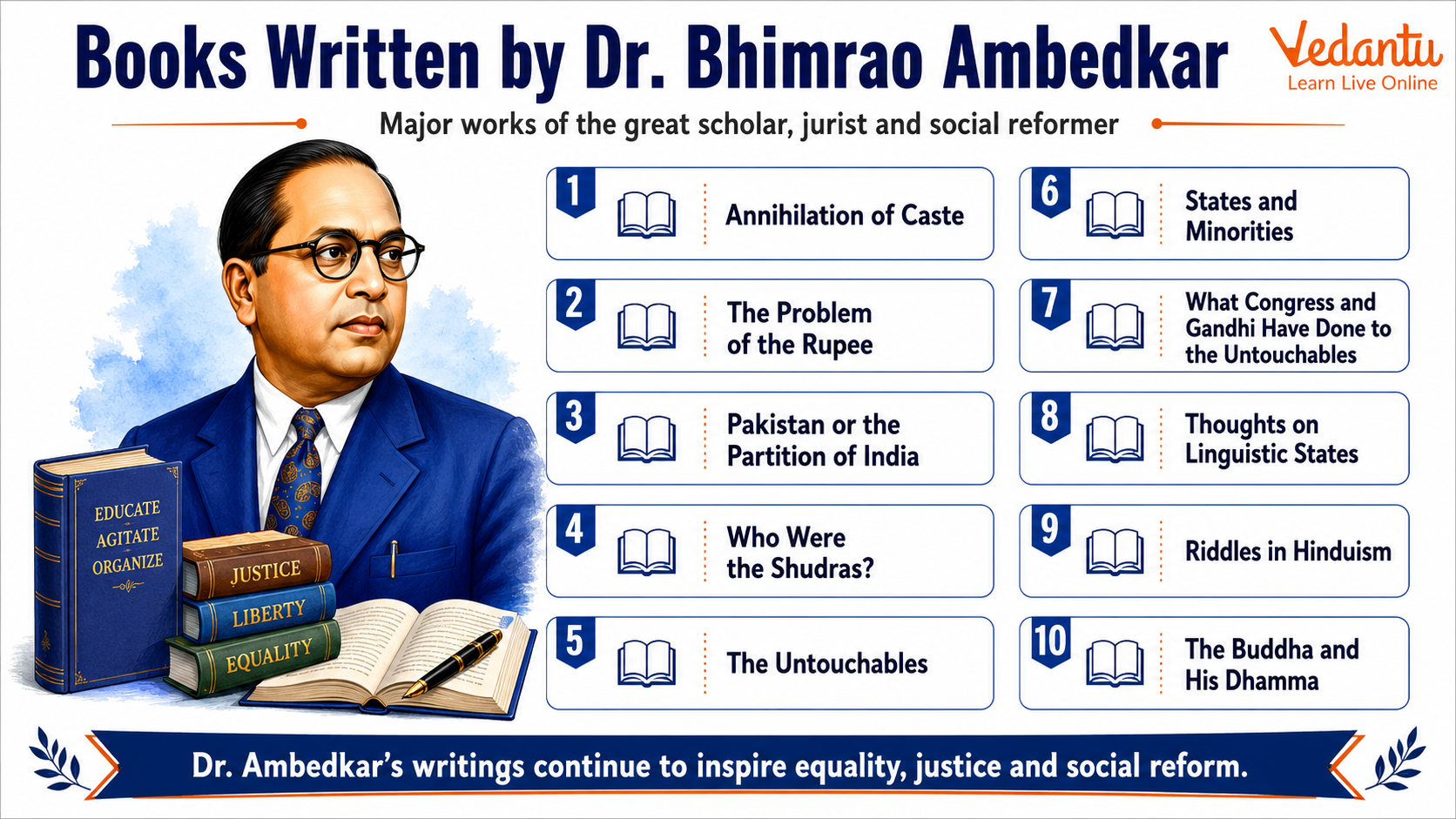
About Dr Bhimrao Ambedkar as an Author
Dr B R Ambedkar was highly educated, holding multiple doctoral degrees from Columbia University and the London School of Economics. His academic training in economics, law, political science, and sociology is clearly reflected in his books. His writings mainly focused on social justice, eradication of caste discrimination, rights of marginalized communities, democracy, religion, and economic reforms.
- Social equality and caste system in India
- Rights of Scheduled Castes and minorities
- Economic and financial policies of British India
- Indian Constitution and democratic values
- Buddhism and social transformation
Major Books Written By Dr Bhimrao Ambedkar
| Book Name | Year | Main Theme |
|---|---|---|
| Annihilation of Caste | 1936 | Critique of caste system and Hindu social order |
| The Problem of the Rupee | 1923 | Indian currency and monetary economics |
| Who Were the Shudras? | 1946 | Historical analysis of Shudra community |
| The Untouchables | 1948 | Origin of untouchability in India |
| States and Minorities | 1947 | Safeguards for minority rights |
| Thoughts on Pakistan | 1941 | Analysis of partition and Muslim League demand |
| The Buddha and His Dhamma | 1957 | Life and teachings of Buddha |
The books listed above represent some of the most influential works of Dr Ambedkar. Many of his writings were published after his death and are compiled in volumes by the Government of Maharashtra under the title "Dr Babasaheb Ambedkar: Writings and Speeches."
Detailed Overview of Important Books
1. Annihilation of Caste
Published in 1936, this book is one of Dr Ambedkar's most famous works. It was originally prepared as a speech for a reformist Hindu group, but it was never delivered due to its strong criticism of the caste system. In this book, Dr Ambedkar argued that social reform must precede political reform and strongly criticized caste-based discrimination.
2. The Problem of the Rupee - Its Origin and Its Solution
This book was based on his doctoral research in economics. It examines the history of Indian currency and proposes reforms in the monetary system. The book influenced the establishment of the Reserve Bank of India.
3. Who Were the Shudras?
In this book, Dr Ambedkar analyzed ancient Hindu texts to explain the origin of the Shudra community. He challenged traditional interpretations and presented a new historical perspective.
4. The Untouchables - Who Were They and Why They Became Untouchables?
This work explores the historical roots of untouchability in India. Dr Ambedkar examined religious and social factors that led to the exclusion of certain communities.
5. The Buddha and His Dhamma
This was Dr Ambedkar's final major work, published posthumously in 1957. It presents a modern interpretation of Buddhism and reflects his belief in equality, rationality, and compassion.
Other Notable Writings
- What Congress and Gandhi Have Done to the Untouchables
- Ranade, Gandhi and Jinnah
- Pakistan or the Partition of India
- Buddha or Karl Marx
- Revolution and Counter-Revolution in Ancient India
Importance of Dr Ambedkar's Books for Students and Competitive Exams
Books written by Dr Bhimrao Ambedkar are highly important for competitive exams such as UPSC, SSC, State PSC, banking exams, and other general knowledge tests. Questions are frequently asked about his major works, their themes, and their impact on Indian society and politics.
- Match the book with its theme
- Identify the year of publication
- Questions on caste reform and social justice
- Economic contributions related to currency and finance
Conclusion
Dr Bhimrao Ambedkar's books reflect his deep scholarship, commitment to social justice, and vision for an equal and democratic India. His writings continue to inspire generations and remain essential reading for understanding Indian society, caste dynamics, constitutional values, and Buddhist philosophy. For students and aspirants, knowing the major books written by Dr Ambedkar and their themes is crucial for building strong general knowledge and exam preparation.
FAQs on Books Written by Dr. Bhimrao Ambedkar and Their Importance
1. What are the most important books written by Dr Bhimrao Ambedkar?
The most important books written by Dr Bhimrao Ambedkar focus on social justice, caste system, economics, and constitutional reforms.
• Annihilation of Caste (1936) – Critique of the caste system in India
• The Problem of the Rupee (1923) – Study on Indian currency and economics
• Who Were the Shudras? (1946) – Historical analysis of Shudra origins
• The Untouchables (1948) – Study on untouchability in Hindu society
• States and Minorities (1947) – Constitutional safeguards for minorities
• Buddha and His Dhamma (1957) – Book on Buddhism and social reform
These works are essential for understanding Dr B.R. Ambedkar’s ideas on equality, democracy, and social reform.
2. Which is the famous book written by Dr B.R. Ambedkar?
The most famous book written by Dr B.R. Ambedkar is Annihilation of Caste.
• Published in 1936
• Strongly criticized the Hindu caste system
• Advocated for social equality and human rights
• Considered a landmark text in Dalit literature and social reform movements
This book remains highly relevant in discussions about caste discrimination, social justice, and constitutional rights.
3. How many books were written by Dr Bhimrao Ambedkar?
Dr Bhimrao Ambedkar wrote several influential books, research papers, and speeches during his lifetime.
• Authored around 15+ major books
• Wrote numerous essays, speeches, and research works
• His writings are compiled in the series "Dr Babasaheb Ambedkar: Writings and Speeches"
His works mainly focus on law, economics, caste system, Buddhism, Indian Constitution, and social reform.
4. What is "Annihilation of Caste" about?
"Annihilation of Caste" is a powerful critique of the Hindu caste system written by Dr Ambedkar.
• Originally prepared as a speech in 1936
• Condemns caste discrimination and untouchability
• Advocates for social equality and reform
• Questions orthodox religious practices
It is one of the most important texts in Indian social reform literature and frequently asked in competitive exams.
5. What is the significance of "The Problem of the Rupee"?
"The Problem of the Rupee: Its Origin and Its Solution" is Dr Ambedkar’s important work on Indian economics.
• Published in 1923
• Analyzes the Indian currency system
• Discusses monetary instability under British rule
• Influenced the formation of the Reserve Bank of India (RBI)
This book highlights Dr Ambedkar’s role as an economist and financial expert, not just a social reformer.
6. What is "Who Were the Shudras?" about?
"Who Were the Shudras?" examines the historical origin of the Shudra community in India.
• Published in 1946
• Studies ancient Hindu texts and scriptures
• Challenges traditional beliefs about varna system
• Argues that Shudras were originally part of the Kshatriya class
This book is important for understanding caste history and social structure in ancient India.
7. Which book did Dr Ambedkar write on Buddhism?
Dr Ambedkar wrote "The Buddha and His Dhamma" on Buddhism.
• Published in 1957 (posthumously)
• Explains the life and teachings of Gautama Buddha
• Promotes Navayana Buddhism
• Emphasizes equality, morality, and social justice
This book played a major role in the Dalit Buddhist movement in India.
8. What is "States and Minorities" written by Dr B.R. Ambedkar?
"States and Minorities" is a memorandum submitted by Dr Ambedkar regarding constitutional safeguards.
• Written in 1947
• Proposed fundamental rights for Scheduled Castes and minorities
• Suggested state socialism and economic safeguards
• Focused on equality before law
This work reflects Ambedkar’s vision for a democratic and inclusive Constitution of India.
9. Why are Dr Ambedkar’s books important for competitive exams?
Dr Ambedkar’s books are important for competitive exams because they cover key topics in Indian polity, history, and economics.
• Frequently asked in UPSC, SSC, State PCS, and other government exams
• Important for understanding the Indian Constitution
• Helps in topics like social justice, caste system, and reform movements
• Relevant for General Knowledge (GK) and current affairs discussions
His writings are essential for students preparing for civil services and academic exams.
10. What themes are common in books written by Dr Bhimrao Ambedkar?
The common themes in books written by Dr Bhimrao Ambedkar revolve around equality, justice, and reform.
• Caste system and untouchability
• Social equality and human rights
• Indian Constitution and democracy
• Economics and monetary policy
• Buddhism and moral philosophy
His works continue to influence discussions on social reform, constitutional law, and Dalit empowerment in modern India.
