






Difference Between Creamy and Non-Creamy Layer in OBC Reservation
The concept of Creamy Layer and Non Creamy Layer is an important part of India’s reservation system under the category of Other Backward Classes - OBC. It helps in identifying socially and educationally backward individuals who are eligible for reservation benefits in government jobs and educational institutions. The creamy layer refers to the relatively advanced and financially well-off members of the OBC category who are excluded from reservation benefits, while the non creamy layer includes those who are genuinely in need of support. Understanding this concept is crucial for students, competitive exam aspirants, and general readers.
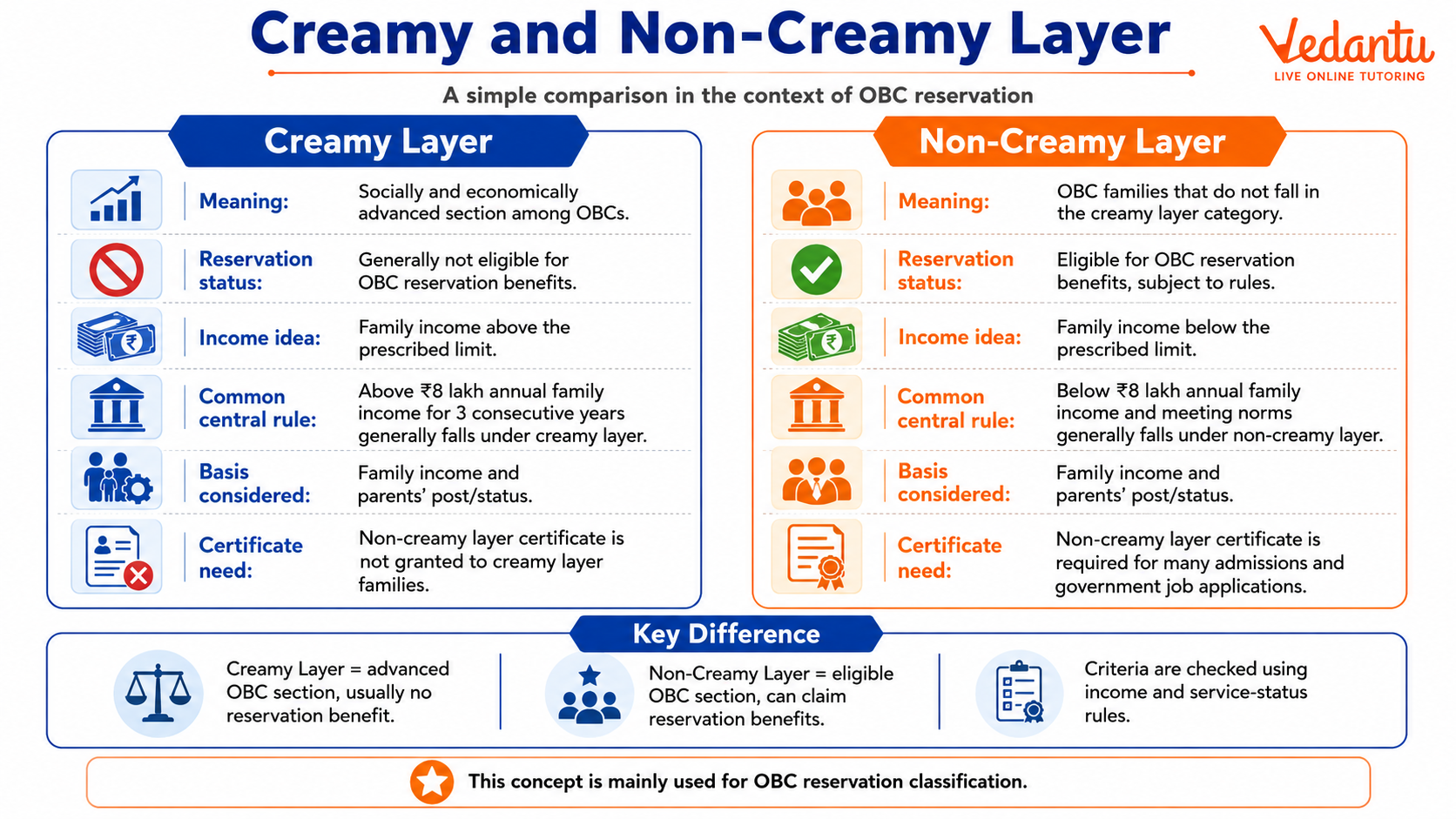
Meaning of Creamy Layer
The creamy layer refers to the economically advanced section within the OBC category. These individuals are considered socially and economically forward compared to other members of the same category. Therefore, they are not eligible for reservation benefits in government jobs and central educational institutions.
- Applies only to OBC category and not to SC or ST categories.
- Based mainly on annual family income and parental status.
- Creamy layer candidates cannot claim OBC reservation benefits.
Income Limit for Creamy Layer
The Government of India sets an income ceiling to determine creamy layer status. As per the latest guidelines, families with an annual income above Rs. 8 lakh are considered under the creamy layer category. This income includes salary, business income, and other sources, but excludes agricultural income in certain cases as per rules.
Meaning of Non Creamy Layer
Non creamy layer refers to those members of the OBC category whose family income is below the prescribed limit and who are not socially or economically advanced. These individuals are eligible to avail reservation benefits in government services and educational institutions.
- Annual family income is below Rs. 8 lakh.
- Parents are not holding high-ranking constitutional or government posts.
- Eligible for 27 percent reservation under OBC quota in central institutions.
Difference Between Creamy Layer and Non Creamy Layer
| Basis | Creamy Layer | Non Creamy Layer |
|---|---|---|
| Income Limit | Above Rs. 8 lakh per year | Below Rs. 8 lakh per year |
| Reservation Eligibility | Not eligible | Eligible |
| Social Status | Socially and economically advanced | Socially and educationally backward |
The main objective of dividing OBCs into creamy and non creamy layer is to ensure that reservation benefits reach the truly deserving and underprivileged sections of society. It prevents the relatively advanced members from repeatedly enjoying the benefits meant for upliftment.
Historical Background
The concept of creamy layer was introduced following the recommendations of the Mandal Commission and later upheld by the Supreme Court in the Indra Sawhney case in 1992. The Court ruled that socially advanced persons among OBCs must be excluded from reservation benefits to maintain fairness and equality.
Who is Excluded from Non Creamy Layer Status
Certain categories of people are automatically classified under the creamy layer irrespective of income. These generally include children of:
- Constitutional post holders.
- Group A and Group B central and state government officers.
- High ranking officers in public sector undertakings.
- Professionals and industrialists with high income.
Importance in Competitive Exams
For competitive exams such as UPSC, SSC, Banking, State PSC, and admissions to central universities, OBC candidates must produce a valid Non Creamy Layer certificate to claim reservation benefits. Without this certificate, they are treated as general category candidates.
Documents Required for Non Creamy Layer Certificate
- Income certificate of parents.
- Caste certificate.
- Affidavit or self declaration.
- Identity and address proof.
Key Points to Remember
- Creamy layer concept applies only to OBC category.
- Current income limit is Rs. 8 lakh per year as per central government norms.
- Introduced after the Indra Sawhney judgment in 1992.
- Non creamy layer candidates get 27 percent reservation in central services.
Conclusion
The distinction between creamy layer and non creamy layer ensures that reservation benefits under the OBC category reach the truly disadvantaged sections of society. It promotes social justice while maintaining fairness within the reservation system. For students and exam aspirants, understanding this concept is essential not only for General Knowledge but also for correctly claiming benefits during applications. A clear understanding of eligibility criteria, income limits, and legal background helps in avoiding confusion and ensuring proper documentation.
FAQs on Creamy and Non-Creamy Layer: Meaning, Rules, and Eligibility
1. What is the difference between Creamy Layer and Non-Creamy Layer in OBC?
The Creamy Layer and Non-Creamy Layer classification divides Other Backward Classes (OBC) based on income and social advancement for reservation benefits.
• Creamy Layer: Economically and socially advanced OBC members who are not eligible for reservation.
• Non-Creamy Layer: Economically weaker OBC members who are eligible for OBC reservation in jobs and education.
• The concept ensures benefits reach the truly disadvantaged sections under OBC reservation policy.
2. What is the income limit for Creamy Layer in OBC?
The current Creamy Layer income limit is ₹8 lakh per annum as per Government of India guidelines.
• If annual family income exceeds ₹8 lakh, the candidate falls under Creamy Layer.
• Income includes salary, business, and other sources (excluding agricultural income in some cases).
• This limit is reviewed periodically by the Central Government.
3. Who introduced the Creamy Layer concept in India?
The Creamy Layer concept was introduced after the landmark Indra Sawhney vs Union of India (1992) Supreme Court judgment.
• Also known as the Mandal Commission case.
• The Supreme Court directed exclusion of advanced OBC members from reservation benefits.
• It aimed to promote social justice and equality under Article 16(4) of the Constitution.
4. Why is the Creamy Layer excluded from OBC reservation?
The Creamy Layer is excluded to ensure that reservation benefits reach the truly backward sections.
• Prevents misuse of affirmative action policies.
• Promotes fair distribution of government job and education quotas.
• Ensures equality as per the Indian Constitution.
• Supports the principle of social and educational backwardness.
5. Is Creamy Layer applicable to SC and ST categories?
No, the Creamy Layer concept currently applies only to OBC categories and not to SC/ST.
• SC (Scheduled Castes) and ST (Scheduled Tribes) receive reservation without income-based exclusion.
• Supreme Court discussions have occurred, but no final implementation for SC/ST.
• The rule remains specific to Other Backward Classes.
6. How can one get a Non-Creamy Layer certificate?
A Non-Creamy Layer certificate is issued by the competent revenue authority of the state.
• Apply at Tehsildar/SDM office or online state portal.
• Submit income proof, caste certificate, and identity documents.
• Certificate is required for OBC reservation in government jobs and educational institutions.
7. What documents are required for Creamy Layer determination?
Income and employment documents are required to determine Creamy Layer status.
• Income certificate of parents/guardians.
• Caste certificate (OBC proof).
• Salary slips or IT returns.
• Employment details if parents work in government services.
These documents help verify eligibility under OBC Non-Creamy Layer criteria.
8. Does agricultural income count in Creamy Layer calculation?
Agricultural income is generally not included in the Creamy Layer income calculation for central OBC lists.
• Only salary, business, and professional income are mainly considered.
• Rules may vary for state OBC lists.
• Always check official guidelines for central and state reservation policies.
9. What is the significance of Creamy Layer in competitive exams?
Creamy Layer status determines eligibility for OBC reservation in competitive exams like UPSC, SSC, and banking exams.
• Only Non-Creamy Layer OBC candidates get age relaxation and quota benefits.
• Certificate must be valid at the time of application.
• Important for aspirants preparing for government recruitment exams.
10. What is the constitutional basis of the Creamy Layer concept?
The Creamy Layer concept is based on constitutional provisions promoting equality and social justice.
• Derived from Article 16(4) (reservation in public employment).
• Linked to Article 14 (Right to Equality).
• Strengthened by the Indra Sawhney judgment (1992).
It ensures balanced implementation of affirmative action and backward class reservation in India.
