






India vs Pakistan Economy Comparison in GDP, Growth Rate and Per Capita Income
India and Pakistan are two neighboring South Asian countries that gained independence in 1947. Since then, both nations have followed different economic paths, resulting in noticeable differences in growth, development, industrial strength, and global economic influence. Understanding the India vs Pakistan economic comparison is important for students, competitive exam aspirants, and general readers who want to analyze South Asian economic trends, GDP growth patterns, trade performance, and development indicators. This page provides a clear and structured comparison of both economies using key economic parameters.
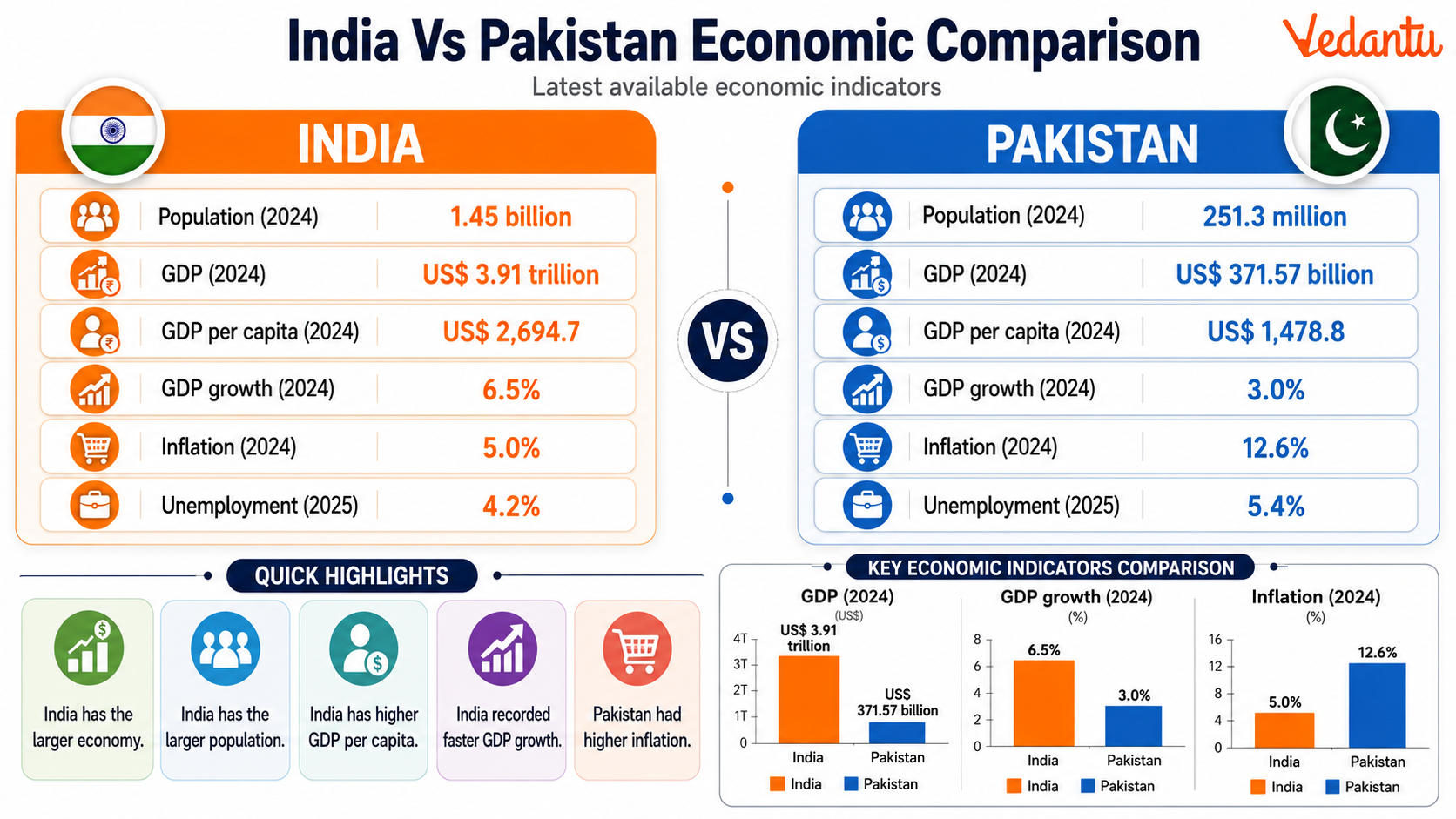
Overview of India and Pakistan Economies
India has emerged as one of the fastest-growing major economies in the world. It has a diversified economic structure supported by services, manufacturing, agriculture, technology, and a strong domestic market. Pakistan, on the other hand, has a developing economy largely dependent on agriculture, textiles, remittances, and external financial assistance. While both countries share historical similarities, their economic trajectories have differed significantly over the decades.
India Vs Pakistan Economic Comparison
| Economic Indicator | India | Pakistan |
|---|---|---|
| GDP Nominal | Over 3.5 Trillion USD | Around 340 Billion USD |
| GDP Growth Rate | 6 - 7 percent average | 2 - 4 percent average |
| GDP Per Capita | Above 2500 USD | Around 1500 USD |
| Main Economic Sector | Services and IT | Agriculture and Textiles |
| Foreign Exchange Reserves | Strong and Stable | Often Under Pressure |
The table clearly shows that India has a significantly larger economy in terms of GDP size and global integration. Pakistan faces challenges such as fiscal deficits, inflation, and external debt pressures, which impact its economic stability.
Sector Wise Comparison
1. Agriculture Sector
Both India and Pakistan have strong agricultural bases due to fertile river systems. Agriculture contributes significantly to employment in both countries. However, India has diversified agricultural output and is a major exporter of rice, wheat, and spices. Pakistan relies heavily on crops like wheat, rice, and cotton, with cotton supporting its textile industry.
2. Industrial Sector
India has developed a diversified industrial base including automobiles, pharmaceuticals, steel, chemicals, and electronics. The Make in India initiative has boosted manufacturing growth. Pakistan's industrial sector is narrower and mainly centered around textiles, cement, sugar, and small scale manufacturing.
3. Services Sector
The services sector is the backbone of the Indian economy, contributing more than 50 percent to GDP. IT services, banking, telecommunications, and digital technology have positioned India as a global outsourcing hub. Pakistan's services sector is growing but remains smaller in scale and global influence compared to India.
Trade and Global Integration
India has strong trade relations with the United States, European Union, China, and Middle Eastern countries. It exports software services, petroleum products, pharmaceuticals, and machinery. Pakistan mainly exports textiles, rice, leather goods, and surgical instruments. India's export basket is more diversified, while Pakistan's export base is concentrated in fewer sectors.
- India is a member of G20 and plays a key role in global economic forums.
- Pakistan often relies on IMF assistance during financial crises.
- India attracts higher Foreign Direct Investment compared to Pakistan.
Inflation and Debt Situation
Inflation remains a recurring challenge for Pakistan, often reaching double digit levels. Currency depreciation has also affected purchasing power. India also faces inflation pressures but generally maintains better macroeconomic stability. Pakistan's external debt burden is higher relative to its economic size, while India manages a comparatively more sustainable debt structure.
Human Development and Economic Impact
Economic growth influences human development indicators such as literacy rate, healthcare access, and poverty reduction. India has made notable progress in digital inclusion, financial inclusion, and infrastructure development. Pakistan has also improved in certain social sectors but continues to face challenges related to poverty, unemployment, and energy shortages.
Key Reasons Behind Economic Differences
- Economic reforms and liberalization policies in India since 1991 boosted private sector growth.
- Political stability and consistent policy direction contributed to India's economic expansion.
- Pakistan faced recurring political instability and security concerns affecting investor confidence.
- Diversification of exports in India reduced dependence on a single sector.
Conclusion
The India vs Pakistan economic comparison highlights a significant gap in GDP size, industrial diversification, global trade presence, and macroeconomic stability. While India has emerged as a major global economy with strong service and manufacturing sectors, Pakistan continues to face structural challenges that limit its economic growth. For students and competitive exam aspirants, understanding this comparison helps in analyzing South Asian economic development, regional geopolitics, and macroeconomic fundamentals in a clear and structured way.
FAQs on India vs Pakistan Economic Comparison: A Simple Study for Students
1. What is the economic comparison between India and Pakistan?
India’s economy is significantly larger and more diversified than Pakistan’s economy.
• India GDP (2025 est.): Around $3.7 trillion (5th largest globally).
• Pakistan GDP (2025 est.): Around $340–350 billion.
• India has strong sectors in IT, services, manufacturing, and pharmaceuticals.
• Pakistan’s economy relies more on agriculture, textiles, and remittances.
This India vs Pakistan economic comparison is frequently asked in competitive exams and GK sections.
2. Which country has a higher GDP growth rate – India or Pakistan?
India generally records a higher and more stable GDP growth rate than Pakistan.
• India’s average growth: 6–7% annually (post-pandemic recovery).
• Pakistan’s growth fluctuates between 2–4% due to inflation and debt issues.
• India benefits from a large domestic market and digital economy.
• Pakistan faces challenges like IMF dependency and fiscal deficits.
GDP growth rate comparison is a key topic in India vs Pakistan economic analysis.
3. How does per capita income compare between India and Pakistan?
India’s per capita income is higher than Pakistan’s in recent years.
• India per capita income: Approx. $2,600+.
• Pakistan per capita income: Around $1,500–1,600.
• Higher income reflects better industrial output and services expansion in India.
• Pakistan’s income levels are affected by inflation and currency depreciation.
Per capita income comparison is important for understanding living standards.
4. Which country has a stronger currency – Indian Rupee or Pakistani Rupee?
The Indian Rupee (INR) is stronger and more stable than the Pakistani Rupee (PKR).
• 1 USD ≈ 83–85 INR.
• 1 USD ≈ 270–300 PKR.
• Pakistan faces higher currency depreciation due to foreign debt and trade imbalance.
• India maintains stronger forex reserves and export capacity.
Currency stability plays a major role in the India vs Pakistan economic comparison.
5. How do India and Pakistan compare in foreign exchange reserves?
India holds significantly higher foreign exchange reserves than Pakistan.
• India forex reserves: Over $600 billion.
• Pakistan forex reserves: Around $8–15 billion (varies).
• High reserves help India manage inflation and currency stability.
• Pakistan often seeks IMF assistance to stabilize reserves.
Forex reserves indicate economic strength and financial security.
6. What are the main industries driving India and Pakistan’s economies?
India has a diversified industrial base, while Pakistan relies heavily on limited sectors.
• India: IT services, pharmaceuticals, automobiles, textiles, agriculture.
• Pakistan: Textiles, agriculture (cotton, wheat), remittances, small-scale manufacturing.
• India’s IT sector contributes significantly to exports.
• Pakistan’s textile exports form a major share of foreign earnings.
Industrial diversification is a key factor in economic development.
7. How does trade performance differ between India and Pakistan?
India has a much larger export-import volume compared to Pakistan.
• India exports: Petroleum products, software services, pharmaceuticals, gems.
• Pakistan exports: Textiles, rice, sports goods.
• India’s global trade partnerships are broader (USA, UAE, China, EU).
• Pakistan faces trade deficits due to high imports and lower export diversification.
Trade performance directly impacts GDP and foreign exchange reserves.
8. Which country has a higher poverty rate – India or Pakistan?
Both countries face poverty challenges, but Pakistan currently experiences higher economic stress.
• India has reduced extreme poverty through welfare schemes and digital inclusion.
• Pakistan struggles with inflation, unemployment, and rising debt.
• Poverty rate varies by rural-urban divide in both nations.
Socio-economic indicators are commonly asked in GK and UPSC comparisons.
9. How does inflation compare between India and Pakistan?
Pakistan generally faces higher inflation compared to India.
• India inflation rate: Usually 5–6% range.
• Pakistan inflation rate: Often exceeds 20% during crises.
• High inflation reduces purchasing power and economic stability.
• India’s Reserve Bank of India (RBI) plays a key role in controlling inflation.
Inflation comparison is crucial in understanding economic stability.
10. Which country has better long-term economic prospects – India or Pakistan?
India is projected to have stronger long-term economic prospects due to structural reforms and demographic advantage.
• India benefits from a large young workforce and digital economy growth.
• Government initiatives like Make in India and Digital India boost development.
• Pakistan needs structural reforms, debt control, and political stability.
• Global agencies project India among the fastest-growing major economies.
Long-term economic outlook is a frequent “People Also Ask” topic in India vs Pakistan comparisons.
