






Indian Film Certification Categories by the Censor Board: U, UA, A & S Ratings
Film certificates in India are issued by the Central Board of Film Certification - CBFC, which functions under the Ministry of Information and Broadcasting. The certification system ensures that films released for public viewing comply with the guidelines laid down under the Cinematograph Act, 1952. The CBFC examines films before public exhibition and assigns appropriate certificates based on their content such as violence, language, sexual content, drug use, and thematic elements. Understanding the types of film certificates is important for competitive exams, general awareness, and media studies.
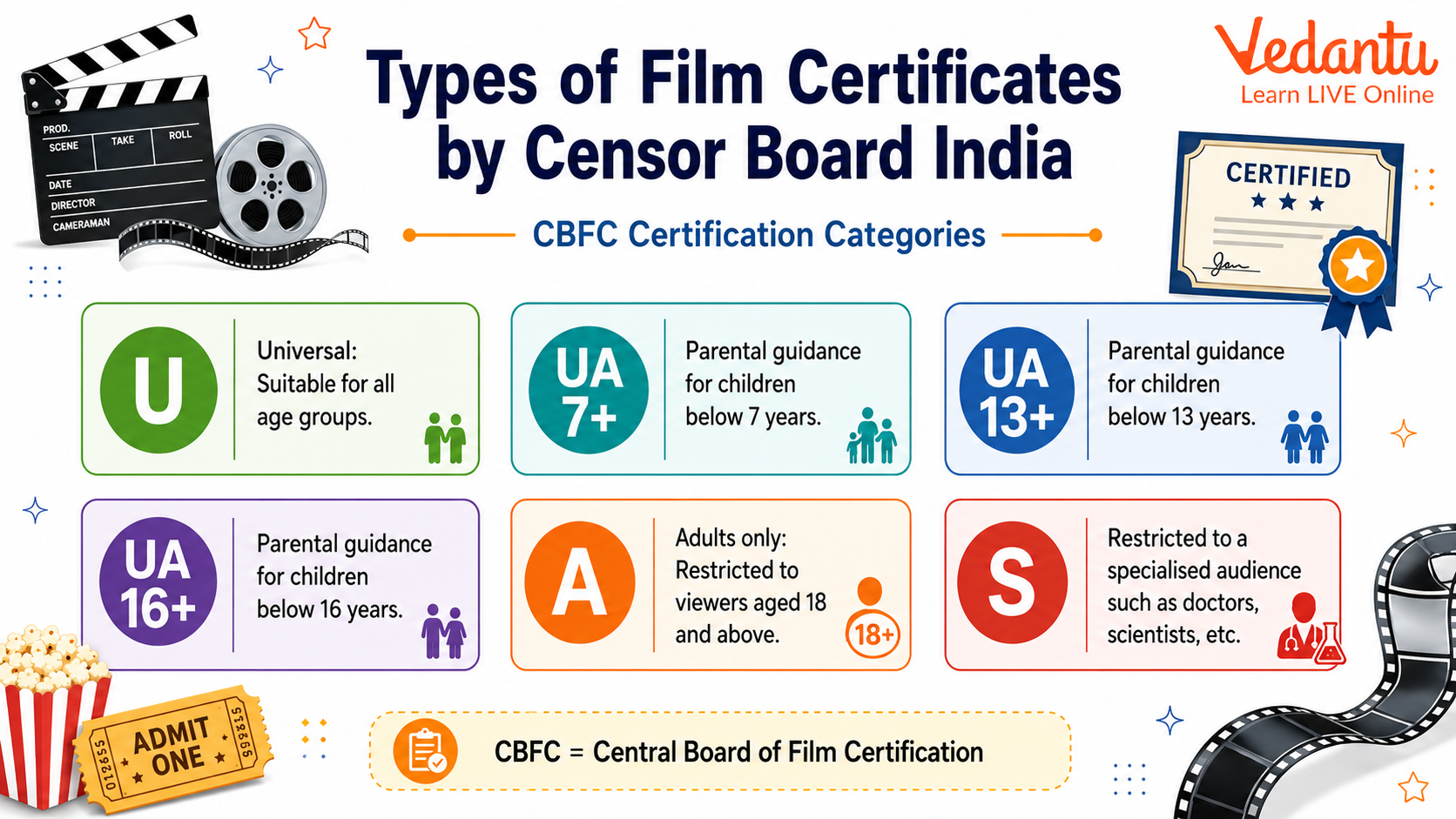
About the Central Board of Film Certification - CBFC
The Central Board of Film Certification - CBFC is a statutory body responsible for regulating the public exhibition of films in India. It ensures that films adhere to cultural, moral, and legal standards of the country. The CBFC reviews films through examining committees and may suggest cuts or modifications before granting certification.
- Established under the Cinematograph Act, 1952
- Functions under the Ministry of Information and Broadcasting
- Headquarters in Mumbai
- Chairperson and board members appointed by the Central Government
Types of Film Certificates in India
The CBFC issues different types of certificates depending on the suitability of the film for various age groups. These classifications help viewers understand the nature of the content before watching.
Film Certification Categories in India
| Certificate Type | Full Form | Meaning and Eligibility |
|---|---|---|
| U | Unrestricted Public Exhibition | Suitable for all age groups |
| UA | Unrestricted Public Exhibition with Parental Guidance | Children below a specified age require parental guidance |
| A | Adults Only | Restricted to viewers aged 18 years and above |
In addition to the above categories, the CBFC also issues an S certificate for films meant for a specialized audience such as doctors or scientists. Each certificate reflects the level of maturity required to understand and view the film content responsibly.
1. U Certificate
Films certified as U are suitable for unrestricted public exhibition. These films contain content that is appropriate for children and adults. They generally avoid strong violence, explicit language, or adult themes.
2. UA Certificate
UA certified films may contain mild violence, moderate language, or themes that require parental guidance for children. In recent updates, UA certification may be further divided into age based sub categories such as UA 7 plus, UA 13 plus, and UA 16 plus to ensure better age classification.
3. A Certificate
A certified films are restricted to adults aged 18 years and above. These films may include strong violence, explicit scenes, mature themes, or strong language. Entry to such films is legally restricted to adults only.
4. S Certificate
S certificate is given to films meant for a specialized group of professionals such as doctors, engineers, or scientists. These films are not meant for general public viewing.
Objectives of Film Certification
The main purpose of film certification is to balance freedom of expression with social responsibility. The CBFC ensures that films do not harm public order, morality, or national integrity.
- Ensure content is suitable for intended age groups
- Prevent glorification of violence, drugs, or anti national activities
- Protect children from harmful or disturbing content
- Maintain public decency and morality
Certification Process in India
The certification process involves several stages before a film is approved for public screening.
- Submission of the film to the CBFC along with required documents and fees
- Examination by an Examining Committee
- Suggestions for cuts or modifications if necessary
- Granting of appropriate certificate
Importance for Competitive Exams
Questions about film certification and the CBFC frequently appear in exams such as UPSC, SSC, State PSC, and other general awareness tests. Candidates should remember the name of the Act - Cinematograph Act, 1952, the ministry under which CBFC functions, and the different types of certificates issued.
- CBFC is a statutory body
- Established under Cinematograph Act, 1952
- Four main certificates - U, UA, A, and S
- Functions under Ministry of Information and Broadcasting
Conclusion
The film certification system in India plays a crucial role in regulating content for public exhibition while safeguarding cultural and social values. The Central Board of Film Certification ensures that films are appropriately classified based on age suitability and thematic content. A clear understanding of the different types of film certificates - U, UA, A, and S - is essential for students preparing for competitive examinations as well as for general awareness about media regulation in India.
FAQs on Types of Film Certificates by Censor Board of India Explained for Students
1. What are the types of film certificates issued by the Censor Board of India?
The Central Board of Film Certification (CBFC) in India issues four main types of film certificates based on content suitability and age group.
• U (Universal) – Suitable for all age groups.
• UA (Parental Guidance) – Children below 12 require parental guidance.
• A (Adults Only) – Restricted to viewers above 18 years.
• S (Special Category) – Restricted to specific professional groups like doctors or scientists.
These categories help regulate movie classification in India under the Cinematograph Act, 1952.
2. What does a U certificate mean in Indian film certification?
A U (Universal) certificate means the film is suitable for audiences of all ages without restrictions.
• No explicit violence or adult content.
• Suitable for children and family viewing.
• Often used for educational, family, and animated films.
The CBFC U certificate ensures the movie content is safe for general public exhibition.
3. What is the meaning of UA certificate in movies?
A UA certificate indicates that children below 12 years can watch the film only under parental guidance.
• May include mild violence or emotional themes.
• Parental discretion is advised.
• Recently sub-categorized into UA 7+, UA 13+, and UA 16+ under updated guidelines.
This film rating in India balances creative freedom with child protection.
4. Who can watch A certificate movies in India?
An A (Adults Only) certificate allows only individuals aged 18 years and above to watch the film.
• Contains strong language, violence, or adult themes.
• Entry is restricted to adults with valid ID proof.
• Common in thriller, crime, and mature drama genres.
The CBFC A rating ensures that sensitive content is restricted to mature audiences.
5. What is an S certificate issued by CBFC?
The S (Special) certificate is issued for films meant for a specific professional group.
• Restricted to doctors, scientists, or agriculture experts.
• Usually educational or technical films.
• Not meant for public exhibition.
This rare film certification category ensures specialized content is viewed only by relevant audiences.
6. Which authority gives film certificates in India?
The Central Board of Film Certification (CBFC) is the statutory body responsible for film certification in India.
• Established under the Cinematograph Act, 1952.
• Functions under the Ministry of Information and Broadcasting.
• Headquarters in Mumbai.
The CBFC is commonly known as the Censor Board of India.
7. What is the Cinematograph Act, 1952?
The Cinematograph Act, 1952 is the law governing film certification and censorship in India.
• Provides legal framework for CBFC guidelines.
• Defines categories like U, UA, A, and S.
• Ensures films maintain public order, morality, and national integrity.
This Act forms the backbone of the movie censorship system in India.
8. What are the new changes in film certification in India?
Recent amendments introduced age-based sub-categories under the UA certificate for better classification.
• UA 7+
• UA 13+
• UA 16+
• Perpetual validity of certificates.
These reforms modernize the Indian film rating system and align it with global standards.
9. Why is film certification important in India?
Film certification is important to regulate content and protect viewers, especially children.
• Ensures age-appropriate viewing.
• Maintains cultural and social values.
• Prevents exposure to harmful content.
The CBFC film certification process balances freedom of expression with public responsibility.
10. Is CBFC a censor board or a certification board?
Officially, the CBFC is a certification authority, not merely a censor board.
• It classifies films based on guidelines.
• Suggests modifications if content violates rules.
• Grants certificates for public exhibition.
Although commonly called the Censor Board of India, its primary role is film classification and certification.
