



Important Questions for Class 4 English Chapter 9 – Hekko
Practise these solved questions on Hekko, the roles of both teams, rules of the game, vocabulary and grammar exercises.
Class 4 English Chapter 9 Important Questions MCQ with Answers
Q1. What does the word "Hekko" mean?
(a) Running with the tiger
(b) Challenging the tiger
(c) Catching the tiger
(d) Playing with the tiger
Answer: (b) Challenging the tiger
Explanation: In the chapter, "Hek" means to challenge, and "ko" means tiger. Together, Hekko means "Challenging the tiger."
Q2. In which district of Nagaland is Hekko played?
(a) Kohima
(b) Dimapur
(c) Mokokchung
(d) Mon
Answer: (c) Mokokchung
Explanation: Hekko is a traditional game played by the people of the Mokokchung district in Nagaland.
Q3. How many players are there in each Hekko team?
(a) 7
(b) 9
(c) 11
(d) 12
Answer: (c) 11
Explanation: Each Hekko team has 11 players. The toss decides which team will be called Aami and which will be called Aakho.
Q4. What must an Aakho player say after being caught by the Aami team?
(a) Hekko
(b) Joko
(c) Khotiba
(d) Khozuba
Answer: (b) Joko
Explanation: "Joko" means surrender. When an Aakho player is caught, the player must say "Joko" to surrender and be released.
Q5. Which title is awarded to the strongest player of the Aakho team?
(a) Khozuba
(b) Aami
(c) Khotiba
(d) Joko
Answer: (c) Khotiba
Explanation: The strongest Aakho player receives the title Khotiba. The fastest player of the Aami team receives the title Khozuba.
Class 4 English Chapter 9 Very Short Answer Questions
Q6. What are the names of the two teams in Hekko?
Answer: The two teams are Aami (the Man) and Aakho (the Tiger).
Q7. What does the Aami team do inside the circle?
Answer: The Aami players form a human chain and try to stay inside the circle. They also try to catch the Aakho players who enter.
Q8. What is the meaning of the word "surrender"?
Answer: Surrender means to stop resisting and accept defeat.
Example: The caught Aakho player says "Joko" to surrender.
Q9. Who receives the titles Khozuba and Khotiba?
Answer:
Khozuba: The fastest player of the Aami team.
Khotiba: The strongest player of the Aakho team.
Class 4 English Chapter 9 Short Answer Questions
Q10. How is the game of Hekko connected to the folk story of Nagaland?
Answer:
According to a folk story from Nagaland, humans and animals once lived together.
They had a disagreement about who was superior.
The humans, called Aami, challenged the tiger, called Aakho.
This challenge became known as Hekko.
Today, the game is played between two teams named Aami and Aakho.
Q11. Explain the roles of the Aami and Aakho teams in Hekko.
Answer:
The two teams have different roles during the game.
Conclusion: Both teams need strength, speed and teamwork to score points.
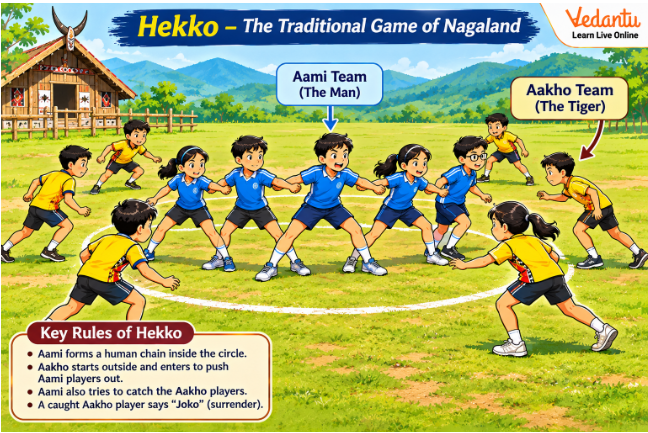
Q12. Picture-Based Question: Observe the Hekko Game and Answer the Questions.
Look at the illustration showing children playing Hekko in a marked circle.
(a) Which team stays inside the circle?
(b) Which team starts outside the circle?
(c) What do the Aami players form inside the circle?
(d) What happens when an Aami player is pushed outside?
(e) What must a caught Aakho player say?
Answer:
(a) The Aami team stays inside the circle.
(b) The Aakho team starts outside the circle.
(c) The Aami players form a human chain.
(d) The Aami player is out and cannot enter the game again.
(e) The caught Aakho player must say "Joko."
Q13. Choose the correct homophones to complete the sentences.
(a) ______ is a beautiful park near my house. (There/Their)
(b) The children completed ______ work. (there/their)
(c) ______ players entered the circle. (Two/Too)
(d) I was ______ tired after playing. (two/too)
(e) The boy ______ the ball. (through/threw)
(f) I can see the trees ______ the window. (through/threw)
Answer:
(a) There is a beautiful park near my house.
(b) The children completed their work.
(c) Two players entered the circle.
(d) I was too tired after playing.
(e) The boy threw the ball.
(f) I can see the trees through the window.
Remember: Homophones are words that sound alike but have different meanings or spellings.
Q14. Match the animals with the sounds they make.
Answer:
Q15. Write the simple past tense of the following verbs.
(a) Challenge
(b) Visit
(c) Jump
(d) Decide
(e) Come
(f) See
(g) Drink
(h) Catch
Answer:
Explanation: Many regular verbs form the past tense by adding -ed or -d. Irregular verbs have different past-tense forms, such as came, saw and caught.
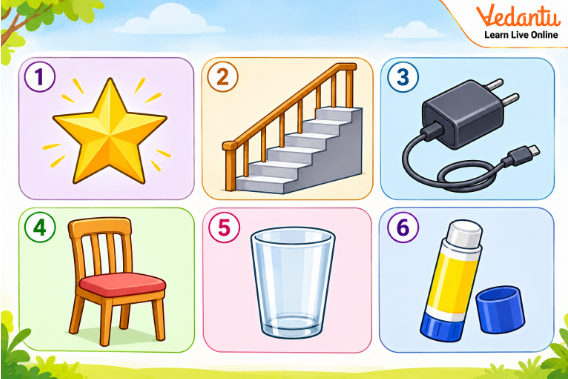
Q16. Look at the pictures and write the correct words beginning with st, ch or gl.
Picture clues:
A bright object seen in the night sky
A set of steps used to go up or down
Something used to charge a mobile phone
A seat with a backrest
A drinking container
A sticky substance used to join paper
Answer:
Class 4 English Chapter 9 Long Answer and Application-Based Questions
Q17. Explain how Hekko is played and when the game ends.
Answer:
Hekko is a traditional team game played in Nagaland.
How to Play:
A circle is drawn on the ground.
The Aami team forms a human chain inside the circle.
The Aakho team stays outside the circle.
At first, two Aakho players enter and try to push Aami players outside.
The Aami players try to catch the Aakho players by surrounding them.
A caught Aakho player must say "Joko" to surrender.
When does the game end?
The game ends when:
All Aakho players are caught.
All Aami players are pushed outside the circle.
The playing time runs out.
A team earns points when it gets an opponent out. The team with the most points wins.
Q18. Identify the traditional and popular children's games from the following descriptions.
(a) Players knock down seven stacked stones with a ball and try to rebuild them.
(b) A player enters the opponent's area while continuously chanting the game's name and tries to tag players.
(c) Players use two wooden sticks, one short and one long.
(d) Children walk beneath an arch formed by two players while singing.
(e) Players flick small glass balls to hit other glass balls.
Answer:
These games involve different skills, including balance, teamwork, movement and concentration.
Q19. What qualities can children develop by playing traditional games such as Hekko?
Answer:
Traditional games can help children develop different physical and social skills.
1. Teamwork
Players work together to follow a common plan.
2. Strength
Running, pushing and other movements require physical strength.
3. Quick Thinking
Players must decide how to move or avoid opponents.
4. Cooperation
Members of the same team help one another during the game.
5. Respect for Rules
Players learn to follow the rules and accept the result fairly.
Conclusion: Hekko encourages children to stay active and learn how to cooperate with others.
Q20. Imagine you are creating a new outdoor game for your classmates. Give it a name, rules and fouls.
Answer:
Game Name: Circle Runners
Time: 10 minutes
Number of Players: 10 players, divided into two teams
Materials Needed: Chalk and a soft ball
Rules:
Draw a large circle on the playground.
Divide the players into two teams.
One team stands inside the circle.
The other team passes a soft ball between its players outside the circle.
The players inside the circle try to avoid being gently tagged with the ball.
After five minutes, the teams exchange roles.
The team scoring more points wins.
Fouls:
Pushing or hurting another player is not allowed.
Players must not throw the ball towards anyone's face.
Players must remain within their assigned areas.
Scoring: The outside team earns one point for each successful gentle tag below the shoulders. After both teams have played outside the circle for five minutes each, the team with more points wins.
Learning: Creating a game helps children understand the importance of rules, teamwork and fair play.
Q21. Why is the Hornbill Festival important to Nagaland? Write a short note.
Answer:
The Hornbill Festival is an important cultural festival of Nagaland.
It brings different Naga communities together to celebrate and share their traditions.
The festival includes traditional dances, music, food, handicrafts and cultural performances.
It helps people learn about the customs and heritage of Nagaland.
The festival also attracts visitors and supports local tourism.
Conclusion: The Hornbill Festival celebrates the rich culture of Nagaland and encourages people to respect different traditions.
Important Words and Grammar for Class 4 English Chapter 9
Use this table to revise the key vocabulary and language topics from Hekko.
How to Prepare Class 4 English Chapter 9 Important Questions
Learn the roles and rules of the Aami and Aakho teams.
Practise homophones and simple past-tense verbs.
Match animals with their sounds.
Identify traditional games from pictures and descriptions.
Exam Tip: Read each question carefully. Check spelling and word meaning before choosing an answer.
Download Class 4 English Chapter 9 Important Questions PDF
Download the Class 4 English Chapter 9 Important Questions PDF from Vedantu. It includes 21 solved questions covering Hekko, game rules, vocabulary, homophones, animal sounds and past-tense exercises. Students can use the PDF for offline practice and exam preparation.
CBSE Class 4 English Chapter 9 Study Materials
Explore these study materials to strengthen your understanding of Hekko.
CBSE Class 4 English Chapter-wise Important Questions
Practise important questions from other chapters of the Santoor English textbook.
Important Study Materials for CBSE Class 4 English
FAQs on Important Questions and Answers for Class 4 English (Santoor) Chapter 9 – Hekko | 2026–27
1. What is the story Hekko about?
Hekko explains a traditional game from Nagaland that is connected to a folk story about humans challenging a tiger. It describes the two teams, their roles, the game rules and how players win points.
2. What does Hekko mean in Class 4 English Chapter 9?
Hekko means "Challenging the tiger." The word comes from "Hek," meaning to challenge, and "ko," meaning tiger.
3. Where is Hekko played in Nagaland?
Hekko is a traditional game played by people in the Mokokchung district of Nagaland. The chapter describes it as a popular team game.
4. What is the difference between the Aami and Aakho teams?
The Aami team stays inside the marked circle and forms a human chain. The Aakho team starts outside the circle and sends players inside to push Aami players out. The Aami team also tries to catch Aakho players.
5. How many players are there in each Hekko team?
Each team has 11 players. A toss decides which team will be called Aami and which will be called Aakho.
6. What does Joko mean in the game of Hekko?
Joko means surrender. A caught Aakho player must say "Joko" before being released.
7. What are Khozuba and Khotiba in Class 4 English Chapter 9?
Khozuba is the title awarded to the fastest player of the Aami team. Khotiba is the title awarded to the strongest player of the Aakho team.
8. What grammar topics are important in Class 4 English Chapter 9?
The main grammar topics include homophones, word beginnings, animal sounds and simple past tense. Students should practise choosing words such as their/there and writing the past forms of verbs.
9. Which homophones should students learn from Hekko?
Important homophone pairs include their–there, two–too, through–threw and right–write. The chapter also includes the similar-sounding words caught and cot.
10. What types of MCQs are important for Class 4 English Chapter 9?
Students should practise MCQs about Hekko's meaning, team names, number of players, game rules, surrender and player titles. Grammar-based MCQs on homophones and past tense are also useful.
11. What traditional games are mentioned in the Hekko chapter?
The chapter's activities include Lagori or Satoliya, Kabaddi, Gilli Danda, London Bridge and Marbles. Students identify these games using their rules and descriptions.
12. How can students prepare Class 4 English Chapter 9 important questions and answers for exams?
Read the chapter carefully and understand how Hekko is played. Then practise MCQs, short answers, homophones, animal sounds and past-tense exercises. Finally, try the picture-based questions without looking at the answers.
13. Where can students download Class 4 English Chapter 9 Important Questions PDF?
Students can download the Class 4 English Chapter 9 Important Questions PDF with answers from Vedantu. It includes solved MCQs, short-answer questions, grammar exercises and picture-based activities for offline practice.
14. Which textbook contains Class 4 English Chapter 9 Hekko?
Hekko is Chapter 9 of the Santoor Grade 4 English textbook. It introduces a traditional game from Nagaland and includes reading, vocabulary, grammar, speaking and writing activities.
