



Important Questions for Class 4 English Chapter 10 – The Swing
Practise these solved questions on the child's experience, the sights described in the poem and the grammar and creative writing activities.
Class 4 English Chapter 10 Important Questions MCQ with Answers
Q1. Who wrote the poem The Swing?
(a) William Wordsworth
(b) Robert Louis Stevenson
(c) William Shakespeare
(d) John Keats
Answer: (b) Robert Louis Stevenson
Explanation: Robert Louis Stevenson wrote The Swing, a poem describing the joy of riding on a swing and looking at the world from above.
Q2. Which of the following does the child see while swinging over the wall?
(a) Trains, buses and shops
(b) Rivers, trees and cattle
(c) Mountains covered with snow
(d) Schools and playgrounds
Answer: (b) Rivers, trees and cattle
Explanation: The child can see rivers, trees, cattle and the wide countryside when the swing rises high above the wall.
Q3. Which word in the poem means "most enjoyable"?
(a) Countryside
(b) Cattle
(c) Pleasantest
(d) Garden
Answer: (c) Pleasantest
Explanation: Pleasantest means the most pleasant. The child considers swinging one of the most enjoyable activities.
Q4. Which pair of words rhymes in the poem?
(a) Trees – Wall
(b) Swing – Thing
(c) Garden – Roof
(d) Cattle – Blue
Answer: (b) Swing – Thing
Explanation: Swing and thing have the same ending sound, making them rhyming words.
Q5. In which sentence is the word "play" used as a noun?
(a) I play with my friends.
(b) We play outside every evening.
(c) We watched a play at school.
(d) Children play in the park.
Answer: (c) We watched a play at school.
Explanation: In this sentence, "play" refers to a dramatic performance. It names something, so it is a noun.
Class 4 English Chapter 10 Very Short Answer Questions
Q6. What does the child see below while riding the swing?
Answer: The child sees a green garden and a brown roof below while riding the swing.
Q7. Why does the child call swinging the pleasantest thing?
Answer: The child calls swinging the pleasantest thing because it feels exciting and enjoyable to rise high into the air and see the beautiful surroundings.
Q8. What does the word "countryside" mean?
Answer: Countryside means the land outside towns and cities, where we often see farms, fields, trees and villages.
Q9. What are cattle?
Answer: Cattle are farm animals such as cows and bulls.
Class 4 English Chapter 10 Short Answer Questions
Q10. How does the child feel while riding the swing? Give two details from the poem to support your answer.
Answer:
The child feels happy and excited while riding the swing.
Two details show this feeling:
The child describes swinging as the most enjoyable thing a child can do.
The child enjoys rising high, looking over the wall and seeing the countryside.
The poem shows how a simple activity can bring happiness and excitement.
Q11. What is the meaning of "Up in the air so blue" in the poem?
Answer:
The phrase describes the child rising high on the swing and looking towards the blue sky.
The child feels as though they are flying in the open air.
The blue sky adds to the cheerful and peaceful picture described in the poem.
Q12. Find the rhyming words from The Swing and add two more words of your own.
Answer:
Explanation: Rhyming words have the same or similar ending sounds.
Q13. Identify whether the highlighted word is a noun or a verb in each sentence.
(a) I like to dance with my friends.
(b) The dance begins at five o'clock.
(c) Can you answer this question?
(d) The answer is correct.
(e) A fly is sitting on the wall.
(f) We fly kites in the park.
Answer:
Remember: A noun names a person, place, animal or thing. A verb usually shows an action or state. Some words can be used as both nouns and verbs.
Q14. Make each sentence longer by adding more information. Follow the example of "Stringing Together" from the textbook.
Start with:
The girl played.
Answer:
The girl played.
The girl played in the park.
The girl played in the park with her friends.
The girl played in the park with her friends after school.
The girl played in the park with her friends after school on a sunny day.
Explanation: Adding details about where, when and with whom an action happens makes a sentence more informative.
Q15. Read the following sentences and identify the different meanings of the word "swing".
(a) I swing on a swing.
(b) The children swing happily in the park.
(c) The wooden swing is near the tree.
Answer:
(a) I swing on a swing.
The first "swing" is a verb because it describes an action.
The second "swing" is a noun because it names the object.
(b) The children swing happily in the park.
Swing is a verb because it tells us what the children are doing.
(c) The wooden swing is near the tree.
Swing is a noun because it names an object.
Remember: The same word can act as a noun or a verb depending on how it is used in a sentence.
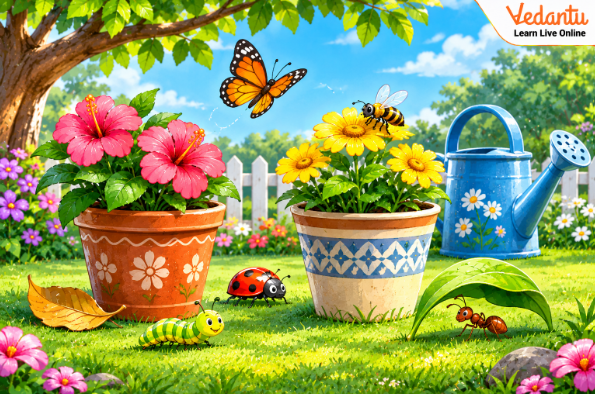
Q16. Picture-Based Question: Fill in the blanks with suitable prepositions.
Words: On, Beside, Between, Above, In front of, Behind, Under
Look at the garden picture showing two flower pots, insects, a watering can and leaves.
(a) A ladybug is ______ the two flower pots.
(b) A butterfly is flying ______ the flowers.
(c) A honeybee is sitting ______ a flower.
(d) The watering can is ______ the flower pots.
(e) An ant is walking ______ a leaf.
(f) A caterpillar is crawling ______ a flower pot.
(g) A fallen leaf is lying ______ a flower pot.
Answer:
(a) Between
(b) Above
(c) On
(d) Behind
(e) Under
(f) In front of
(g) Beside
Explanation: Prepositions tell us the position or location of people, animals and objects.
Class 4 English Chapter 10 Long Answer and Application-Based Questions
Q17. Explain the main idea of the poem The Swing. How does the poet describe the child's experience?
Answer:
The Swing describes the happiness and excitement a child feels while riding a swing.
1. Enjoying the Swing
The child loves moving up and down and considers swinging a wonderful activity.
2. Looking at the Sky
As the swing rises, the child looks towards the beautiful blue sky.
3. Seeing the Countryside
From above the wall, the child can see rivers, trees, cattle and the countryside.
4. Looking Down
The child also notices a green garden and a brown roof below.
5. Feeling Free
The movement of the swing makes the child feel as though they are flying.
Conclusion: The poem shows that simple outdoor activities can bring joy and help children appreciate the beauty of nature.
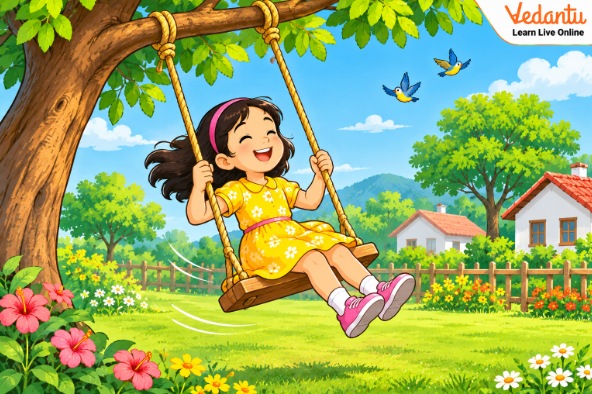
Q18. Picture-Based Question: Observe the Swing and Answer the Questions.
A picture shows a child riding a swing beside a tree. The child can see a garden, houses, birds and trees while moving up and down.
Answer the following questions:
(a) What is the child doing?
(b) Name two things the child can see from the swing.
(c) What does the child's expression tell you?
(d) Which outdoor activity is described in the poem?
(e) Write one sentence about how you would feel while riding a swing.
Answer:
(a) The child is riding a swing.
(b) The child can see a garden and trees.
(c) The child looks happy and excited.
(d) The poem describes swinging.
(e) I would feel happy and excited while swinging in the park.
Q19. Imagine you have a magical swing that can take you anywhere. Write a short paragraph about your adventure.
Answer:
My Magical Swing
One day, I sat on a magical swing in my garden. As I moved higher, the swing took me above the clouds. I could see bright stars, colourful planets and the Earth far below. I waved at the birds flying nearby. After my wonderful adventure, the swing slowly brought me back to my garden. I felt very happy and wished to go on another adventure.
Important Words and Grammar for Class 4 English Chapter 10
Use this quick-reference table to revise the poem and language exercises.
How to Prepare Class 4 English Chapter 10 Important Questions
Read the poem aloud and understand what the child sees.
Practise rhyming words and identify nouns and verbs.
Use pictures to learn prepositions.
Write short sentences about your favourite activities.
Exam Tip: Read each question carefully and write clear answers using correct spelling and punctuation.
Download Class 4 English Chapter 10 Important Questions PDF
Download the Class 4 English Chapter 10 Important Questions PDF with answers from Vedantu. It includes 19 solved questions covering The Swing, rhyming words, nouns, verbs, prepositions and picture-based exercises. Students can use the PDF for offline practice and exam preparation.
CBSE Class 4 English Chapter 10 Study Materials
Explore these materials to improve your understanding of The Swing.
CBSE Class 4 English Chapter-wise Important Questions
Practise important questions from the other chapters of the Santoor textbook.
Important Study Materials for CBSE Class 4 English
FAQs on Important Questions and Answers for Class 4 English (Santoor) Chapter 10 – The Swing | 2026–27
1. What is the poem The Swing about in Class 4 English Chapter 10?
The poem describes a child's happiness while riding a swing. The child rises high into the air and enjoys looking at rivers, trees, cattle, a garden and the countryside. It shows how a simple outdoor activity can bring joy.
2. Who wrote the poem The Swing in the Santoor textbook?
Robert Louis Stevenson wrote the poem The Swing. The poem describes the excitement of swinging and the beautiful view seen from above.
3. What does the child see when the swing goes over the wall?
The child sees rivers, trees, cattle and the wide countryside. The higher position of the swing allows the child to enjoy a broader view of the surroundings.
4. Why does the poet call swinging the pleasantest thing?
The poet calls swinging the pleasantest thing because it is enjoyable and exciting. The child loves the feeling of rising high and coming down again while looking at the beautiful surroundings.
5. What are the important rhyming words in The Swing?
Important rhyming pairs include swing–thing, blue–do, wall–all, wide–countryside, green–seen and brown–down. Students should practise recognising these words by listening to their ending sounds.
6. What is the difference between a noun and a verb in Class 4 English Chapter 10?
A noun names a person, place, animal or thing, while a verb describes an action or state. Some words can be used in both ways. For example, in "I swing on a swing," the first swing is a verb and the second is a noun.
7. What is the sentence expansion activity in The Swing?
The sentence expansion activity asks students to make a sentence longer by adding useful details. For example, "The girl played" can become "The girl played in the park with her friends after school."
8. Which prepositions should students practise from Class 4 English Chapter 10?
Students should practise on, beside, between, above, in front of, behind and under. The chapter includes a picture activity with flower pots, insects, and a watering can to help students understand these words.
9. What is the tongue twister activity in The Swing?
The chapter includes a tongue twister about a woodchuck to help students practise the W sound. Students also learn to distinguish the pronunciation of W and V in words such as wet and vet.
10. What is the meaning of pleasantest, cattle and countryside?
Pleasantest means most enjoyable, cattle refers to farm animals such as cows and bulls, and countryside means the land outside towns and cities, often containing farms, fields and villages.
11. What is the Swings of Imagination activity in Chapter 10?
In this activity, students imagine a magical swing that can take them to an exciting place, such as outer space, a jungle or a world inside a book. They draw the scene and write a short paragraph about their adventure.
12. How can I prepare Class 4 English Chapter 10 important questions and answers for exams?
Read the poem carefully and practise its meaning, rhyming words and vocabulary. Then revise nouns, verbs, sentence expansion and prepositions. Picture-based exercises and short writing activities can help improve understanding.
13. Where can students download Class 4 English Chapter 10 Important Questions PDF?
Students can download the Class 4 English Chapter 10 Important Questions PDF with answers from Vedantu. The PDF includes solved MCQs, poem-based questions, grammar exercises and picture-based activities for offline practice.
14. Which textbook contains Class 4 English Chapter 10 The Swing?
The Swing is Chapter 10 of the Santoor Grade 4 English textbook. It belongs to Unit 4, Up High, and includes poem comprehension, grammar, pronunciation and creative writing activities.
