



How to Write Stepwise Answers for Class 4 English Chapter 9 Hekko?
Class 4 English Chapter 9 Hekko Question Answer
Let us Think (Page 93)
A. Answer the following.
Question 1. What does the word ‘Hekko’ mean?
Answer: The term “Hekko” means to challenge the tiger. It comes from “Hek,” which means challenge, and “Ko,” which means tiger.
Question 2. What are the two teams in the game called?
Answer: The game has two teams known as Aami (the Man) and Aakho (the Tiger).
Question 3. How many players are there in each team?
Answer: Each team has eleven players.
Question 4. What do the players in the Aami team do inside the circle?
Answer: The Aami players join hands to form a human chain inside the circle and try to remain within it while protecting themselves from being pushed out by the Aakho team. They also attempt to catch the Aakho players when they step into the circle.
Question 5. Why do you think the Aakho team (Tiger) must say “Joko” when they are caught?
Answer: When an Aakho player is caught, they must say “Joko,” which means surrender, to accept defeat and be set free so that the next teammate can take their turn. This shows that they have been overpowered, similar to giving up in a real contest or battle.
B. Think and Discuss.
Question 1. If you were playing the game Hekko, would you prefer to be in the Aami or Aakho team? Why?
Answer: If I were playing Hekko, I would choose to be on the Aami team. This team forms a human chain to guard the circle, which needs strong teamwork, good coordination, and fast reactions. I like working with others and defending a space together. It would be thrilling to plan with my teammates and try to stop the Aakho players from pushing us out or getting away when caught.
Question 2. If you could add a new rule to the game, what would it be? What would be the benefit of the new rule?
Answer: If I were allowed to introduce a new rule, I would let the Aami team pull in an Aakho player standing near the edge of the circle once during the game, even if the player has not stepped inside. This would make the game more thrilling and force the Aakho team to plan their moves more wisely. Such a rule would create better balance and make the game more exciting by allowing both teams to use smart strategies.
Let us Learn (Pages 94-97)
A. Choose the correct option to complete the sentence.
1. ______ their/there (their/there) is a beautiful park in my neighbourhood.
They completed ________ (there/their) work very fast.
Answer:
There is a beautiful park in my neighbourhood.
They completed their work very fast.
2. two/too ________ of my friends participated in the poster-making competition.
I was ________ tired after playing.
Answer:
Two of my friends participated in the poster-making competition.
I was too tired after playing.
3. through/threw
The bowler ________ the ball towards the batsman.
I can see the clouds ________ my window pane.
Answer:
The bowler threw the ball towards the batsman.
I can see the clouds through my window pane.
4. caught/cot
My mother ________ me eating an icecream at night.
I sleep on a ________ when I am at my grandmother’s village.
Answer:
My mother caught me eating an ice cream at night.
I sleep on a cot when I am at my grandmother’s village.
5. right/write
While crossing the road, look to your ________ then left, then right again and then cross the road.
________ in a neat and legible handwriting.
Answer:
While crossing the road, look to your right, then left, then right again and then cross the road.
Write in a neat and legible handwriting.
B. Look at the pictures and write their names. One has been done for you.
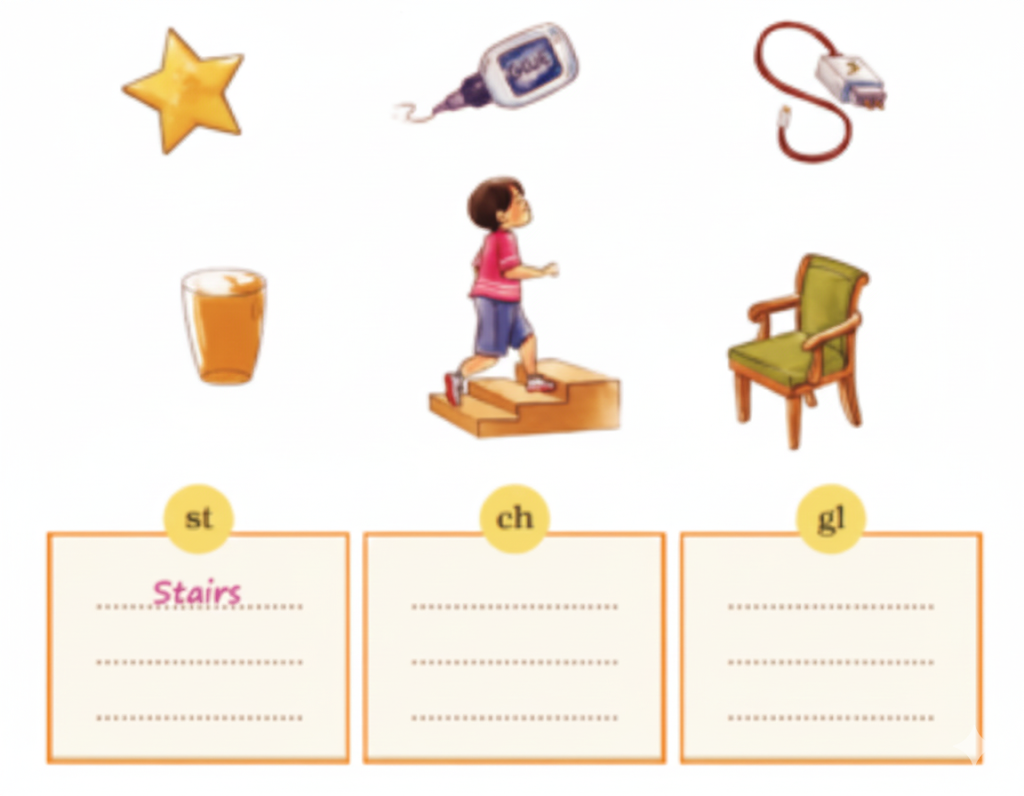
Answer:
C. Match the animals with their sound.
Answer:
D. Read the following sentences. Notice the underlined words.
Once upon a time, humans and animals lived together. Aakho declared that the tigers had the first right on all the things. The humans challenged Aakho.
The underlined words tell us that the events happened some time ago or in the past.
In past simple tense, you can add -ed to verbs to get this form.
There are many verbs to which we don’t add -ed. For example; came, drank, drove, saw, etc. Such verbs are called irregular verbs.
E. Fill in the blanks using -ed.
Last week, we ________ (visit) the park for a while. There were many children in the park. They were playing different games. My mother ________ (point) at the children playing kabbadi. On our way home, my sister ________ (jump) in a puddle and muddied everyone’s clothes. I ________ (enjoy) my visit to the park.
My sister ________ (want) to go to the pond but I ________ (decide) to stay and watch the game of kabbadi. I ________ (watch) the game for a while and then ________ (join) my mother and sister. There were many fishes in the pond. I ________ (spot) a goldfish and my sister ________ (notice) two tadpoles in the pond.
Answer:
Last week, we visited the park for a while. There were many children in the park. They were playing different games. My mother pointed at the children playing kabbadi. On our way home, my sister jumped in a puddle and muddied everyone’s clothes. I enjoyed my visit to the park.
My sister wanted to go to the pond but I decided to stay and watch the game of kabbadi. I watched the game for a while and then joined my mother and sister. There were many fishes in the pond. I spotted a goldfish and my sister noticed two tadpoles in the pond.
Let us Listen (Page 98)
Listen to the description of some traditional games of India. Identify each game and write its name in the space given below.
Question 1. In this game, we stack seven stones on top of each other. The first team throws a ball to knock them down. After the stones are knocked down, the members of the first team hurriedly rearrange, the stack while the opponent team catches the ball to quickly hit the members of the first team before the stones are restacked. If you are hit by the ball, you are out. Can you guess the name of the game?
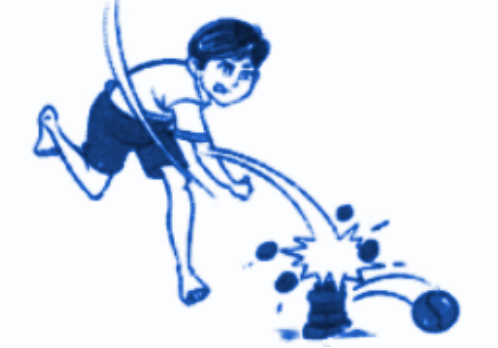
Answer: Satoliya/Pittu/Lagori or Seven Stones
Question 2. In this game, there are two teams. One player from the first team crosses into the second team’s side while chanting the name of the game continuously without taking a breath! The goal is to tag as many players as possible and return to their side before being caught. If the player is caught, the other team scores. Can you guess the name of this game?
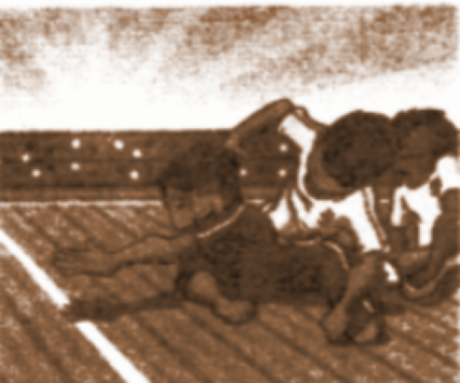
Answer: Kabaddi
Question 3. This game is played with two wooden sticks-a short one and a longer one. The goal is to hit the shorter stick and make it jump in the air, then strike it again to send it flying. Players measure how far the shorter stick travels to score points.
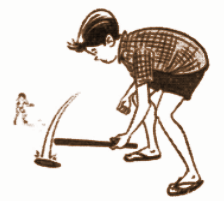
Answer: Gilli Danda
Question 4. In this game, two children form an arch with their arms while others walk under it, singing a song. When the song ends, the arch drops, and the player caught joins in. It’s a fun and rhythmic game played in many parts of India.
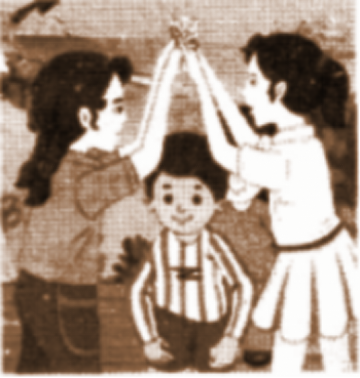
Answer: London Bridge
Question 5.
In this game, children use a small round shaped glass object, aiming to knock out other glass round objects placed in a circle. Players flick the glass object with their fingers, trying to hit the target objects and win them. This is a popular outdoor game played in many parts of India.
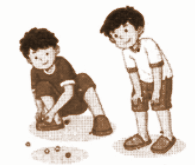
Answer: Marbles or Kancha/Goti
Let us Speak (Page 100)
A. Look at the pictures and identify the games being played.
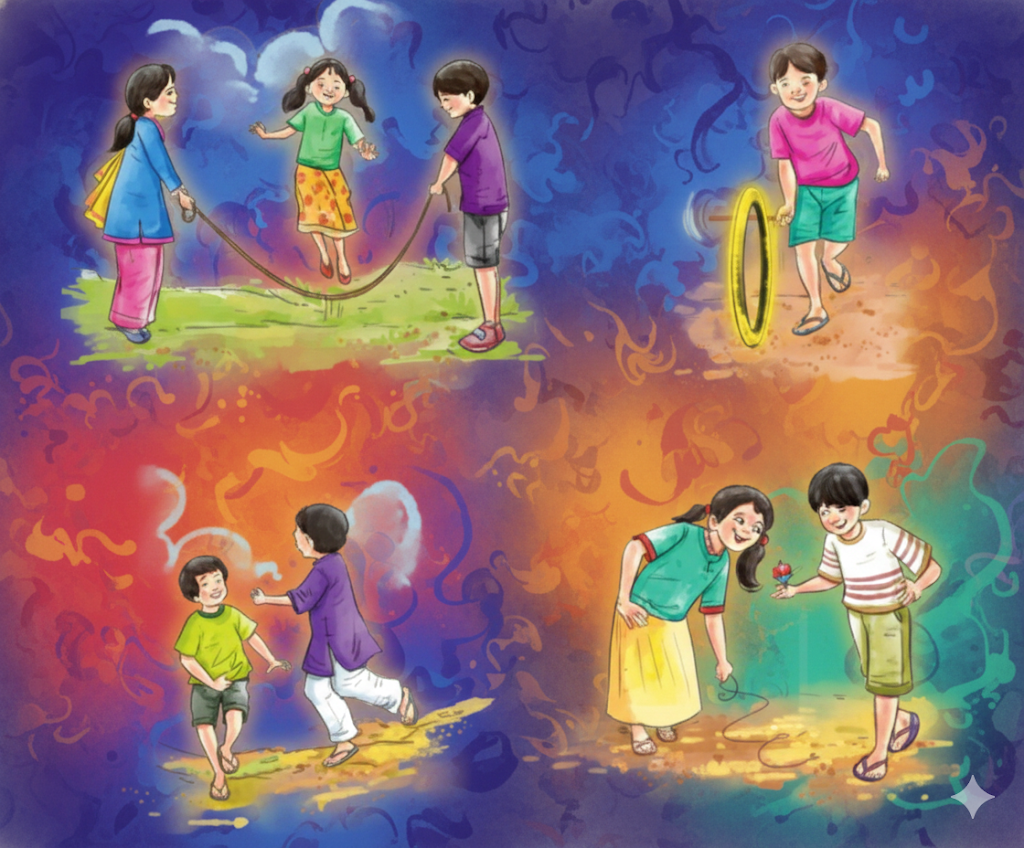
Have you played any of these games before?
Answer: Yes, I have skipped rope with my friends in the playground during recess.
Discuss with your partner about the games you recognise.
Answer: I know rope skipping as a game where two players hold the ends of a rope while another player jumps over the moving rope as many times as possible until the rope is touched. This game is very good for health as it strengthens the heart and improves breathing.
Which one is your favourite? Why do you enjoy playing it?
Answer: My favourite game is Seven Stones (Lagori) because it is energetic, enjoyable, and requires teamwork. I love the thrill of rebuilding the stone pile while avoiding the ball. It combines skill, speed, and smart thinking.
Let us Write (Page 101)
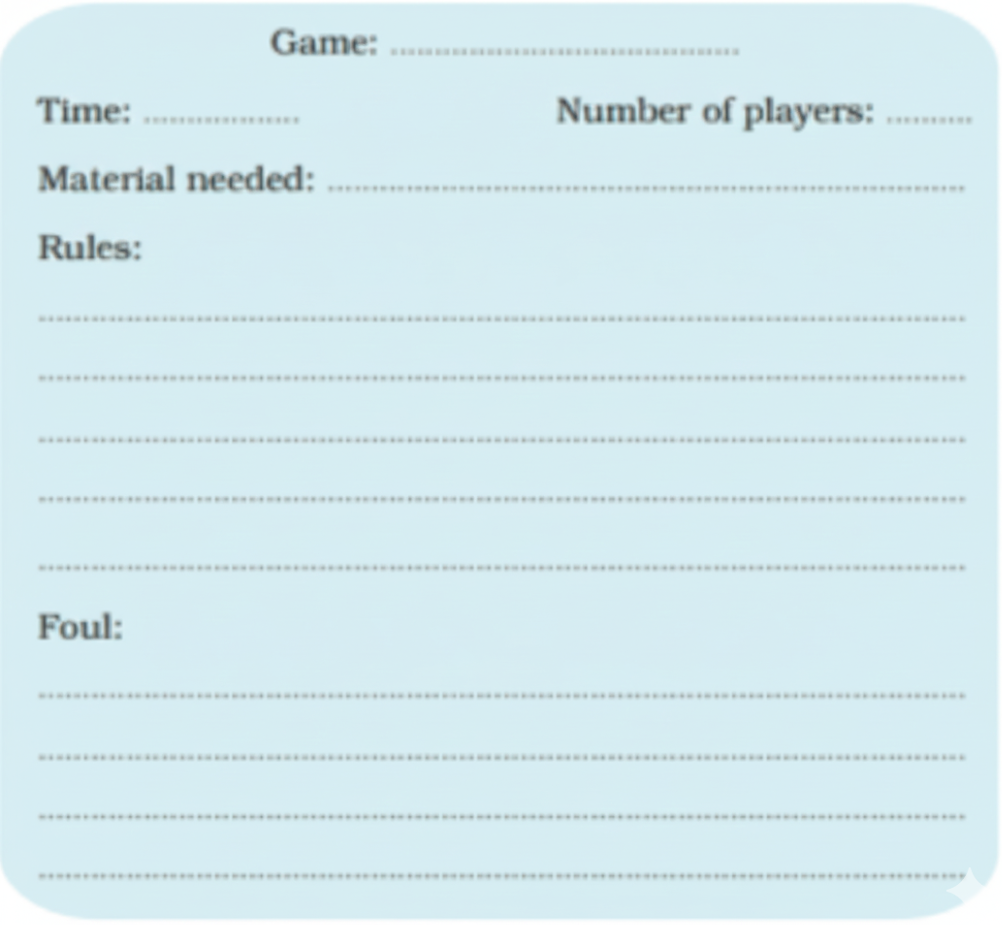
A. You read how the people of Nagaland made the game of Hekko. Use the space given below to write about a new game that you would like to play.
Answer:
Game: Shadow Chase
Time: 15 minutes for each round
Number of players: 8–10
Materials needed: Chalk or rope to draw a large circle, and coloured cloth bands to identify teams
Rules:
Players are divided into two teams: Chasers and Runners.
A big circle is marked on the ground, and the Runners stay inside it.
The Chasers remain outside the circle and try to touch the shadows of the Runners without entering the circle.
A Runner is declared “out” when his or her shadow is touched.
After 7 minutes, the teams exchange roles.
The team that tags the highest number of shadows is the winner.
Fouls:
If a Chaser steps inside the circle, one point is subtracted from their team’s score.
If a Runner steps outside the circle, they are immediately out.
Let us Explore (Page 101)
Nagaland is a land of festivals. Hornbill is one of the festivals to promote the culture of the state. Find out more about it.
Answer:
The Hornbill Festival is one of the largest and most popular festivals of Nagaland. It is usually celebrated from 1st to 10th December at Kisama Heritage Village near Kohima. The festival is named after the hornbill bird, which holds a special place in Naga culture.
This colourful festival displays the rich traditions of the Naga tribes through their music, dances, food, crafts, and traditional clothing. Visitors can enjoy folk performances, local games, fashion shows, food stalls, rock music concerts, and storytelling. It is also known as the “Festival of Nagaland” because many tribes take part in it. The festival helps promote Naga culture and attracts tourists from around the world.
Understanding Hekko: A Unique Game from Nagaland
The chapter Hekko in NCERT Solutions Class 4 English Santoor introduces students to a traditional game that boosts teamwork and strategy. Learning about Aami and Aakho helps students appreciate the cultural richness of Nagaland.
Focusing on key details, like the meaning of Hekko and the roles of each team, will help you master exam questions easily. Practicing these questions from the NCERT Class 4 English Chapter 9 Hekko can boost student confidence and understanding.
Reviewing the exercise-based solutions regularly ensures you remember important facts and grammar. This strengthens your preparation and helps you score better marks in Class 4 English exams.
FAQs on NCERT Solutions For Class 4 English Santoor Chapter 9 Hekko - 2026-27 Free PDF Download (Login Required)
1. What are NCERT Solutions for Class 4 English Santoor Chapter 9 Hekko?
NCERT Solutions for Class 4 English Santoor Chapter 9 Hekko provide step-by-step answers to all textbook questions, helping students master every concept.
- Covers intext and back exercise questions in detail
- Aligns with CBSE 2026–27 syllabus and marking schemes
- Offers structured, exam-ready answers using important keywords
- Includes definitions, diagrams (if required), and writing tips
- Great resource for revision and full marks preparation
2. How can I write stepwise NCERT answers to score full marks in Class 4 English Chapter 9?
To score full marks for NCERT questions in Class 4 English Chapter 9, use a stepwise format:
- Start with a clear introduction using keywords from the question
- Answer each part in separate, numbered steps
- Use short sentences for clarity
- Include relevant definitions and examples
- Underline or highlight important concepts
- Maintain neat, legible handwriting and logical sequence
3. Which questions from Santoor Chapter 9 Hekko are likely to appear in school exams?
Likely exam questions for Class 4 English Santoor Chapter 9 focus on key themes and core concepts:
- Short answer questions about the main idea or message of the chapter
- Definitions or explanations of keywords from the lesson
- Long answer or character-based questions
- Intext exercises and back exercise Q&A
- Diagram labeling or sequence order if present in the lesson
4. Are diagrams or clear definitions mandatory in NCERT solutions for this chapter?
Including diagrams and clear definitions is not always mandatory for Class 4 English Chapter 9, but is highly recommended:
- Add neatly labeled diagrams if the question asks for them
- Write precise definitions for keywords to earn step marks
- Diagrams and definitions help in better understanding and scoring
- Follow NCERT/CBSE answer-writing conventions
5. Where can I download the complete NCERT Solutions PDF for Class 4 English Santoor Chapter 9?
You can download the free PDF of NCERT Solutions for Class 4 English Santoor Chapter 9 from reliable educational websites.
- Look for platforms offering free PDF downloads for CBSE/NCERT
- Ensure the solution covers the latest 2026–27 syllabus
- Check for chapterwise and exercise-wise answers
- Use the PDF for offline study and quick revision
6. What is the best way to revise Santoor Chapter 9 Hekko before exams?
The best way to revise Santoor Chapter 9 Hekko for Class 4 English exams is by using a structured approach:
- Go through stepwise NCERT answers for every exercise
- Use a 1-day, 3-day, or 7-day revision planner for effective coverage
- Practice important questions and definitions
- Attempt MCQs, sample papers, and review quick notes
- Ensure all diagrams and key terms are covered
7. How do I structure long answers in Class 4 English to get better marks?
To score well in long answer questions for Class 4 English Chapter 9:
- Begin with a concise introduction restating the question
- Present your answer in logical paragraphs
- Use bullet points or numbered steps if applicable
- Include examples and important keywords
- Conclude by linking back to the question’s main idea
8. Are NCERT Solutions enough for Class 4 English exams?
NCERT Solutions for Class 4 English are generally sufficient for school and CBSE exams:
- They strictly follow the CBSE 2026–27 syllabus
- Cover all intext questions and back exercises
- Provide step-by-step explanations for better understanding
- To score even better, also practice MCQs, Exemplar Questions, and sample papers
9. Do examiners award partial marks for correct steps even if the final answer is wrong?
Yes, CBSE examiners can award partial marks for correct steps even if the final answer is incorrect, provided:
- The student shows the right method or process
- Relevant steps are correctly attempted
- Key definitions or concepts are present
- It is important to write in stepwise fashion to maximize partial marking opportunities
10. How do I prepare for diagrams or map labelling in Class 4 English Chapter 9?
To prepare for diagrams or map labeling in Class 4 English Santoor Chapter 9:
- Study all diagrams and pictures given in the textbook
- Practice drawing and labeling neatly with a pencil
- Memorize common labels, spellings, and conventions
- Refer to NCERT Solutions for correctly labeled examples
- Marks are often awarded for presentation and accuracy
11. What are the most important topics from Santoor Chapter 9 for the exam?
The most important topics in Santoor Chapter 9 Hekko for Class 4 English include:
- Main story theme and moral
- Character traits and lesson takeaways
- Key definitions used in the chapter
- Important exercises (both intext and back)
- Any diagrams or sequence-based exercises
12. Why should I use stepwise NCERT solutions for Santoor Chapter 9?
Stepwise NCERT solutions for Santoor Chapter 9 help students to:
- Follow CBSE marking scheme for maximum step marks
- Improve clarity and organization in answers
- Learn the correct use of definitions and diagrams
- Boost exam confidence and minimize mistakes
- Score full marks with clear, practice-focused answers
