



Learn and Practise Class 4 English Chapter 6 Important Questions on Braille
Explore Class 4 English Chapter 6 important questions with answers to understand Louis Braille's journey and practise the language activities from the textbook. Solve the MCQs and written questions below, check your answers and download the PDF for additional practice before school assessments.
Class 4 English Chapter 6 Important Questions MCQ (Multiple Choice Questions)
1. In which country was Louis Braille born?
(a) India
(b) France
(c) England
(d) Germany
Answer: (b) France
2. How old was Louis Braille when he met with the accident that affected his eyesight?
(a) Three years
(b) Five years
(c) Seven years
(d) Ten years
Answer: (a) Three years
3. Who invented the 'Night Writing' system?
(a) Louis Braille
(b) Louis's father
(c) Captain Charles Barbier de la Serre
(d) A teacher at the Royal Institute
Answer: (c) Captain Charles Barbier de la Serre
4. How do people read the Braille alphabet?
(a) By listening to sounds
(b) By touching raised dots with their fingers
(c) By looking at colourful pictures
(d) By reading large printed letters
Answer: (b) By touching raised dots with their fingers
5. Choose the correct past continuous form of the sentence: "The dogs are barking at the stranger."
(a) The dogs was barking at the stranger.
(b) The dogs were bark at the stranger.
(c) The dogs were barking at the stranger.
(d) The dogs are barked at the stranger.
Answer: (c) The dogs were barking at the stranger.
Class 4 English Chapter 6 Braille Important Questions – Very Short Answer
6. What was the profession of Louis Braille's father?
Answer:
Louis Braille's father was a blacksmith.
7. Which institute did Louis Braille join in 1819?
Answer:
Louis Braille joined the Royal Institute for Young Blind Persons in Paris.
8. How many letters of the English alphabet have Braille symbols?
Answer:
The Braille alphabet has symbols for all 26 letters of the English alphabet.
9. Why is a Braille book thicker than a regular printed book?
Answer:
A Braille book is thicker because its raised-dot letters need more space and cannot be placed too close together.
Class 4 English Chapter 6 Important Questions – Short Answer Questions
10. Why was the 'Night Writing' system not successful?
Answer:
Captain Charles Barbier de la Serre developed Night Writing using raised dots and dashes so soldiers could read messages with their fingers in the dark. However, the system was too difficult to use and did not become successful. Louis Braille later simplified the idea and developed the Braille alphabet.
11. Look at the picture and answer the following questions.
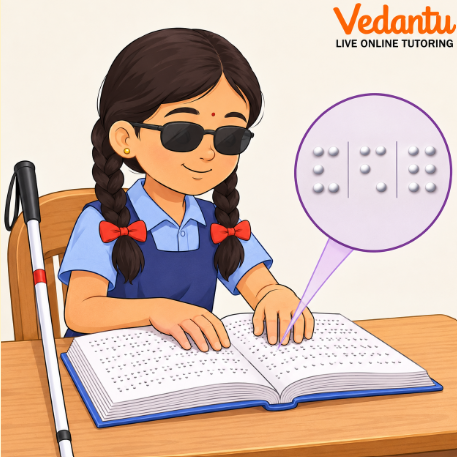
Questions:
(a) What method of reading is shown in the picture?
(b) Which part of the body does the student use to read the book?
(c) Who developed this reading system?
Answer:
(a) The picture shows the Braille method of reading.
(b) The student uses their fingers to feel the raised dots.
(c) Louis Braille developed the Braille alphabet.
12. Change the following sentences into the past continuous tense.
(a) Grandfather is searching for his spectacles.
(b) Sheeba is writing a letter.
(c) We are playing kho-kho.
(d) The man is using his hands to push his wheelchair.
Answer:
(a) Grandfather was searching for his spectacles.
(b) Sheeba was writing a letter.
(c) We were playing kho-kho.
(d) The man was using his hands to push his wheelchair.
13. Complete the sentences using 'was' or 'were' with the correct action word ending in '-ing'.
(a) The cats ______ (sleep) when I reached home.
(b) Sameer ______ (play) hopscotch last evening.
(c) The students ______ (write) in their notebooks.
(d) Louis Braille ______ (play) near his home.
Answer:
(a) The cats were sleeping when I reached home.
(b) Sameer was playing hopscotch last evening.
(c) The students were writing in their notebooks.
(d) Louis Braille was playing near his home.
Class 4 English Chapter 6 Braille Important Questions – Long Answer Questions
14. Describe how Louis Braille lost his eyesight and later developed the Braille alphabet.
Answer:
Louis Braille was a little boy who lived in France. When he was three years old, he was playing near his father, who was a blacksmith. While playing with the tools, a sharp tool pierced his eye.
The accident caused him to lose sight in one eye. After a few days, his other eye was also affected, and he became completely blind.
In 1819, when Louis was ten years old, he joined the Royal Institute for Young Blind Persons in Paris. There, he learnt letters using wood, cloth and pins arranged in pincushions.
Later, Louis learnt about Night Writing, a system of raised dots and dashes developed by Captain Charles Barbier de la Serre. He simplified this difficult system and developed the Braille alphabet, which made reading through touch easier for people with blindness.
15. What is the Braille alphabet? Explain how it helps people with blindness read and write.
Answer:
Braille is a reading and writing system that uses raised dots to represent letters and other characters. People can identify the dots by touching them with their fingertips.
The Braille alphabet has symbols for all 26 letters of the English alphabet. These symbols help people with blindness read words, sentences, stories and books.
Braille is useful because:
It allows people with blindness to read through touch.
It helps them learn letters and words.
It supports reading and writing without depending on printed letters.
People with sight can also learn Braille and write poems or stories using it.
Braille books are thicker than regular books because the raised-dot symbols require more space.
16. What precautions should children take to protect their eyes from accidents?
Answer:
Children should take care of their eyes because they are delicate and important for everyday activities. The accident involving Louis Braille teaches us that sharp objects can seriously injure our eyes.
We can protect our eyes by following these precautions:
Never play with sharp tools such as knives, needles or pointed objects.
Do not touch dangerous tools without an adult's permission.
Avoid handling or lighting firecrackers.
Keep sharp objects away from the face and eyes.
Wear suitable protective eyewear during activities where objects might injure the eyes.
Inform an adult immediately if an eye injury occurs and seek medical help.
Following these precautions can help prevent eye injuries.
17. How can you help a classmate who has low vision? Explain with examples.
Answer:
We should treat classmates with low vision with kindness and respect. We can help them participate in classroom activities and make learning more comfortable.
Some ways to help are:
Provide reading materials printed in large letters.
Read aloud when a classmate asks for help.
Keep books and classroom materials in places where they are easy to find.
Describe pictures and classroom activities clearly when needed.
Offer help while moving around the classroom, but ask before assisting.
Include classmates with low vision in games, discussions and group activities.
We should always respect their independence and ask what support they prefer. This helps everyone feel included and comfortable at school.
Explore Braille and Improve English Skills with Vedantu's Class 4 Chapter 6 Practice Questions
Learning about Louis Braille helps students understand how people with blindness can read through touch. Vedantu combines story-based questions with grammar and writing practice to help children understand the chapter and answer questions confidently.
With Vedantu's Class 4 English Chapter 6 important questions PDF download, students can:
Understand Louis Braille's life: Learn about his childhood accident, education and development of the Braille alphabet.
Explore reading through touch: Use picture-based questions to understand how raised dots form Braille symbols.
Practise English grammar: Change sentences into the past continuous tense using 'was' and 'were' correctly.
Improve pronunciation: Practise words with consonant clusters, such as splinter, splash, split and splendid.
Develop thoughtful answers: Learn how to explain eye safety precautions and ways to support classmates with low vision.
The Class 4 English Chapter 6 important questions PDF from Vedantu contains the same 17 solved questions provided on this page. Students can download it for offline practice and preparation for classroom assessments.
CBSE Class 4 English Chapter 6 Study Materials
Explore the following materials to understand Braille.
CBSE Class 4 English Chapter-wise Important Questions
Practise important questions from the other chapters of the Santoor English textbook.
Important Study Materials for CBSE Class 4 English
FAQs on Important Questions for Class 4 English (Santoor) Chapter 6 Braille | 2026-27
1. What are the important questions for Class 4 English Chapter 6 Braille?
Class 4 English Chapter 6 important questions cover Louis Braille's childhood accident, his education in Paris, Night Writing and the development of the Braille alphabet. Students should also practise questions on past continuous tense, eye safety and helping classmates with low vision.
2. What did Louis Braille do to make reading easier for people with blindness?
Louis Braille simplified the Night Writing system developed by Captain Charles Barbier de la Serre. He created an alphabet using raised dots that people could recognise through touch. This made reading and writing more accessible to people with blindness.
3. What are the important grammar exercises in Class 4 English Chapter 6?
The chapter includes past continuous tense using 'was' and 'were' with action words ending in '-ing'. Students practise changing sentences such as "Sheeba is writing a letter" into "Sheeba was writing a letter." The chapter also includes descriptive sentences and consonant clusters such as 'spl'.
4. Where can I find Class 4 English Chapter 6 important questions MCQ with answers?
Students can find Class 4 English Chapter 6 important questions MCQ with answers on Vedantu. These cover Louis Braille's birthplace, childhood accident, Night Writing, reading through touch and past continuous tense. Each question includes options and the correct answer.
5. How can I download the Class 4 English Chapter 6 Braille questions and answers PDF?
Students can use the PDF download option on Vedantu to get the 17 solved questions from Braille. The document includes MCQs, very short, short and long answer questions with answers based on the Santoor textbook, making it useful for preparation at home.
