



Stepwise Answers & Exam Tips: Class 4 English Santoor Braille Chapter
Class 4 English Chapter 6 Braille Question Answer
Let us Think (Page 58)
A. Answer the following.
Question 1. Describe the Braille alphabet.
Answer: The Braille alphabet is a reading and writing system that uses raised dots felt by touch. Each letter of the English alphabet is represented by a unique pattern of raised dots, allowing blind people to read and write independently.
Question 2. Why was ‘Night Writing’ not a success?
Answer: “Night Writing” was not successful because it was difficult to understand and use. Its complex system of raised dots and dashes made it hard to learn, so it was not widely accepted.
Question 3. What did Louis Braille do to make reading easier for the blind?
Answer: Louis Braille improved the system of “Night Writing” and developed the Braille alphabet. His invention made reading much easier for blind people by allowing them to use their sense of touch.
B. Think and discuss.
Question 1. You may have seen people with blindness walking with a white cane. Why is the cane always white coloured?
Answer: The cane is white so that others can easily notice it. It helps people recognise that the user is blind, allowing them to offer help or move carefully. It also represents independence for visually impaired people.
Question 2. Imagine that the world becomes dark for a day and there is no light. What difficulties might one face on such a day?
Answer: Without light, people would face many difficulties, such as being unable to see where they are going or having trouble reading, cooking, working, and carrying out daily activities. It would be hard to recognise people, avoid obstacles, and remain safe. This helps us understand the challenges faced by blind people and why tools like Braille and white canes are so important.
Let us Speak (Pages 58-59)
Close your eyes. Pick an object. Keep the object back. Now complete the sentences and share them with the class.
1. The object in my hand was _________ in shape.
Answer: The object in my hand was round in shape.
2. The object in my hand was _________ (longer/ shorter) than my forefinger.
Answer: The object in my hand was shorter than my forefinger.
3. The object in my hand was a _________.
Answer: The object in my hand was a marble.
Now add two more lines to describe the object.
Answer:
1. It felt smooth and cold to touch.
2. It made a soft sound when I rolled it in my palm.
Let us Listen (Page 59)
Your Teacher will read out the following words. Listen carefully and repeat.
(spoon, splinter, spin, splash, speak, Split, space, splendid)
Answer: Students should do it by themselves.
Let us Write (Pages 60-63)
A. Write these words using the Braille alphabet. You can paste “bindis”. One is done for you.
1. Cat

Answer

2. Man


3. Boy

Answer:

4. Jug

Answer:

5. Write your name in Braille.
Answer: Do it yourself using the Braille alphabet provided in the NCERT textbook on page number 56.
B. Louis Braille lost his eyesight in an accident. Some time ago, a newspaper reported that a child lost one eye while lighting firecrackers.
List the precautions that should be taken to protect the eyes from harm.
Answer: The following safety measures should be followed to protect our eyes from injury:
We should avoid playing with sharp objects or tools.
We must wear protective glasses while working with chemicals, machines, or near firecrackers.
We should keep a safe distance when watching fireworks or lighting crackers.
We should never rub our eyes with unclean hands.
We must avoid looking directly at the sun or very bright lights.
We should follow all safety instructions while using electrical or mechanical devices.
Harmful liquids and sprays should be kept away from our face.
We should visit an eye doctor regularly for eye check-ups.
C. Read the following sentences and notice the underlined words.
Long ago, in France, a little boy named Louis Braille was playing near his home.
The cats were sleeping when I reached home.
Sameer was playing hopscotch last evening. All the above sentences are examples of events that started in the past and continued for some time.
If the sentence is about one person, animal or bird, we use ‘was + action word + ing.’
Example: The student was writing in his notebook.
If the sentence is about more than one person, animal or bird, we use ‘were + action word + ing.’
Example: The students were writing in their notebooks.
The following sentences describe actions in the present. Change them to the past as shown in the examples.
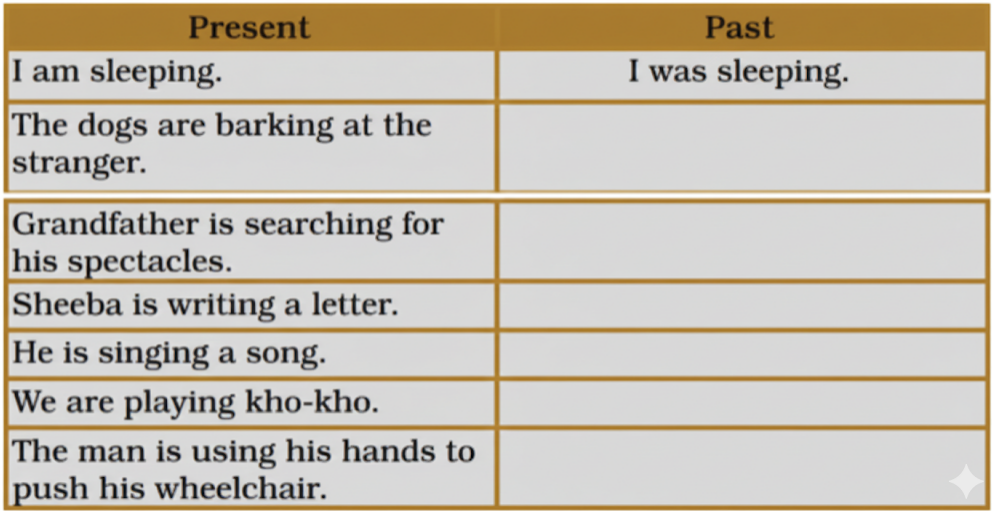
Answer:
D. Look at the picture story.
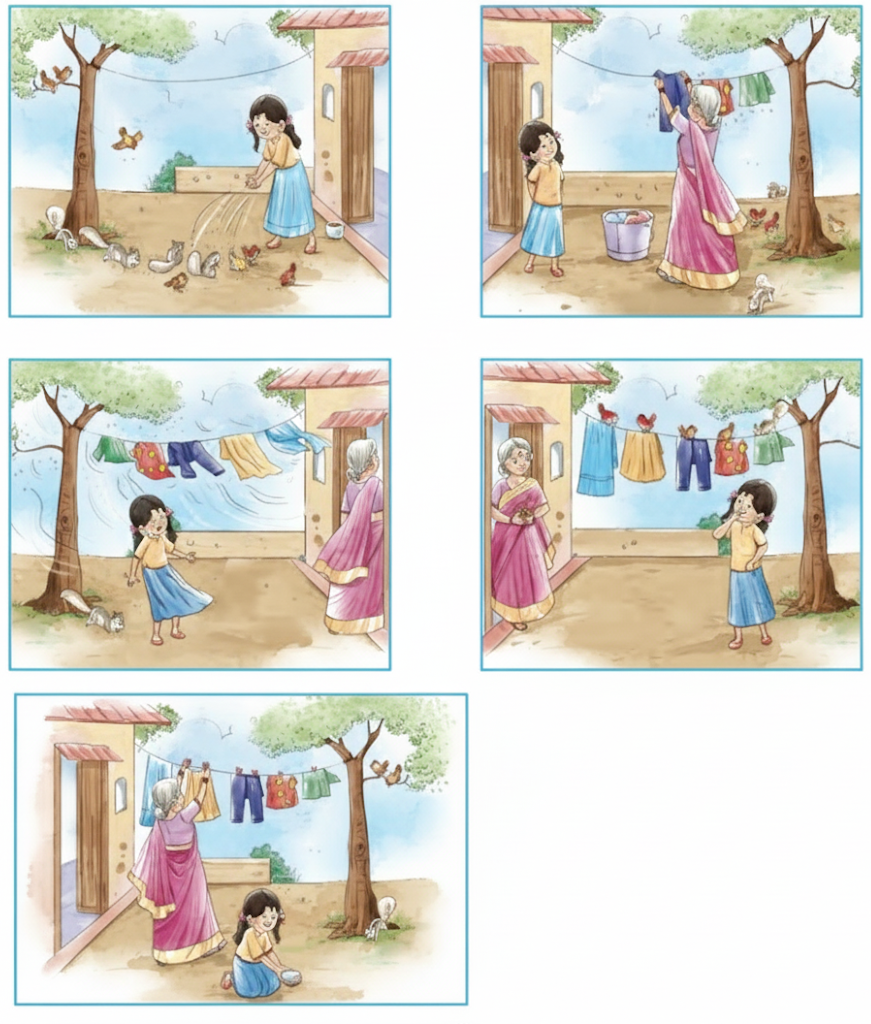
Now fill in the blanks from the suitable options.
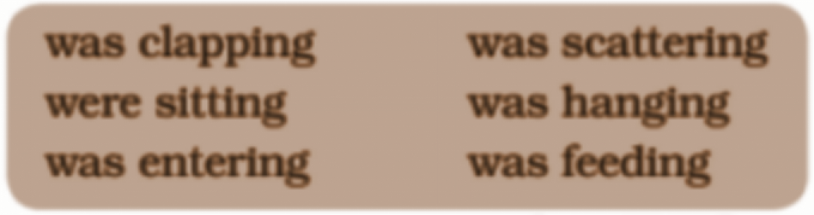
My friend Tarandeep told me an interesting thing yesterday. She _________ her friends, the squirrels and the sparrows. She _________ grains for them.
Her grandmother _________ out the clothes to dry on a clothesline.
Grandmother _________ the house when a strong wind began to blow.
When she returned with the clothes pegs, she saw a wonderful scene! The sparrows and squirrels _________ on the clothes to prevent them from falling. Tarandeep _________ her hands with joy.
Grandmother put the pegs on the clothes, and Tarandeep set down a bowl of water for her friends.
Answer: Yesterday, my friend Tarandeep shared something interesting with me. She was feeding her little friends—the squirrels and sparrows—by sprinkling grains for them. At the same time, her grandmother was hanging clothes on a clothesline to dry.
Just as Grandmother was going inside the house, a strong wind started blowing. When she came back with the clothes pegs, she witnessed a lovely sight. The sparrows and squirrels were sitting on the clothes, keeping them from flying away. Tarandeep clapped happily at the scene. Grandmother then pinned the clothes securely, and Tarandeep placed a bowl of water for her animal friends.
Let us Do (Page 64)
Question 1. Take a piece of paper. With the help of a matchstick, or the back of a pencil, press hard on the paper to ‘draw’ a circle, a plus sign, or a letter of the alphabet. Now, close your eyes, turn the page over, and run your finger on the raised surface on the paper. Can you make out what the shape or outline is? Now, try the same activity with your friend. You may also use white clay for the same.
Answer: Students should do it by themselves.
Question 2. There are some children with low vision. (e.g., wearing thick glasses or holding a book too close to their eyes). Being a classmate and friend, how can you assist them?
For example: Bringing a printout of a paragraph with large fonts to help them read.
Answer:
As a classmate and friend, I can support children with low vision by:
Providing large-print materials or writing notes in bigger letters for them.
Helping them locate their seat or belongings when needed.
Reading aloud if the text is too small or difficult for them to see.
Ensuring proper classroom lighting and suggesting they sit near the window or in the front.
Being patient, kind, and encouraging, and never making them feel excluded.
Avoiding sudden or quick movements that they may not notice easily.
Writing clearly on the blackboard during group work or when acting as the class monitor.
Let us Explore (Page 64)
Find out about the nearest resource centre for people with blindness.
Answer:
You can locate the nearest resource centre for people with blindness by searching online or asking your teacher for guidance. Some well-known organisations in India include:
National Association for the Blind (NAB)
National Institute for the Empowerment of Persons with Visual Disabilities (NIEPVD), Dehradun
All India Confederation of the Blind (AICB)
NCERT Solutions Class 4 English Santoor Chapter 6 Braille (2026-27) – Key Concepts
Explore the inspiring story of Louis Braille in NCERT Solutions Class 4 English Santoor Chapter 6. Understanding Braille’s unique alphabet helps students appreciate how reading and writing are made accessible for everyone. Revising this chapter strengthens language, empathy, and basic grammar concepts.
The chapter highlights the value of inclusivity and innovation in education. Practical exercises help you absorb key ideas and improve writing skills. Using the latest NCERT solutions for 2026-27 ensures you’re practicing from updated, accurate content for scoring better in exams.
Review all the exercise-based questions and answers to build confidence. Focusing on important safety tips and past tense grammar examples will help you excel in both your tests and class activities. Regular revision brings success!
FAQs on NCERT Solutions For Class 4 English Santoor Chapter 6 Braille - 2026-27 Free PDF Download (Login Required)
1. What are NCERT Solutions for Class 4 English Chapter 6 Braille?
NCERT Solutions for Class 4 English Chapter 6 Braille provide step-by-step answers to all textbook exercises, helping students understand concepts and prepare effectively for exams.
- Include intext and back exercise solutions
- Aligned with CBSE marking scheme and 2026–27 syllabus
- Help with definitions, diagrams, and model answers
- Useful for revision and exam practice
2. How can I write stepwise answers for full marks in Class 4 English Chapter 6?
To score full marks in Class 4 English Chapter 6, write your answers in clear, stepwise points as per the NCERT format.
- Start with a brief introduction to the answer
- Use short paragraphs or bulleted points
- Highlight key terms like 'Braille', 'Louis Braille'
- If required, include definitions and diagrams
- Conclude with a summary sentence
3. Are diagrams or definitions mandatory in NCERT Class 4 English Braille answers?
Including definitions and diagrams is highly recommended in answers for Braille Chapter 6.
- Definitions clarify important concepts (e.g., Braille system, inventor)
- Diagrams of Braille dots may be asked and help demonstrate understanding
- Use neat labelling and correct spellings to score full marks
- Check CBSE sample papers for question trends
4. Where can I download the NCERT Solutions PDF for Class 4 English Chapter 6 Braille?
You can download the free PDF NCERT Solutions for Class 4 English Chapter 6 from trusted educational platforms.
- Look for an easy single-click download option
- Ensure the solutions are CBSE 2026–27 syllabus aligned
- Offline access is helpful for quick revision
- Check the source for teacher-reviewed content and completeness
5. What are the most important topics from Class 4 English Chapter 6 Braille?
The most important topics in Chapter 6 Braille include:
- The story of Louis Braille and the invention of Braille
- How the Braille system works (patterns of dots)
- Importance of Braille for visually impaired people
- Definitions, diagrams, and uses of Braille
- Textbook back exercises and intext questions
6. How should long answers be structured to match CBSE marking scheme for Chapter 6?
Long answers in Chapter 6 should be structured using introduction, main body, and conclusion.
- Start with a brief introduction or definition
- Present your answer in logical steps or paragraphs
- Mention key persons, terms, and examples
- End with a concluding remark
- Use headings or bullet points where suitable
7. Why is it important to practice NCERT Solutions for Chapter 6 Braille during revision?
Practicing NCERT Solutions for Chapter 6 Braille ensures complete understanding and helps boost exam performance.
- Covers all types of exam questions
- Clarifies important concepts, definitions, and diagrams
- Familiarizes you with marking scheme and answer pattern
- Reduces chances of missing out on key points
8. What common mistakes should I avoid while answering Chapter 6 Braille questions?
To avoid losing marks, be careful of these common errors in Chapter 6:
- Missing important facts or steps in your answer
- Incorrect spellings of names like Louis Braille
- Messy diagrams or wrong labels
- Skipping key definitions or explanations
- Not following the required answer structure
9. How does reviewing exam tips and marking scheme help in Class 4 English Chapter 6 Braille?
Reviewing exam tips and the CBSE marking scheme helps you understand answer expectations and score better.
- Know which keywords and points earn marks
- Prepare both short and long answers as per the pattern
- Practice presenting steps clearly for partial marking
- Align your revision with CBSE guidelines
10. Are NCERT Solutions enough for Class 4 English exams?
NCERT Solutions for Class 4 English are generally sufficient for exam preparation as they follow the latest CBSE 2026–27 syllabus and cover all important questions.
- Help you revise intext and back exercise questions
- Provide model answers that match CBSE patterns
- Include short, long, and diagram-based questions
- For extra practice, also review sample papers and important questions
