



Exercise-wise Answers for Santoor Chapter 10: The Swing (Class 4 English)
Class 4 English Chapter 10 The Swing Question Answer
Let us Think (Page 104)
A. Answer the following.
Question 1. What does the poet see when the swing goes over the wall?
Answer: As the swing moves over the wall, the poet sees rivers, trees, cattle, and the countryside.
Question 2. Does the poet enjoy swings? Which lines tell us that?
Answer: Yes, the poet loves swings. This is shown in the line, “Oh, I do think it the most pleasant thing / Ever a child can do!”
Question 3. “Up in the air so blue” Why do you think the poet says the air is blue?
Answer: The poet calls the air blue because, while swinging, he looks up at the sky, which appears blue in the daytime.
B. Think and discuss
Question 1. Have you seen a swing?
Answer: I have seen a swing.
Question 2. Where have you seen it?
Answer: I have seen it in parks as well as in school playgrounds.
Question 3. What was it made of?
Answer: It was made using metal chains with a wooden or plastic seat.
Let us Learn (Pages 104-1.05)
Stringing together.
Jeevan waited.
Jeevan waited for the bus.
Jeevan waited for the bus all morning.
Jeevan waited for the bus all morning in the rain.
Jeevan waited for the bus all morning in the rain because his scooter was in the garage being repaired.
Frame a set of sentences as shown in the example. Make sure that each sentence is longer than the previous one.
Answer:
Aanya danced.
Aanya performed on the stage.
Aanya performed on the stage during the school function.
Aanya performed on the stage during the school function wearing a beautiful costume.
Aanya performed on the stage during the school function in a lovely costume and received everyone’s applause.
Let us Learn (Pages 105-106)
Read the following sentence.
I swing on a swing.
The first ‘swing’ is an action word(verb). It means to move forward and backward.
The second ‘swing’ refers to an object. There are many words that can be used both as a verb and a noun. You are already familiar with such words.
Now, read the following sentences. Circle the verbs and underline the nouns. One has been done for you.
A. Word: dance
The dance begins in an hour. ✓ (noun underlined)
My friends and I (dance) when we are happy. ✓ (verb circled)
B. Word: play
I like to (play) kho-kho. ✓ (verb circled)
We are going to watch a play tomorrow. ✓ (noun underlined)
C. Word: answer
Can you (answer) the questions? ✓ (verb circled)
I know the answer. ✓ (noun underlined)
D. Word: fly
There is a fly on the wall. ✓ (noun underlined)
My friends (fly) kites on 15th August. (verb circled)
E. Word: waves
The waves did not let us finish our sandcastle. ✓ (noun underlined)
She (waves) to her siblings while leaving for school. ✓ (verb circled)
Let us Speak (Page 107)
Read aloud the following tongue twister.
How much wood would a woodchuck chuck if a woodchuck could chuck wood?
(a) Now, read aloud the tongue twister by making an ‘O’ shape with your lips while pronouncing the ‘w sound. Repeat it 4-5 times.
(b) Read aloud the following words. Remember to make an ‘O’ shape with your mouth while pronouncing ‘ W ‘.

Answer: Students should do it by themselves.
Let us Listen (Pages 107-108)
Your teacher will read out the poem again. Listen carefully and make a list of words that rhyme.
You may add two more words of your choice as well.
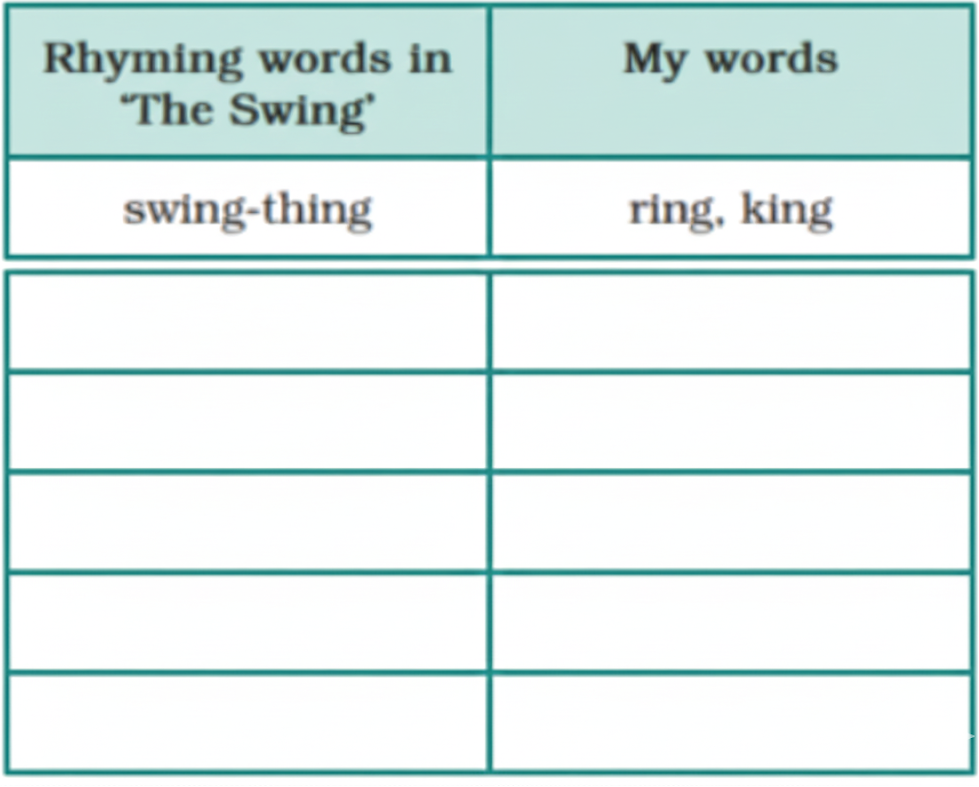
Answer:
Rhyming words in ‘The Swing’:
swing – thing
blue – do
wall – all
wide – countryside
green – seen
brown – down
My words:
ring – king ✓ (rhymes with swing, thing)
call – tall ✓ (rhymes with wall, all)
Let us Write (Pages 108-109)
I do think it the pleasantest thing ever a child can do!
The word ‘pleasantest’ means enjoyable. There are many things that people enjoy doing.
Question 1. Write a short paragraph about the activities you enjoy doing in your free time.
Answer: In my free time, I like to take part in many enjoyable activities. I enjoy reading storybooks because they let me explore new and interesting worlds. Sometimes I go cycling around my neighbourhood or play outdoor games with my friends. I also like drawing and colouring. On rainy days, I watch cartoons or help my parents in the kitchen. All these activities make me feel cheerful and relaxed.
Question 2. Look at the picture carefully.
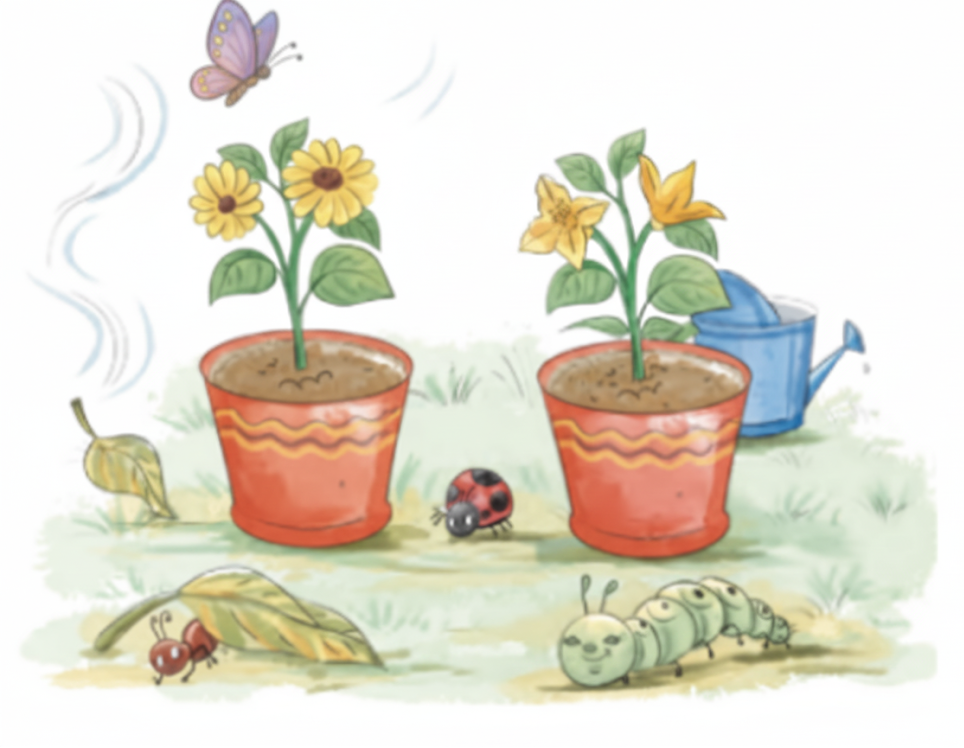
Fill in the blanks with suitable prepositions from the box.

A butterfly is flying _________ the flower.
A honeybee is sitting _________ the flower.
The watercan is _________ the flower pots.
An ant is walking _________ the leaf.
A caterpillar is walking _________ a flowerpot.
A leaf has fallen _________ the flower pot.
Answer:
between
above.
on.
behind
in front of.
beside.
under
Let us Do (Page 110)
Swings of Imagination
Ask students to draw a magical swing that can take them anywhere (outer space, a jungle, a book world). Then, write a short paragraph about the adventure.

Answer:
Adventure Paragraph:
One day, I sat on my magical swing and gave it a soft push. To my surprise, it flew high into the sky and carried me all the way to outer space! I drifted past sparkling stars, greeted friendly aliens, and even jumped on the moon as if it were a trampoline.
Next, the swing rushed toward a bright planet made of candy. There, I met space creatures who created music using light. It was the most thrilling adventure I had ever experienced. When I returned, I was already eager to go on another ride.
Let us explore (Pages 110)
There are some festivals or months in which people like swinging on swings. Collect some information about those festivals or months, and share it with the class.
Answer: Students should do it by themselves.
Mastering NCERT Solutions Class 4 English Santoor Chapter 10 The Swing (2026-27)
Grasping the themes of NCERT Solutions Class 4 English Santoor Chapter 10 The Swing (2026-27) improves reading skills and boosts comprehension. Children can relate to the joy of swinging and explore new words as they answer the questions from this captivating poem.
Practicing exercise-based solutions for this chapter will help students develop their understanding of rhyming words, prepositions, and sentence structure. Regular revision of the chapter questions supports strong English foundations for higher classes.
Prepare for exams by reviewing key lessons from The Swing poem and using sample answers to check your understanding. With clear explanations and engaging content, confidence in attempting Class 4 English questions grows naturally.
FAQs on NCERT Solutions For Class 4 English Santoor Chapter 10 The Swing - 2026-27 Free PDF Download (Sign-in Required)
1. What are NCERT Solutions for Class 4 English Santoor Chapter 10 The Swing?
NCERT Solutions for Class 4 English Santoor Chapter 10 The Swing are stepwise, exam-oriented answers to all textbook exercises.
- Provide model solutions for every question in Chapter 10
- Written as per CBSE marking scheme and latest syllabus (2026-27)
- Help in concept clarity, answer presentation, and exam practice
- Useful for school exams, assignments, and last-minute revision
2. How should I write answers for Class 4 English Chapter 10 to score full marks in CBSE?
To score full marks in CBSE exams for Chapter 10 The Swing, follow these key steps:
- Start your answer with a clear relevant introduction
- Write step-by-step/pointwise answers using the lesson details
- Use keywords and phrases from the chapter
- Keep sentences short, neat, and error-free
- For long answers, use subheadings or bullet points
- If asked, add definitions, diagrams, or quotes from the poem
- Review your answer for spelling and grammar mistakes before submission
3. Where can I download the PDF for NCERT Solutions Class 4 English Santoor Chapter 10?
You can download a free PDF of NCERT Solutions Class 4 English Santoor Chapter 10 The Swing from trusted educational sites.
- PDF includes all exercise-wise answers for quick revision
- Useful for offline study and last-minute revision
- Check official NCERT solution resources or reputed CBSE help portals
4. What topics are covered in Chapter 10 The Swing of Class 4 English Santoor?
Chapter 10 The Swing focuses on these key learning areas:
- Poem comprehension and meaning of 'The Swing'
- Important vocabulary and rhyming words
- Simple questions and answers based on the poem
- Imagination, observation, and expression skills in English
5. Are diagrams or definitions required for Class 4 English Chapter 10 solutions?
Definitions are sometimes required for key words in questions, but diagrams are generally not compulsory in this poem.
- When a question asks for meaning or synonyms, add a short definition
- If a picture-based activity or drawing is asked, use neat & proper labelling
- Always follow CBSE answer presentation tips
6. What are the most important questions from Chapter 10 The Swing for exams?
Some key exam questions for Chapter 10 The Swing include:
- Short answer questions: Main idea of the poem, describing what the child sees on the swing
- Fill in the blanks with rhyming words from the poem
- Vocabulary/explanation of new words
- Personal response: How do you feel when you are on a swing?
7. How does preparing NCERT solutions for Chapter 10 The Swing help students for the CBSE exam?
Practising NCERT solutions for Chapter 10 The Swing builds confidence and improves exam performance.
- Ensures conceptual clarity and strong basics in English
- Teaches stepwise presentation as per CBSE scheme
- Trains students to avoid common mistakes and use proper keywords
- Prepares learners for all types of exam questions — MCQ, short and long answer, fill in the blanks
8. Are NCERT Solutions enough for Class 4 English exams?
NCERT Solutions for Class 4 English cover all important questions from the textbook and are sufficient for regular school exams.
- For advanced practice, add sample papers, MCQs, and previous year questions
- Revise chapter summaries and key vocabulary regularly
- Practise model answers for better marks
9. How do I revise Chapter 10 The Swing quickly before the exam?
To revise Chapter 10 The Swing for CBSE exams quickly:
- Read the chapter summary and main points
- Go through all NCERT solutions and sample answers
- Revise key words, rhyming pairs, and definitions
- Practice one model long answer and 2-3 short answers
- Attempt one MCQ or fill in the blank from the chapter
10. Do examiners award partial marks for correct steps even if the final answer is wrong?
CBSE examiners usually give partial marks if your answer includes the right steps but the final answer is incorrect.
- Mention each step clearly following the NCERT solution format
- Avoid missing main points or keywords
- Always review your answers for calculation or factual errors
