






Types of Green Snakes, Where They Live, and What They Eat
The Green Snake is a beautiful and fascinating reptile known for its bright green colour and slim body. These snakes are experts at blending into trees, bushes, and grass. Many green snake species are harmless and help control insect and rodent populations. Learning about Green Snake facts, habitat, diet, characteristics, and life cycle helps us understand why these reptiles are important for maintaining balance in nature.
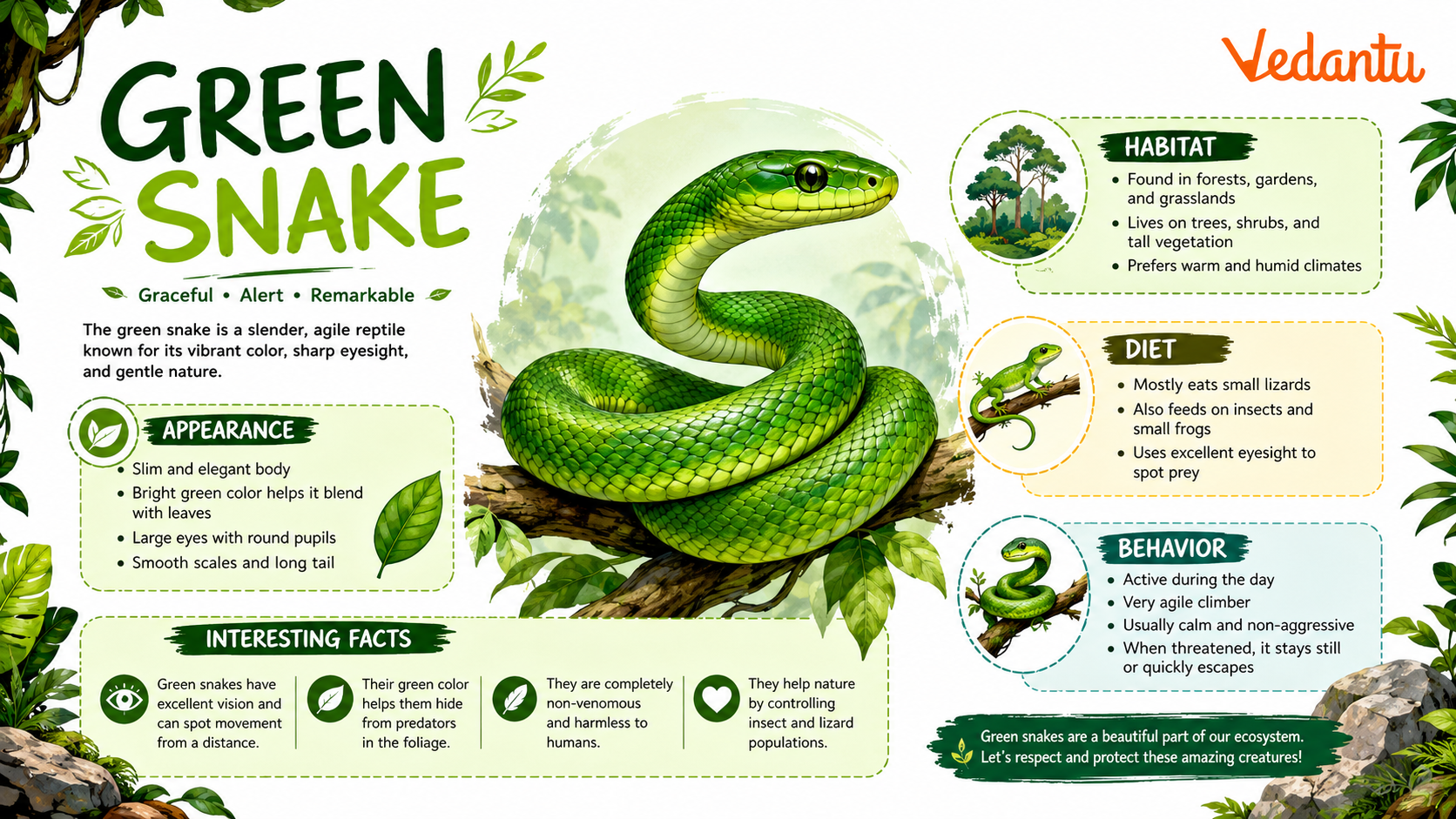
Quick Facts About Green Snake
| Feature | Details |
|---|---|
| Common Name | Green Snake |
| Scientific Name | Opheodrys (for Smooth & Rough Green Snakes) |
| Animal Group | Reptile |
| Type | Non-venomous (most common species) |
| Size | 45–90 cm (depending on species) |
| Diet | Insects, spiders, small invertebrates |
| Habitat | Grasslands, forests, gardens, wetlands |
| Lifespan | Up to 6–8 years in the wild |
Appearance and Physical Characteristics
- Long, slender, and lightweight body.
- Bright green upper body with a pale yellow or white belly.
- Large eyes with round pupils.
- Smooth or slightly keeled scales (depending on species).
- Flexible body helps them move easily through branches.
The bright green colour is the most striking feature of the Green Snake. This colour helps it hide among leaves and grass, protecting it from predators like birds and larger snakes.
Green Snake Habitat and Distribution
- Commonly found in North America.
- Lives in forests, grasslands, meadows, and wetlands.
- Often seen in bushes, shrubs, and low tree branches.
- Prefers warm climates with plenty of vegetation.
The Green Snake habitat usually includes areas with dense plants. These places provide both food and protection. They are excellent climbers and spend much of their time above the ground.
Diet and Feeding Habits
Carnivorous (insectivore).
Crickets, grasshoppers, caterpillars, spiders.
Actively searches for prey in bushes and grass.
Controls insect populations naturally.
Green Snake diet mainly includes soft-bodied insects. They do not use venom to kill prey. Instead, they quickly grab and swallow small insects whole.
Behaviour and Lifestyle
- Usually solitary animals.
- Active during the day (diurnal).
- Very calm and shy in nature.
- Rarely bite humans.
- Freeze or stay still to avoid danger.
One of the most interesting Green Snake characteristics is its gentle behaviour. Instead of attacking, it relies on camouflage to stay safe.
Green Snake Life Cycle
- Egg Laying: Females lay 3–12 eggs in early summer.
- Incubation: Eggs hatch after about 3–4 weeks.
- Hatchlings: Baby snakes are bright green and fully independent.
- Adult Stage: Grow into adults within 1–2 years.
The Green Snake life cycle is simple. The young snakes receive no parental care and must survive on their own from birth.
What Makes Green Snake Special?
Importance and Role in Nature
- Controls harmful insect populations.
- Serves as food for birds and larger predators.
- Maintains ecological balance.
- Indicates a healthy environment.
Amazing Green Snake Facts
Fun Facts for Kids
- Green Snakes look like moving leaves!
- They are safe and not dangerous to humans.
- They love climbing small bushes.
- Baby Green Snakes are tiny and very cute.
- They help farmers by eating insects.
FAQs on Green Snake: Identification, Habitat, and Behavior Explained
1. What is a Green Snake?
A Green Snake is a type of snake known for its bright green color and tree-living habits.
- Belongs to different species like the Rough Green Snake and Smooth Green Snake
- Usually thin, long, and bright green for camouflage
- Often found in trees, bushes, and grassy areas
- Common in North America and other tropical regions
- Keywords: green snake species, small green snake, tree snake
2. Are Green Snakes poisonous or dangerous?
Most Green Snakes are non-venomous and harmless to humans.
- Do not have dangerous venom
- Rarely bite unless threatened
- Prefer to escape instead of attack
- Safe to observe but should not be handled in the wild
- Keywords: are green snakes dangerous, non-venomous snake, harmless snake
3. Where do Green Snakes live?
Green Snakes live in natural habitats with lots of plants and trees.
- Found in forests, grasslands, and wetlands
- Common in the United States, especially the Southeast
- Prefer bushes, shrubs, and tree branches
- Like warm climates with plenty of insects
- Keywords: green snake habitat, where do green snakes live, forest snake
4. What do Green Snakes eat?
Green Snakes mainly eat small insects and soft-bodied animals.
- Favorite foods include grasshoppers, crickets, and caterpillars
- Sometimes eat spiders and small insects
- Do not eat large animals or mammals
- Help control insect populations
- Keywords: green snake diet, what do green snakes eat, insect-eating snake
5. How big does a Green Snake grow?
A Green Snake usually grows to a small or medium size compared to other snakes.
- Average length is about 2 to 3 feet
- Very thin and lightweight body
- Young snakes are smaller but bright green
- Size helps them hide easily in leaves
- Keywords: green snake size, how long is a green snake, small green snake length
6. Why are Green Snakes green?
Green Snakes are green to blend into their leafy surroundings for protection.
- Bright green color provides camouflage
- Helps them hide from predators like birds
- Makes it easier to sneak up on insects
- Color may fade slightly after death
- Keywords: snake camouflage, why are snakes green, green snake adaptation
7. Can Green Snakes be kept as pets?
Green Snakes can be kept as pets, but they need special care and attention.
- Require a large enclosure with plants and branches
- Need live insects for food
- Prefer minimal handling because they stress easily
- Should only be kept by experienced reptile owners
- Keywords: green snake pet, pet snake care, keeping green snakes
8. How do Green Snakes protect themselves?
Green Snakes protect themselves mainly by hiding and staying still.
- Use camouflage to blend into leaves
- Freeze when they sense danger
- May release a mild odor to scare predators
- Quickly move through branches to escape
- Keywords: snake defense, how do green snakes survive, snake predators
9. How long do Green Snakes live?
Green Snakes usually live several years depending on their environment.
- Average lifespan is about 6 to 8 years in the wild
- May live longer in safe captivity
- Face threats from birds, larger snakes, and habitat loss
- Healthy diet increases lifespan
- Keywords: green snake lifespan, how long do snakes live, snake life cycle
10. What is the difference between a Rough Green Snake and a Smooth Green Snake?
The main difference between a Rough Green Snake and a Smooth Green Snake is their scale texture and habitat preference.
- Rough Green Snake has keeled (rough) scales
- Smooth Green Snake has smooth, shiny scales
- Rough species prefers trees and bushes
- Smooth species is often found in grassy fields
- Keywords: rough vs smooth green snake, green snake types, snake identification
