






What Are Barnacles? Habitat, Life Cycle, and How They Survive
Barnacles are small marine animals that live attached to rocks, ships, whales, and even turtles. Though they look like tiny shells, they are actually crustaceans related to crabs and lobsters. Barnacles are famous for their strong sticking power and unique upside-down lifestyle. Found in oceans around the world, they play an important role in marine ecosystems. Let’s explore exciting Barnacle facts, habitat, diet, characteristics, and life cycle in a fun and easy way!
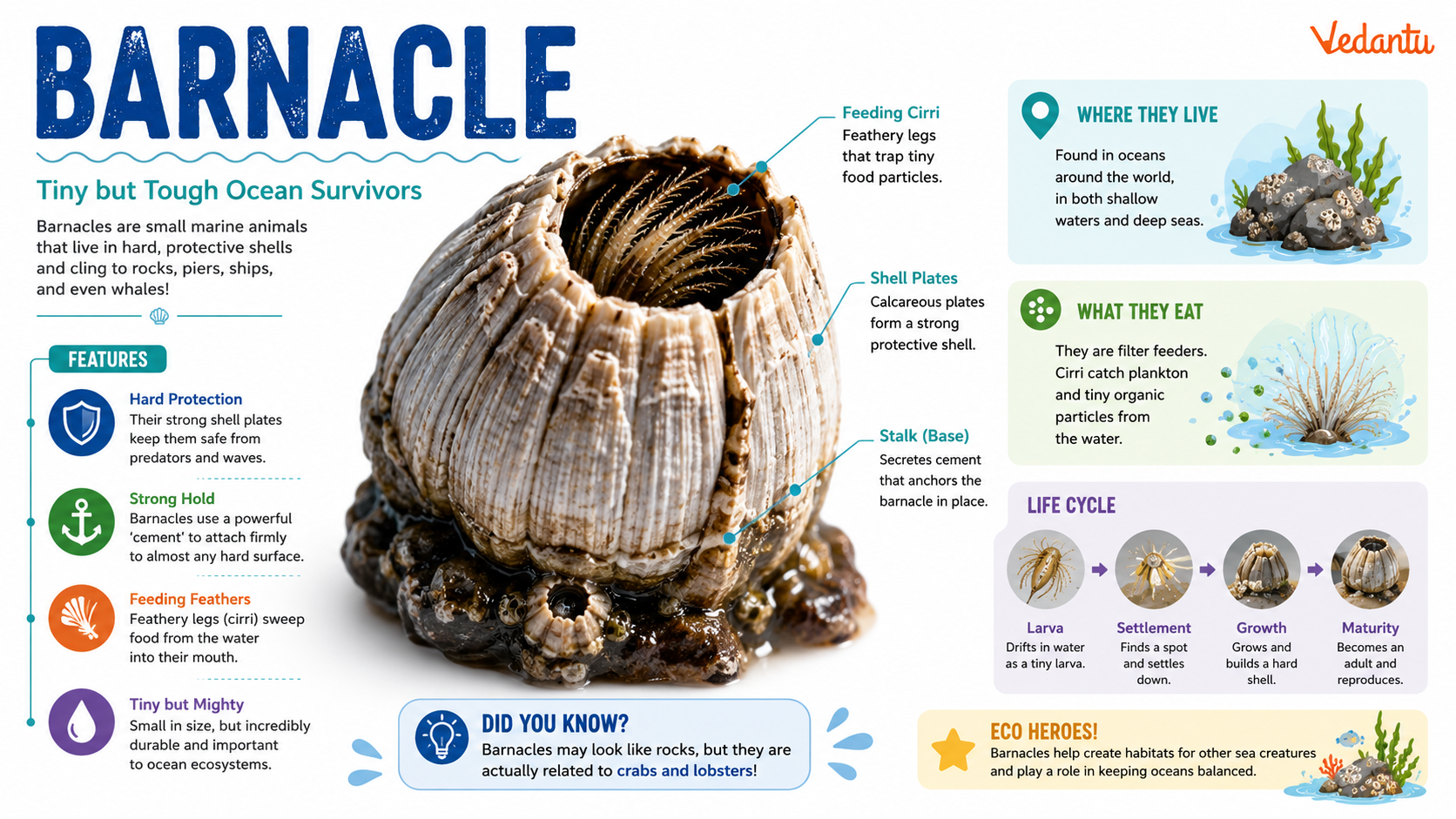
Quick Facts About Barnacle
| Feature | Details |
|---|---|
| Common Name | Barnacle |
| Animal Group | Crustacean (related to crabs and lobsters) |
| Habitat | Oceans, rocky shores, ships, whales |
| Diet | Plankton and tiny floating organisms |
| Size | Usually 1–7 cm wide |
| Lifespan | Up to 8–20 years (species dependent) |
| Movement | Fixed in one place as adults |
| Special Feature | Produces one of the strongest natural glues |
Appearance and Physical Characteristics
- Hard outer shell made of calcium plates.
- Volcano-shaped body stuck to a surface.
- Soft body hidden inside the shell.
- Feathery legs called cirri used to catch food.
- Usually white, grey, or light brown in colour.
Barnacle Habitat and Distribution
- Found in oceans all around the world.
- Common on rocky shores and coastal areas.
- Attach to ships, piers, boats, and docks.
- Some species live on whales, sea turtles, and crabs.
- Can survive in areas where waves crash strongly.
Diet and Feeding Habits
- They are filter feeders.
- Open their shell plates when underwater.
- Stretch out feathery legs (cirri).
- Sweep food particles into their mouth.
Behaviour and Lifestyle
- Live permanently attached to one surface.
- Stay closed tightly when out of water.
- Can survive strong waves and rough sea conditions.
- Often live in large crowded groups.
Barnacle Life Cycle
- Egg Stage: Eggs hatch into tiny larvae in water.
- Larva Stage: Free-swimming larvae move around in the ocean.
- Attachment Stage: Larva finds a hard surface and sticks permanently.
- Adult Stage: Grows shell plates and begins filter feeding.
What Makes Barnacles Special?
Importance and Role in Nature
Amazing Barnacle Facts
- Barnacles are related to crabs, not clams.
- They can live up to 20 years.
- Some species attach only to whales.
- Their glue works even underwater.
- Ships often slow down due to barnacle growth.
- They close their shells tightly to prevent drying.
Fun Facts for Kids
FAQs on Barnacle: Fascinating Facts About This Ocean Clinger
1. What is a barnacle?
A barnacle is a small sea animal that sticks to hard surfaces like rocks, ships, and whales.
- Barnacles are marine crustaceans related to crabs and lobsters.
- They live in the ocean and attach themselves permanently.
- Their hard outer shell protects their soft body.
- They are often found in tidal zones and coastal waters.
2. Are barnacles plants or animals?
Barnacles are animals, not plants, even though they look like rocks or shells.
- They belong to the group called crustaceans.
- They are related to crabs, shrimp, and lobsters.
- They move as babies but stay fixed as adults.
- They eat tiny sea creatures called plankton.
3. How do barnacles stick to surfaces?
Barnacles stick to surfaces using a super-strong natural glue.
- They produce a powerful adhesive substance.
- This glue works underwater.
- They attach to rocks, boats, piers, turtles, and whales.
- Once attached, they usually never move again.
4. Where do barnacles live?
Barnacles live in saltwater oceans all around the world.
- They are common in coastal areas.
- Many live in the intertidal zone where tides rise and fall.
- Some attach to ships in deep ocean waters.
- They prefer hard surfaces for attachment.
5. What do barnacles eat?
Barnacles eat tiny floating food particles from the water.
- Their main food is plankton.
- They use feathery legs called cirri to catch food.
- They filter food from moving water.
- This makes them filter feeders.
6. Do barnacles move?
Barnacles move only when they are babies, but stay still as adults.
- Baby barnacles are called larvae.
- Larvae swim freely in the ocean.
- Once they find a good spot, they attach permanently.
- Adult barnacles cannot move from that place.
7. Why are barnacles found on ships and whales?
Barnacles attach to ships and whales because they need hard surfaces to live on.
- Ship hulls provide strong, steady surfaces.
- Whales and sea turtles offer moving surfaces in the ocean.
- Attachment helps barnacles travel to new places.
- Large numbers can cause biofouling on boats.
8. Are barnacles harmful?
Barnacles are mostly harmless to humans but can cause problems for boats.
- They do not bite or sting people.
- Sharp shells can scratch skin.
- On ships, they increase water resistance.
- This can slow boats and use more fuel.
9. How long do barnacles live?
Barnacles can live for several years depending on their species.
- Some species live about 5 to 10 years.
- Life span depends on water conditions.
- Predators like starfish and snails may eat them.
- They survive best in stable marine environments.
10. What are the main types of barnacles?
There are different types of barnacles found in oceans worldwide.
- Acorn barnacles – small and volcano-shaped.
- Gooseneck barnacles – have a long stalk.
- Parasitic barnacles – live inside other sea animals.
- Each type belongs to the marine crustacean group.
