




Which of the following does not form intramolecular hydrogen bonding?
A. \[{\rm{CC}}{{\rm{l}}_{\rm{3}}}{\rm{CH(OH}}{{\rm{)}}_{\rm{2}}}\]
B.
C.
D.
Answer
 Verified
232.8k+ views
Hint: Hydrogen bonding is a special type of dipole-dipole interaction and exists in molecules containing a hydrogen atom linked by a covalent bond to a highly electronegative atom having a small size.
Complete Step by Step Solution:
The electrostatic force of attraction between the hydrogen atom of one molecule and a highly electronegative element such as \[{\rm{N,}}\,{\rm{O}}\]and \[{\rm{F}}\] present within the same molecule or another molecule of the same or different compounds is known as hydrogen bond.
A hydrogen bond is represented by a dotted line in contrast to a thick line representing a covalent bond between two atoms. There are two different types of hydrogen bonds. They are:
(i) Intermolecular hydrogen bonding: This type of hydrogen bond is formed between the two molecules of the same or different compounds. Some examples of the compounds exhibiting intermolecular hydrogen bonds are hydrogen fluoride \[{\rm{(HF)}}\], water \[{\rm{(}}{{\rm{H}}_{\rm{2}}}{\rm{O)}}\], and ammonia \[{\rm{(N}}{{\rm{H}}_3})\].
(ii) Intramolecular hydrogen bonding: This type of hydrogen bond is formed between hydrogen atom and \[{\rm{N,}}\,{\rm{O}}\]and \[{\rm{F}}\].atom of the same molecule. This type of bonding is commonly known as chelation and is more frequently found in organic compounds. Intramolecular hydrogen bonding is possible when six or five-membered rings can be formed. Some examples are ortho-nitro phenol, salicylic acid and salicylaldehyde.
The compound in option (A) is 2,2,2-trichloroethane-1,1-diol, which is also called a chloral hydrate. The chlorine atom is highly electronegative and is known to not show any hydrogen bonding either inter or intra because of its electron density that comes from its size. Chloral hydrate is a geminal diol which is usually unstable. In order to make it stable, chlorine is believed to form intramolecular hydrogen bonding.
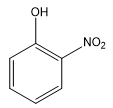
The compound in option (B) is ortho-nitrophenol. Chelation (intramolecular hydrogen bonding) is only possible in ortho isomers since the two groups are close to each other. Hence, intramolecular hydrogen bonding takes place in ortho-nitrophenol.
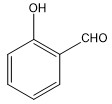
The compound in option (C) is salicylaldehyde. Chelation (intramolecular hydrogen bonding) is only possible in ortho isomers since the two groups are close to each other. Hence, intramolecular hydrogen bonding takes place in salicylaldehyde.
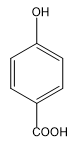
The compound din option (D) is para- hydroxybenzoic acid. Chelation (intramolecular hydrogen bonding) is not possible in meta and para isomers since the two groups are located far away from each other. Therefore, in such cases intermolecular hydrogen bonding takes place.
Therefore, option D is correct.
Note: Intramolecular hydrogen bonding (chelation) decreases the boiling point of the compound and also its solubility in water by restricting the possibility of intermolecular hydrogen bonding.
Complete Step by Step Solution:
The electrostatic force of attraction between the hydrogen atom of one molecule and a highly electronegative element such as \[{\rm{N,}}\,{\rm{O}}\]and \[{\rm{F}}\] present within the same molecule or another molecule of the same or different compounds is known as hydrogen bond.
A hydrogen bond is represented by a dotted line in contrast to a thick line representing a covalent bond between two atoms. There are two different types of hydrogen bonds. They are:
(i) Intermolecular hydrogen bonding: This type of hydrogen bond is formed between the two molecules of the same or different compounds. Some examples of the compounds exhibiting intermolecular hydrogen bonds are hydrogen fluoride \[{\rm{(HF)}}\], water \[{\rm{(}}{{\rm{H}}_{\rm{2}}}{\rm{O)}}\], and ammonia \[{\rm{(N}}{{\rm{H}}_3})\].
(ii) Intramolecular hydrogen bonding: This type of hydrogen bond is formed between hydrogen atom and \[{\rm{N,}}\,{\rm{O}}\]and \[{\rm{F}}\].atom of the same molecule. This type of bonding is commonly known as chelation and is more frequently found in organic compounds. Intramolecular hydrogen bonding is possible when six or five-membered rings can be formed. Some examples are ortho-nitro phenol, salicylic acid and salicylaldehyde.
The compound in option (A) is 2,2,2-trichloroethane-1,1-diol, which is also called a chloral hydrate. The chlorine atom is highly electronegative and is known to not show any hydrogen bonding either inter or intra because of its electron density that comes from its size. Chloral hydrate is a geminal diol which is usually unstable. In order to make it stable, chlorine is believed to form intramolecular hydrogen bonding.
The compound in option (B) is ortho-nitrophenol. Chelation (intramolecular hydrogen bonding) is only possible in ortho isomers since the two groups are close to each other. Hence, intramolecular hydrogen bonding takes place in ortho-nitrophenol.
The compound in option (C) is salicylaldehyde. Chelation (intramolecular hydrogen bonding) is only possible in ortho isomers since the two groups are close to each other. Hence, intramolecular hydrogen bonding takes place in salicylaldehyde.
The compound din option (D) is para- hydroxybenzoic acid. Chelation (intramolecular hydrogen bonding) is not possible in meta and para isomers since the two groups are located far away from each other. Therefore, in such cases intermolecular hydrogen bonding takes place.
Therefore, option D is correct.
Note: Intramolecular hydrogen bonding (chelation) decreases the boiling point of the compound and also its solubility in water by restricting the possibility of intermolecular hydrogen bonding.
Recently Updated Pages
Know The Difference Between Fluid And Liquid

Types of Solutions in Chemistry: Explained Simply
Difference Between Crystalline and Amorphous Solid: Table & Examples
Hess Law of Constant Heat Summation: Definition, Formula & Applications
Disproportionation Reaction: Definition, Example & JEE Guide
JEE General Topics in Chemistry Important Concepts and Tips
Trending doubts
JEE Main 2026 Application Login: Direct Link, Registration, Form Fill, and Steps
JEE Main Marking Scheme 2026- Paper-Wise Marks Distribution and Negative Marking Details
In Carius method of estimation of halogens 015g of class 11 chemistry JEE_Main
Understanding How a Current Loop Acts as a Magnetic Dipole
Understanding Average and RMS Value in Electrical Circuits
Understanding Collisions: Types and Examples for Students
Other Pages
JEE Advanced Weightage 2025 Chapter-Wise for Physics, Maths and Chemistry
Ideal and Non-Ideal Solutions Explained for Class 12 Chemistry
JEE Main Participating Colleges 2026 - A Complete List of Top Colleges
Understanding Atomic Structure for Beginners
NCERT Solutions For Class 11 Chemistry in Hindi Chapter 1 Some Basic Concepts of Chemistry (2025-26)
NCERT Solutions For Class 11 Chemistry in Hindi Chapter 8 Redox Reactions (2025-26)