




Two vertical plane mirrors are inclined at an angle of ${60^0}$ with each other. A ray of light travelling horizontally is reflected first from one mirror and then from the other. The resultant deviation is
A. ${60^0}$
B. ${100^0}$
C. ${180^0}$
D. ${240^0}$
Answer
 Verified
232.8k+ views
Hint: Start with the information given in the question that is angle between the two mirrors, direction of the ray of light falling on the first mirror and then on the second mirror. Then try to find the angle deviation from the horizontal direction of the light ray falling on both the mirrors. Try to use a figure to find out all the angles.
Complete step by step solution:
Angle between the two mirrors is given in the question.
Therefore, $\angle ABC = {60^0}$ (given in question)
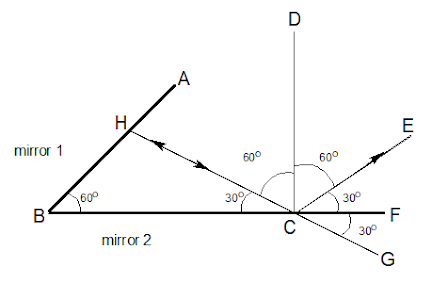
Now from the figure drawn above we can see that a ray of light is falling on the mirror 1 then gets reflected by it and falls on the mirror 2 and then gets reflected in the direction of E. Ray of light is falling horizontally on the mirror 1 therefore,
$\angle BHC = {90^0}$
So, $\angle HBC + \angle BHC + \angle BCH = {180^0}$
Putting the value, we get
${60^0} + {90^0} + \angle BCH = {180^0}$
After solving we get;
$\angle BCH = {30^0}$
If we draw a perpendicular line on C that is DC, we get;
$\angle DCH = {60^0}$
similarly we get;
$\angle DCF = {60^0}$
Therefore $\angle ECF = {30^0}$
From alternate angle we $\angle FCG = {30^0}$
Now we have to find the angle of deviation x
From the figure above we get;
$x = {180^0} + \angle GCF + \angle FCE$
$\Rightarrow x = {180^0} + {30^0} + {30^0}$
$\therefore x = {240^0}$
Hence the correct answer is option D.
Note: Be careful about the direction of the ray of light falling on both the mirrors, here it is horizontal if it is vertical then the answer will also change. Be careful about all the angles. Use the given information from the question to draw the required figure and then put all the value of the angle.
Complete step by step solution:
Angle between the two mirrors is given in the question.
Therefore, $\angle ABC = {60^0}$ (given in question)
Now from the figure drawn above we can see that a ray of light is falling on the mirror 1 then gets reflected by it and falls on the mirror 2 and then gets reflected in the direction of E. Ray of light is falling horizontally on the mirror 1 therefore,
$\angle BHC = {90^0}$
So, $\angle HBC + \angle BHC + \angle BCH = {180^0}$
Putting the value, we get
${60^0} + {90^0} + \angle BCH = {180^0}$
After solving we get;
$\angle BCH = {30^0}$
If we draw a perpendicular line on C that is DC, we get;
$\angle DCH = {60^0}$
similarly we get;
$\angle DCF = {60^0}$
Therefore $\angle ECF = {30^0}$
From alternate angle we $\angle FCG = {30^0}$
Now we have to find the angle of deviation x
From the figure above we get;
$x = {180^0} + \angle GCF + \angle FCE$
$\Rightarrow x = {180^0} + {30^0} + {30^0}$
$\therefore x = {240^0}$
Hence the correct answer is option D.
Note: Be careful about the direction of the ray of light falling on both the mirrors, here it is horizontal if it is vertical then the answer will also change. Be careful about all the angles. Use the given information from the question to draw the required figure and then put all the value of the angle.
Recently Updated Pages
Circuit Switching vs Packet Switching: Key Differences Explained

JEE General Topics in Chemistry Important Concepts and Tips
JEE Extractive Metallurgy Important Concepts and Tips for Exam Preparation
JEE Amino Acids and Peptides Important Concepts and Tips for Exam Preparation
JEE Atomic Structure and Chemical Bonding important Concepts and Tips
Electricity and Magnetism Explained: Key Concepts & Applications
Trending doubts
JEE Main 2026: Session 2 Registration Open, City Intimation Slip, Exam Dates, Syllabus & Eligibility
JEE Main 2026 Application Login: Direct Link, Registration, Form Fill, and Steps
JEE Main Marking Scheme 2026- Paper-Wise Marks Distribution and Negative Marking Details
Understanding the Angle of Deviation in a Prism
Hybridisation in Chemistry – Concept, Types & Applications
How to Convert a Galvanometer into an Ammeter or Voltmeter
Other Pages
JEE Advanced Marks vs Ranks 2025: Understanding Category-wise Qualifying Marks and Previous Year Cut-offs
Dual Nature of Radiation and Matter Class 12 Physics Chapter 11 CBSE Notes - 2025-26
Understanding Uniform Acceleration in Physics
Understanding the Electric Field of a Uniformly Charged Ring
JEE Advanced Weightage 2025 Chapter-Wise for Physics, Maths and Chemistry
Derivation of Equation of Trajectory Explained for Students