




Two parallel conductors A and B equal length carry currents I and 10 I, respectively, in the same direction. Then
A. A and B repel each other with same face
B. A and B attract each other with same face
C. A will attract B, but B will repel A
D. A and B attract each other with different face
Answer
 Verified
232.8k+ views
Hint:We will apply the right-hand. From the right-hand rule, we will be able to find the directions as well as the force to be normal to current and magnetic fields. According to Fleming’s left-hand rule, we express the directions of various parameters with the thumb, index finger, or the forefinger and middle finger. It provides a relationship between the magnetic fields that the conductor is put in, force, and induced current.
Complete answer:
Electric current: When this flow occurs, the electrons inside the material begin to move, causing current to flow through it. Different materials exhibit varying degrees of flow.
Simple fields that are created around the surface of any charge are known as magnetic fields. These variables will determine whether the charge has characteristics that make it positive or negative.
According to Fleming's left-hand rule, we may observe the relationship between the directions of force (F), current (I), and magnetic field if we stretch our thumb, middle finger, and index finger of our left hand in mutually perpendicular (create an angle of 90 degrees) directions to each other (B). As a result, the conductor exposed to the magnetic field feels a magnetic force that is orthogonal to both the fields and the current's flow directions..
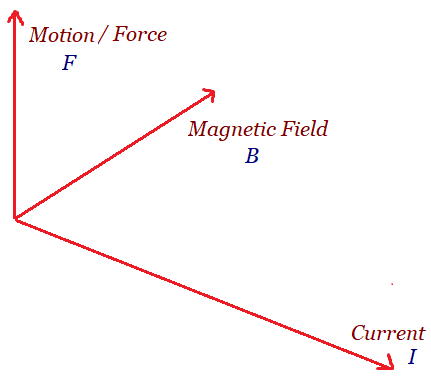
Using the Fleming left-hand rule, we can observe that if the stream is flowing in the same direction, their forces will be directed toward one another and they will attract one another.
Therefore, A and B attract each other with the same face.
Thus, the correct option is B.
Note: we should be aware that current-carrying conductors in parallel are subject to a constant force. Additionally, if the currents running through parallel wires are going in different directions, the wires will repel one another; yet, if the currents are going in the same direction, the wires will attract one another.
Complete answer:
Electric current: When this flow occurs, the electrons inside the material begin to move, causing current to flow through it. Different materials exhibit varying degrees of flow.
Simple fields that are created around the surface of any charge are known as magnetic fields. These variables will determine whether the charge has characteristics that make it positive or negative.
According to Fleming's left-hand rule, we may observe the relationship between the directions of force (F), current (I), and magnetic field if we stretch our thumb, middle finger, and index finger of our left hand in mutually perpendicular (create an angle of 90 degrees) directions to each other (B). As a result, the conductor exposed to the magnetic field feels a magnetic force that is orthogonal to both the fields and the current's flow directions..
Using the Fleming left-hand rule, we can observe that if the stream is flowing in the same direction, their forces will be directed toward one another and they will attract one another.
Therefore, A and B attract each other with the same face.
Thus, the correct option is B.
Note: we should be aware that current-carrying conductors in parallel are subject to a constant force. Additionally, if the currents running through parallel wires are going in different directions, the wires will repel one another; yet, if the currents are going in the same direction, the wires will attract one another.
Recently Updated Pages
Circuit Switching vs Packet Switching: Key Differences Explained

JEE General Topics in Chemistry Important Concepts and Tips
JEE Extractive Metallurgy Important Concepts and Tips for Exam Preparation
JEE Amino Acids and Peptides Important Concepts and Tips for Exam Preparation
JEE Atomic Structure and Chemical Bonding important Concepts and Tips
Electricity and Magnetism Explained: Key Concepts & Applications
Trending doubts
JEE Main 2026: Session 2 Registration Open, City Intimation Slip, Exam Dates, Syllabus & Eligibility
JEE Main 2026 Application Login: Direct Link, Registration, Form Fill, and Steps
JEE Main Marking Scheme 2026- Paper-Wise Marks Distribution and Negative Marking Details
Understanding the Angle of Deviation in a Prism
Hybridisation in Chemistry – Concept, Types & Applications
How to Convert a Galvanometer into an Ammeter or Voltmeter
Other Pages
JEE Advanced Marks vs Ranks 2025: Understanding Category-wise Qualifying Marks and Previous Year Cut-offs
Dual Nature of Radiation and Matter Class 12 Physics Chapter 11 CBSE Notes - 2025-26
Understanding Uniform Acceleration in Physics
Understanding the Electric Field of a Uniformly Charged Ring
JEE Advanced Weightage 2025 Chapter-Wise for Physics, Maths and Chemistry
Derivation of Equation of Trajectory Explained for Students