




There are m points on a straight-line AB and n points on another line AC, none of them being point A. Triangles are formed from these points as vertices when (i) A is excluded (ii) A is included. Then the ratio of the number of triangles in the two cases is?
A. $\dfrac{{m + n - 2}}{{m + n}}$
B. $\dfrac{{m + n - 2}}{2}$
C. $\dfrac{{m + n - 2}}{{m + n + 2}}$
D. None of these
Answer
 Verified
232.8k+ views
Hint: For simplifying the problem based on permutation and combination, we know that ‘r’ items can be selected from a collection of ‘n’ items in $^n{C_r}$ways. According to the question first, we will find the number of triangles in both the cases given using this formula then the ratio is evaluated to get an accurate answer.
Formula Used:
$^n{C_r} = \dfrac{{n!}}{{r!\left( {n - r} \right)!}}$
Complete step by step Solution:
There are m points on line AB and n points on line AC excluding point A in both the lines (given).
Also, we know the formula to find out the number of ways from permutation is $^n{C_r} = \dfrac{{n!}}{{r!\left( {n - r} \right)!}}$
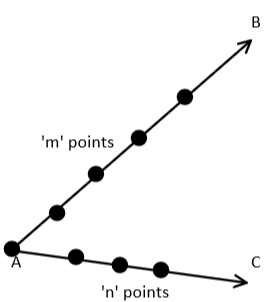
Case 1. When point A is excluded:
We can make a triangle by choosing ‘2 points from AB & 1 point from AC’ or ‘1 point from AB & 2 point from AC’. Therefore,
Number of possible triangles formed = \[{P_A}{ = ^m}{C_2} \times {}^n{C_1} + {}^m{C_1} \times {}^n{C_2}\]
$ = \dfrac{{m!}}{{2!\left( {m - 2} \right)!}} \times \dfrac{{n!}}{{1!\left( {n - 1} \right)!}} + \dfrac{{m!}}{{1!\left( {m - 1} \right)!}} \times \dfrac{{n!}}{{2!\left( {n - 2} \right)!}}$
Now, Open the factorial by using the formula $n! = n(n - 1)(n - 2)(n - 3)............$
$ = \dfrac{{m(m - 1)(m - 2)!}}{{2 \times 1 \times \left( {m - 2} \right)!}} \times \dfrac{{n(n - 1)!}}{{1 \times \left( {n - 1} \right)!}} + \dfrac{{m(m - 1)!}}{{1 \times \left( {m - 1} \right)!}} \times \dfrac{{n(n - 1)(n - 2)!}}{{2 \times 1 \times \left( {n - 2} \right)!}}$
$ = \dfrac{{m(m - 1)}}{2} \times n + m \times \dfrac{{n(n - 1)}}{2}$
Taking $\dfrac{{mn}}{2}$ common from the above expression we get
$ = \dfrac{{mn}}{2}(m - 1 + n - 1)$
${P_A} = \dfrac{{mn}}{2}(m + n - 2)$
Case 2. When point A is includes
In this we can take point A or not. In case when A is taken, we can make a triangle by taking 1 point from both lines AB and AC. In case A is not taken, we can make a triangle by choosing ‘2 points from AB & 1 point from AC’ or vice-versa (just as above). Therefore,
Number of possible triangles formed = \[{P_B} = {}^m{C_1} \times {}^n{C_1} + {(^m}{C_2} \times {}^n{C_1} + {}^m{C_1} \times {}^n{C_2})\]
$ = \dfrac{{m!}}{{1!\left( {m - 1} \right)!}} \times \dfrac{{n!}}{{1!\left( {n - 1} \right)!}} + \dfrac{{mn}}{2}(m + n - 2)$
Now, Open the factorial by using the formula $n! = n(n - 1)(n - 2)(n - 3)............$
$ = \dfrac{{m(m - 1)!}}{{1 \times \left( {m - 1} \right)!}} \times \dfrac{{n(n - 1)!}}{{1 \times \left( {n - 1} \right)!}} + \dfrac{{mn}}{2}(m + n - 2)$
$ = m \times n + \dfrac{{mn}}{2}(m + n - 2)$
Taking $\dfrac{{mn}}{2}$ common from the above expression we get
$ = \dfrac{{mn}}{2}(2 + m + n - 2)$
${P_B} = \dfrac{{mn}}{2}(m + n)$
Thus, the ratio of number of possible triangles formed in both cases will be :
$\dfrac{{{P_A}}}{{{P_B}}} = \dfrac{{\dfrac{{mn}}{2}(m + n - 2)}}{{\dfrac{{mn}}{2}(m + n)}} = \dfrac{{m + n - 2}}{{m + n}}$
Hence, the correct option is A.
Note: Since the problem is based on Permutation & Combination hence, it is necessary to analyze the given conditions on the basis of which the number of ways to form a triangle is calculated. Also, we will get an incorrect answer if we take all three points on the same line (collinear). Calculations must be performed very carefully.
Formula Used:
$^n{C_r} = \dfrac{{n!}}{{r!\left( {n - r} \right)!}}$
Complete step by step Solution:
There are m points on line AB and n points on line AC excluding point A in both the lines (given).
Also, we know the formula to find out the number of ways from permutation is $^n{C_r} = \dfrac{{n!}}{{r!\left( {n - r} \right)!}}$
Case 1. When point A is excluded:
We can make a triangle by choosing ‘2 points from AB & 1 point from AC’ or ‘1 point from AB & 2 point from AC’. Therefore,
Number of possible triangles formed = \[{P_A}{ = ^m}{C_2} \times {}^n{C_1} + {}^m{C_1} \times {}^n{C_2}\]
$ = \dfrac{{m!}}{{2!\left( {m - 2} \right)!}} \times \dfrac{{n!}}{{1!\left( {n - 1} \right)!}} + \dfrac{{m!}}{{1!\left( {m - 1} \right)!}} \times \dfrac{{n!}}{{2!\left( {n - 2} \right)!}}$
Now, Open the factorial by using the formula $n! = n(n - 1)(n - 2)(n - 3)............$
$ = \dfrac{{m(m - 1)(m - 2)!}}{{2 \times 1 \times \left( {m - 2} \right)!}} \times \dfrac{{n(n - 1)!}}{{1 \times \left( {n - 1} \right)!}} + \dfrac{{m(m - 1)!}}{{1 \times \left( {m - 1} \right)!}} \times \dfrac{{n(n - 1)(n - 2)!}}{{2 \times 1 \times \left( {n - 2} \right)!}}$
$ = \dfrac{{m(m - 1)}}{2} \times n + m \times \dfrac{{n(n - 1)}}{2}$
Taking $\dfrac{{mn}}{2}$ common from the above expression we get
$ = \dfrac{{mn}}{2}(m - 1 + n - 1)$
${P_A} = \dfrac{{mn}}{2}(m + n - 2)$
Case 2. When point A is includes
In this we can take point A or not. In case when A is taken, we can make a triangle by taking 1 point from both lines AB and AC. In case A is not taken, we can make a triangle by choosing ‘2 points from AB & 1 point from AC’ or vice-versa (just as above). Therefore,
Number of possible triangles formed = \[{P_B} = {}^m{C_1} \times {}^n{C_1} + {(^m}{C_2} \times {}^n{C_1} + {}^m{C_1} \times {}^n{C_2})\]
$ = \dfrac{{m!}}{{1!\left( {m - 1} \right)!}} \times \dfrac{{n!}}{{1!\left( {n - 1} \right)!}} + \dfrac{{mn}}{2}(m + n - 2)$
Now, Open the factorial by using the formula $n! = n(n - 1)(n - 2)(n - 3)............$
$ = \dfrac{{m(m - 1)!}}{{1 \times \left( {m - 1} \right)!}} \times \dfrac{{n(n - 1)!}}{{1 \times \left( {n - 1} \right)!}} + \dfrac{{mn}}{2}(m + n - 2)$
$ = m \times n + \dfrac{{mn}}{2}(m + n - 2)$
Taking $\dfrac{{mn}}{2}$ common from the above expression we get
$ = \dfrac{{mn}}{2}(2 + m + n - 2)$
${P_B} = \dfrac{{mn}}{2}(m + n)$
Thus, the ratio of number of possible triangles formed in both cases will be :
$\dfrac{{{P_A}}}{{{P_B}}} = \dfrac{{\dfrac{{mn}}{2}(m + n - 2)}}{{\dfrac{{mn}}{2}(m + n)}} = \dfrac{{m + n - 2}}{{m + n}}$
Hence, the correct option is A.
Note: Since the problem is based on Permutation & Combination hence, it is necessary to analyze the given conditions on the basis of which the number of ways to form a triangle is calculated. Also, we will get an incorrect answer if we take all three points on the same line (collinear). Calculations must be performed very carefully.
Recently Updated Pages
Geometry of Complex Numbers Explained

JEE General Topics in Chemistry Important Concepts and Tips
JEE Extractive Metallurgy Important Concepts and Tips for Exam Preparation
JEE Amino Acids and Peptides Important Concepts and Tips for Exam Preparation
JEE Atomic Structure and Chemical Bonding important Concepts and Tips
Electricity and Magnetism Explained: Key Concepts & Applications
Trending doubts
JEE Main 2026: Session 2 Registration Open, City Intimation Slip, Exam Dates, Syllabus & Eligibility
JEE Main 2026 Application Login: Direct Link, Registration, Form Fill, and Steps
JEE Main Marking Scheme 2026- Paper-Wise Marks Distribution and Negative Marking Details
Understanding the Angle of Deviation in a Prism
Hybridisation in Chemistry – Concept, Types & Applications
How to Convert a Galvanometer into an Ammeter or Voltmeter
Other Pages
JEE Advanced Marks vs Ranks 2025: Understanding Category-wise Qualifying Marks and Previous Year Cut-offs
NCERT Solutions For Class 11 Maths Chapter 12 Limits and Derivatives (2025-26)
NCERT Solutions For Class 11 Maths Chapter 10 Conic Sections (2025-26)
Understanding the Electric Field of a Uniformly Charged Ring
JEE Advanced Weightage 2025 Chapter-Wise for Physics, Maths and Chemistry
Derivation of Equation of Trajectory Explained for Students