




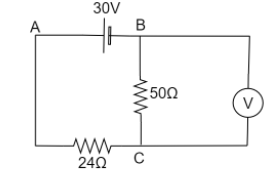
The voltmeter shown in the figure reads $18\;V$ across $50\;$ ohm resistor. The resistance of the voltmeter is nearly
(A) $140\Omega $
(B) $128.5\Omega $
(C) $103\Omega $
(D) $162\Omega $
Answer
 Verified
232.8k+ views
Hint: To solve this problem, we use Kirchhoff’s Junction law to obtain the different amounts of current flowing through the resistors. This can be used to determine the amount of current flowing through the voltmeter. After this, we can use Ohm’s law to determine the resistance of the voltmeter.
Formula used:
$V = IR$
Complete step by step answer:
In the given circuit, we have the voltmeter connected in parallel with the $50\Omega $ resistor. The current originates from the positive terminal of the $30\;V$ battery and divides into two streams at the point $C$. The division of current can be determined by Kirchhoff’s current law or Kirchhoff’s junction law. Which states that at a junction, the total amount of current entering must be equal to the total amount of current leaving it.
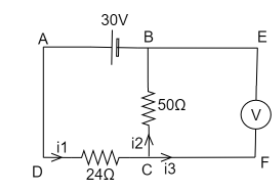
Let current $I$ be the current coming out of the positive terminal of $30\;V$ battery, let ${I_1}$ be the current entering the $50\Omega $ resistor, and let ${I_2}$ be the current entering the voltmeter.
Now consider the junction $C$,
Here, current entering the junction= ${I_1}$
And the current leaving the junction$ = {I_2} + {I_3}$
Then, according to Kirchhoff's junction law,
${I_1} = {I_2} + {I_3}$
It is given that the voltage across the $50\Omega $ resistor (or between $CB\;$ or $FE\;$ ) is $18\;V$,
Thus, the current across the $50\Omega $ resistor is-
${I_2} = \dfrac{{{V_{CB}}}}{{{R_{CB}}}}$
Putting the values,
${I_2} = \dfrac{{18}}{{50}}$
${I_2} = 0.36A$
Now, the voltage across $24\Omega $ resistor (or between $DC\;$) is,
$30 - 18 = 12V$
Thus, the current across the $24\Omega $ resistor,
${I_1} = \dfrac{{{V_{DC}}}}{{{R_{DC}}}}$
Putting the values,
${I_1} = \dfrac{{12}}{{24}}$
$\Rightarrow$ ${I_1} = 0.5A$
Putting these values at the junction $C$, we get-
$0.5 = 0.36 + {I_3}$
$\Rightarrow$ ${I_3} = 0.14A$
The current that flows across the voltmeter is ${I_3} = 0.14A$
We know that the voltage across the voltmeter is, $V = 18$
Therefore, the resistance across the voltmeter is,
$R = \dfrac{V}{{{I_3}}}$
Putting the values we have,
$R = \dfrac{{18}}{{0.14}}$
$\Rightarrow$ $R = 128.6\Omega $
Thus, option (2) is the correct answer.
Note: The points in a circuit which do not have any component other than wire have the same potential and carry the same current unless it is a resistance wire or a junction. For example, the points, $B$ and $E$ have the same potential.
Formula used:
$V = IR$
Complete step by step answer:
In the given circuit, we have the voltmeter connected in parallel with the $50\Omega $ resistor. The current originates from the positive terminal of the $30\;V$ battery and divides into two streams at the point $C$. The division of current can be determined by Kirchhoff’s current law or Kirchhoff’s junction law. Which states that at a junction, the total amount of current entering must be equal to the total amount of current leaving it.
Let current $I$ be the current coming out of the positive terminal of $30\;V$ battery, let ${I_1}$ be the current entering the $50\Omega $ resistor, and let ${I_2}$ be the current entering the voltmeter.
Now consider the junction $C$,
Here, current entering the junction= ${I_1}$
And the current leaving the junction$ = {I_2} + {I_3}$
Then, according to Kirchhoff's junction law,
${I_1} = {I_2} + {I_3}$
It is given that the voltage across the $50\Omega $ resistor (or between $CB\;$ or $FE\;$ ) is $18\;V$,
Thus, the current across the $50\Omega $ resistor is-
${I_2} = \dfrac{{{V_{CB}}}}{{{R_{CB}}}}$
Putting the values,
${I_2} = \dfrac{{18}}{{50}}$
${I_2} = 0.36A$
Now, the voltage across $24\Omega $ resistor (or between $DC\;$) is,
$30 - 18 = 12V$
Thus, the current across the $24\Omega $ resistor,
${I_1} = \dfrac{{{V_{DC}}}}{{{R_{DC}}}}$
Putting the values,
${I_1} = \dfrac{{12}}{{24}}$
$\Rightarrow$ ${I_1} = 0.5A$
Putting these values at the junction $C$, we get-
$0.5 = 0.36 + {I_3}$
$\Rightarrow$ ${I_3} = 0.14A$
The current that flows across the voltmeter is ${I_3} = 0.14A$
We know that the voltage across the voltmeter is, $V = 18$
Therefore, the resistance across the voltmeter is,
$R = \dfrac{V}{{{I_3}}}$
Putting the values we have,
$R = \dfrac{{18}}{{0.14}}$
$\Rightarrow$ $R = 128.6\Omega $
Thus, option (2) is the correct answer.
Note: The points in a circuit which do not have any component other than wire have the same potential and carry the same current unless it is a resistance wire or a junction. For example, the points, $B$ and $E$ have the same potential.
Recently Updated Pages
Froth Flotation Principle and Process Important Concepts and Tips for JEE

Free Radical Substitution Mechanism: Steps & Examples for JEE/NEET
Fluid Pressure Explained: Definition, Formula & Examples
JEE Extractive Metallurgy Important Concepts and Tips for Exam Preparation
Excess Pressure Inside a Liquid Drop Explained
Equivalent Resistance Explained: Series & Parallel Circuits Guide
Trending doubts
JEE Main 2026: Session 2 Registration Open, City Intimation Slip, Exam Dates, Syllabus & Eligibility
JEE Main 2026 Application Login: Direct Link, Registration, Form Fill, and Steps
JEE Main Marking Scheme 2026- Paper-Wise Marks Distribution and Negative Marking Details
Understanding the Angle of Deviation in a Prism
Hybridisation in Chemistry – Concept, Types & Applications
How to Convert a Galvanometer into an Ammeter or Voltmeter
Other Pages
JEE Advanced Marks vs Ranks 2025: Understanding Category-wise Qualifying Marks and Previous Year Cut-offs
Dual Nature of Radiation and Matter Class 12 Physics Chapter 11 CBSE Notes - 2025-26
Understanding Uniform Acceleration in Physics
Understanding the Electric Field of a Uniformly Charged Ring
JEE Advanced Weightage 2025 Chapter-Wise for Physics, Maths and Chemistry
Derivation of Equation of Trajectory Explained for Students