




The forward biased diode
Answer
 Verified
232.8k+ views
Hint: Here, we get the answer by knowing about the PN Junction diode and its characteristics of forward bias current flows from higher potential to lower potential and from opinion you can get the answer.
Complete step by step solution:
The P-N junction diode can be represented by
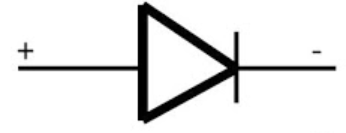
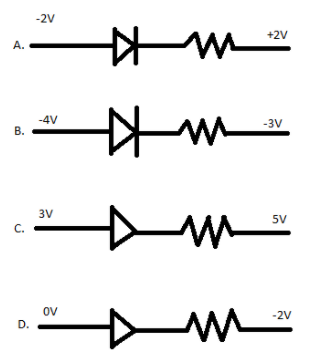
in which the ‘+’ side is called a cathode. In the forward bias current flows from anode to cathode and anode must be connected to higher potential and cathode must be connected to lower potential. When voltage is supplied from the battery source current starts to flow from higher potential to lower potential and is the same way diodes must be inserted that current enter from anode side and leave from cathode side. Anode side is also called P side and cathode side also called N side. Therefore the voltage must be higher at the anode side and voltage must be lower at the cathode side. So, from options we can see in option(D) only, the P side is at higher potential than n side.
P side (anode) at ’0’ volt and n side (cathode) at ‘-2’ volt.
Note: In the case of reverse bias, the polarity of battery change and there current enters to n side (cathode) and leaves from p side (anode). We can see option(C) n side at higher potential (5V) and p side at lower potential (3V). So, it is the case of reverse bias diode circuits.
Complete step by step solution:
The P-N junction diode can be represented by
in which the ‘+’ side is called a cathode. In the forward bias current flows from anode to cathode and anode must be connected to higher potential and cathode must be connected to lower potential. When voltage is supplied from the battery source current starts to flow from higher potential to lower potential and is the same way diodes must be inserted that current enter from anode side and leave from cathode side. Anode side is also called P side and cathode side also called N side. Therefore the voltage must be higher at the anode side and voltage must be lower at the cathode side. So, from options we can see in option(D) only, the P side is at higher potential than n side.
P side (anode) at ’0’ volt and n side (cathode) at ‘-2’ volt.
Note: In the case of reverse bias, the polarity of battery change and there current enters to n side (cathode) and leaves from p side (anode). We can see option(C) n side at higher potential (5V) and p side at lower potential (3V). So, it is the case of reverse bias diode circuits.
Recently Updated Pages
Circuit Switching vs Packet Switching: Key Differences Explained

JEE General Topics in Chemistry Important Concepts and Tips
JEE Extractive Metallurgy Important Concepts and Tips for Exam Preparation
JEE Amino Acids and Peptides Important Concepts and Tips for Exam Preparation
JEE Atomic Structure and Chemical Bonding important Concepts and Tips
Electricity and Magnetism Explained: Key Concepts & Applications
Trending doubts
JEE Main 2026: Session 2 Registration Open, City Intimation Slip, Exam Dates, Syllabus & Eligibility
JEE Main 2026 Application Login: Direct Link, Registration, Form Fill, and Steps
JEE Main Marking Scheme 2026- Paper-Wise Marks Distribution and Negative Marking Details
Understanding the Angle of Deviation in a Prism
Hybridisation in Chemistry – Concept, Types & Applications
How to Convert a Galvanometer into an Ammeter or Voltmeter
Other Pages
JEE Advanced Marks vs Ranks 2025: Understanding Category-wise Qualifying Marks and Previous Year Cut-offs
Dual Nature of Radiation and Matter Class 12 Physics Chapter 11 CBSE Notes - 2025-26
Understanding Uniform Acceleration in Physics
Understanding the Electric Field of a Uniformly Charged Ring
JEE Advanced Weightage 2025 Chapter-Wise for Physics, Maths and Chemistry
Derivation of Equation of Trajectory Explained for Students