




The components required to make a simple series circuit to light a bulb are:
(A) Wires and cell
(B) Cell and Switch
(C) Bulb and wires
(D) Both B and C
Answer
 Verified
232.8k+ views
Hint: To answer this question we should be having an idea about the various elements that are required to make a simple circuit. Among the elements we should be knowing which are the essential ones and which are the ones without which also the circuit can work. The more the number of components the more will be the complexity. So from the name it is known that a simple circuit will be having only the important components.
Complete step by step answer:
The components that are required to make a simple series circuit to light a bulb are the following:
1. Cells: The cells are required to make the current flow in the circuit. So without them the circuit will not be functional.
2. Switch: A switch is required to keep a control on the current flow in the circuit.
3. Bulbs: Since we are making a simple series circuit to light a bulb, we need to use bulbs in the circuit.
4. Wires: Wires are required to connect the various components that are present in the circuit.
Hence we can say that the components required to make a simple series circuit to light a bulb are cell, switch, bulb and wires. So both option B and C are the answer.
Hence option D is correct.
The diagram of a simple series circuit is given below:
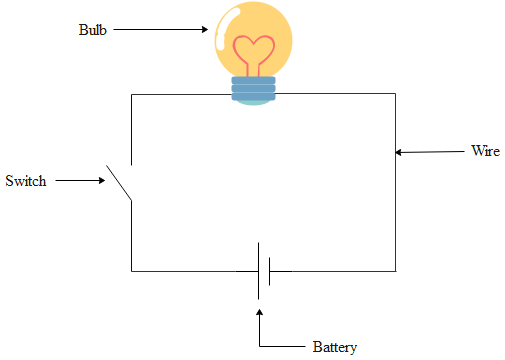
Note: In the answer, we have come across the term series circuit. This series circuit is defined as a circuit which consists of one resistor or even we can have more than one resistor. But the flow of electricity will be confined to only one path in the circuit. The electrons will flow from one end of the circuit to the other and there will be no branches in the circuit.
Complete step by step answer:
The components that are required to make a simple series circuit to light a bulb are the following:
1. Cells: The cells are required to make the current flow in the circuit. So without them the circuit will not be functional.
2. Switch: A switch is required to keep a control on the current flow in the circuit.
3. Bulbs: Since we are making a simple series circuit to light a bulb, we need to use bulbs in the circuit.
4. Wires: Wires are required to connect the various components that are present in the circuit.
Hence we can say that the components required to make a simple series circuit to light a bulb are cell, switch, bulb and wires. So both option B and C are the answer.
Hence option D is correct.
The diagram of a simple series circuit is given below:
Note: In the answer, we have come across the term series circuit. This series circuit is defined as a circuit which consists of one resistor or even we can have more than one resistor. But the flow of electricity will be confined to only one path in the circuit. The electrons will flow from one end of the circuit to the other and there will be no branches in the circuit.
Recently Updated Pages
Circuit Switching vs Packet Switching: Key Differences Explained

JEE General Topics in Chemistry Important Concepts and Tips
JEE Extractive Metallurgy Important Concepts and Tips for Exam Preparation
JEE Amino Acids and Peptides Important Concepts and Tips for Exam Preparation
JEE Atomic Structure and Chemical Bonding important Concepts and Tips
Electricity and Magnetism Explained: Key Concepts & Applications
Trending doubts
JEE Main 2026: Session 2 Registration Open, City Intimation Slip, Exam Dates, Syllabus & Eligibility
JEE Main 2026 Application Login: Direct Link, Registration, Form Fill, and Steps
JEE Main Marking Scheme 2026- Paper-Wise Marks Distribution and Negative Marking Details
Understanding the Angle of Deviation in a Prism
Hybridisation in Chemistry – Concept, Types & Applications
How to Convert a Galvanometer into an Ammeter or Voltmeter
Other Pages
JEE Advanced Marks vs Ranks 2025: Understanding Category-wise Qualifying Marks and Previous Year Cut-offs
Dual Nature of Radiation and Matter Class 12 Physics Chapter 11 CBSE Notes - 2025-26
Understanding Uniform Acceleration in Physics
Understanding the Electric Field of a Uniformly Charged Ring
JEE Advanced Weightage 2025 Chapter-Wise for Physics, Maths and Chemistry
Derivation of Equation of Trajectory Explained for Students