




Seawater at a frequency \[f = 9 \times {10^2}Hz\] , has permittivity \[ \in = 80{ \in _0}\] and resistivity \[\rho = 0.25\,\Omega m\] . Imagine a parallel plate capacitor is immersed in seawater and is driven by an alternating voltage source \[V\left( t \right){\text{ = }}{V_0}sin\left( {2\pi ft} \right)\] . Then the conduction current density becomes ${10^x}$ times the displacement current density after time \[t = {\text{ }}\dfrac{1}{{800\,}}\] . Find the value of $x$. (Given : \[\dfrac{1}{{4\pi { \in _0}}} = 9 \times {10^9}N{m^2}{C^{ - 2}}\] )
Answer
 Verified
232.8k+ views
Hint:In the given question frequency, permittivity and resistivity of seawater are given. Also we are given the alternating voltage source given to the parallel plate capacitor. We first need to find displacement current using its differential formula. Then we find the conduction current. Finally we use the given relationship between ${I_d}$ and ${I_c}$ to find the value of $x$ .
Formula Used:
Displacement current, ${I_d} = \dfrac{{dq}}{{dt}}$
where $q = CV$ given that C is the capacitance of the given parallel plate capacitor
Capacitance, $C = \dfrac{{ \in d}}{A}$
where d is the distance between the plates of the capacitor and A is the area of the plate of parallel plate capacitor.
Conduction current, ${I_c} = \dfrac{V}{R}$
where R is the resistance of the capacitor.
Complete step by step solution:
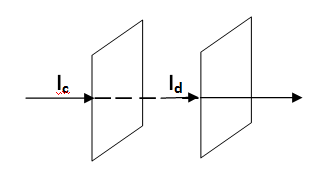
Given: Frequency of seawater, \[f = 9 \times {10^2}Hz\]
Permittivity of seawater, \[ \in = 80{ \in _0}\]
Resistivity of seawater, \[\rho = 0.25\,\Omega m\]
Alternating Voltage given to the capacitor: \[V\left( t \right){\text{ = }}{V_0}sin\left( {2\pi ft} \right)\] ...(1)
Also, ${I_c} = {10^x} \times {I_d}$ ...(2)
Since, \[ \in = 80{ \in _0}\] therefore, from the relation \[ \in = { \in _r}{ \in _0}\] we get that \[{ \in _r} = 80\] .
Now, we know that the displacement current is, ${I_d} = \dfrac{{dq}}{{dt}}$ where $q = CV$ and $C = \dfrac{{ \in A}}{d}$ ...(3)
Thus, we get, ${I_d} = C\dfrac{{dV}}{{dt}}$ ...(4)
This is because $V$ depends on $t$ whereas $C$ does not.
Differentiating $V$ with respect to $t$ we get,
$\dfrac{{dV}}{{dt}} = {V_0}2\pi f\cos \left( {2\pi ft} \right)$ ...(5)
Combining equations (1), (3), (4) and (5), we get
\[{I_d} = \dfrac{{ \in A}}{d}\left( {{V_0}2\pi f\cos \left( {2\pi ft} \right)} \right)\]
Thus, we get final equation as: \[{I_d} = \dfrac{{{ \in _r}{ \in _0}A}}{d}{V_0}(2\pi f)\cos \left( {2\pi ft} \right)\] ...(6)
Similarly, we find an equation for conduction current which is given by the formula:
${I_c} = \dfrac{V}{R}$ ...(7)
where R is the resistance of the capacitor and is given by $R = \rho \dfrac{d}{A}$ . ...(8)
Now combining the equations (1), (7) and (8), we get
${I_c} = \dfrac{{{V_0}sin\left( {2\pi ft} \right)}}{{\rho \dfrac{d}{A}}}$
This implies that ${I_c} = \dfrac{{{V_0}Asin\left( {2\pi ft} \right)}}{{\rho d}}$ ...(9)
\Now we will divide equation (6) by equation (9), we get
\[\dfrac{{{I_d}}}{{{I_c}}} = \dfrac{{\dfrac{{{ \in _r}{ \in _0}A}}{d}{V_0}(2\pi f)\cos \left( {2\pi ft} \right)}}{{\dfrac{{{V_0}Asin\left( {2\pi ft} \right)}}{{\rho d}}}}\]
\[\dfrac{{{I_d}}}{{{I_c}}} = { \in _r}{ \in _0}\rho (2\pi f)\cot \left( {2\pi ft} \right)\] ...(10)
Since, \[\dfrac{1}{{4\pi { \in _0}}} = 9 \times {10^9}N{m^2}{C^{ - 2}}\]
Therefore, we can say that \[{ \in _0} = \dfrac{1}{{4\pi \times 9 \times {{10}^9}}}\]
Now, we put the given values in the equation (10), we get
\[\dfrac{{{I_d}}}{{{I_c}}} = \dfrac{1}{{4\pi \times 9 \times {{10}^9}}} \times 80 \times 0.25 \times (2\pi \times 9 \times {10^2})\cot \left( {2\pi \times 9 \times {{10}^2} \times \dfrac{1}{{800\,}}} \right)\]
After doing calculations, we get
\[\dfrac{{{I_d}}}{{{I_c}}} = \dfrac{{{{10}^3}}}{{{{10}^9}}}\cot \left( {\dfrac{{9\pi }}{{4\,}}} \right)\]
As we know that $\cot \left( {\dfrac{{9\pi }}{4}} \right) = 1$
Therefore, we get \[\dfrac{{{I_d}}}{{{I_c}}} = \dfrac{1}{{{{10}^6}}}\]
This equation can be written as
\[{I_c} = {10^6}{I_d}\] ...(11)
Comparing equations (2) and (11),
We get, $x = 6$ .
Hence, $x = 6$ is the answer.
Note:One can make mistakes while combining the different equations to achieve the final expressions of displacement current and conduction current. In such types of questions we can also be asked to draw plots between different quantities like $V$ and $I$ etc as an additional part of the question. Also frequency might not be given directly, rather angular frequency or time period may be given in which case we first find the value of frequency and then proceed as above.
Formula Used:
Displacement current, ${I_d} = \dfrac{{dq}}{{dt}}$
where $q = CV$ given that C is the capacitance of the given parallel plate capacitor
Capacitance, $C = \dfrac{{ \in d}}{A}$
where d is the distance between the plates of the capacitor and A is the area of the plate of parallel plate capacitor.
Conduction current, ${I_c} = \dfrac{V}{R}$
where R is the resistance of the capacitor.
Complete step by step solution:
Given: Frequency of seawater, \[f = 9 \times {10^2}Hz\]
Permittivity of seawater, \[ \in = 80{ \in _0}\]
Resistivity of seawater, \[\rho = 0.25\,\Omega m\]
Alternating Voltage given to the capacitor: \[V\left( t \right){\text{ = }}{V_0}sin\left( {2\pi ft} \right)\] ...(1)
Also, ${I_c} = {10^x} \times {I_d}$ ...(2)
Since, \[ \in = 80{ \in _0}\] therefore, from the relation \[ \in = { \in _r}{ \in _0}\] we get that \[{ \in _r} = 80\] .
Now, we know that the displacement current is, ${I_d} = \dfrac{{dq}}{{dt}}$ where $q = CV$ and $C = \dfrac{{ \in A}}{d}$ ...(3)
Thus, we get, ${I_d} = C\dfrac{{dV}}{{dt}}$ ...(4)
This is because $V$ depends on $t$ whereas $C$ does not.
Differentiating $V$ with respect to $t$ we get,
$\dfrac{{dV}}{{dt}} = {V_0}2\pi f\cos \left( {2\pi ft} \right)$ ...(5)
Combining equations (1), (3), (4) and (5), we get
\[{I_d} = \dfrac{{ \in A}}{d}\left( {{V_0}2\pi f\cos \left( {2\pi ft} \right)} \right)\]
Thus, we get final equation as: \[{I_d} = \dfrac{{{ \in _r}{ \in _0}A}}{d}{V_0}(2\pi f)\cos \left( {2\pi ft} \right)\] ...(6)
Similarly, we find an equation for conduction current which is given by the formula:
${I_c} = \dfrac{V}{R}$ ...(7)
where R is the resistance of the capacitor and is given by $R = \rho \dfrac{d}{A}$ . ...(8)
Now combining the equations (1), (7) and (8), we get
${I_c} = \dfrac{{{V_0}sin\left( {2\pi ft} \right)}}{{\rho \dfrac{d}{A}}}$
This implies that ${I_c} = \dfrac{{{V_0}Asin\left( {2\pi ft} \right)}}{{\rho d}}$ ...(9)
\Now we will divide equation (6) by equation (9), we get
\[\dfrac{{{I_d}}}{{{I_c}}} = \dfrac{{\dfrac{{{ \in _r}{ \in _0}A}}{d}{V_0}(2\pi f)\cos \left( {2\pi ft} \right)}}{{\dfrac{{{V_0}Asin\left( {2\pi ft} \right)}}{{\rho d}}}}\]
\[\dfrac{{{I_d}}}{{{I_c}}} = { \in _r}{ \in _0}\rho (2\pi f)\cot \left( {2\pi ft} \right)\] ...(10)
Since, \[\dfrac{1}{{4\pi { \in _0}}} = 9 \times {10^9}N{m^2}{C^{ - 2}}\]
Therefore, we can say that \[{ \in _0} = \dfrac{1}{{4\pi \times 9 \times {{10}^9}}}\]
Now, we put the given values in the equation (10), we get
\[\dfrac{{{I_d}}}{{{I_c}}} = \dfrac{1}{{4\pi \times 9 \times {{10}^9}}} \times 80 \times 0.25 \times (2\pi \times 9 \times {10^2})\cot \left( {2\pi \times 9 \times {{10}^2} \times \dfrac{1}{{800\,}}} \right)\]
After doing calculations, we get
\[\dfrac{{{I_d}}}{{{I_c}}} = \dfrac{{{{10}^3}}}{{{{10}^9}}}\cot \left( {\dfrac{{9\pi }}{{4\,}}} \right)\]
As we know that $\cot \left( {\dfrac{{9\pi }}{4}} \right) = 1$
Therefore, we get \[\dfrac{{{I_d}}}{{{I_c}}} = \dfrac{1}{{{{10}^6}}}\]
This equation can be written as
\[{I_c} = {10^6}{I_d}\] ...(11)
Comparing equations (2) and (11),
We get, $x = 6$ .
Hence, $x = 6$ is the answer.
Note:One can make mistakes while combining the different equations to achieve the final expressions of displacement current and conduction current. In such types of questions we can also be asked to draw plots between different quantities like $V$ and $I$ etc as an additional part of the question. Also frequency might not be given directly, rather angular frequency or time period may be given in which case we first find the value of frequency and then proceed as above.
Recently Updated Pages
Circuit Switching vs Packet Switching: Key Differences Explained

JEE General Topics in Chemistry Important Concepts and Tips
JEE Extractive Metallurgy Important Concepts and Tips for Exam Preparation
JEE Amino Acids and Peptides Important Concepts and Tips for Exam Preparation
JEE Atomic Structure and Chemical Bonding important Concepts and Tips
Electricity and Magnetism Explained: Key Concepts & Applications
Trending doubts
JEE Main 2026: Session 2 Registration Open, City Intimation Slip, Exam Dates, Syllabus & Eligibility
JEE Main 2026 Application Login: Direct Link, Registration, Form Fill, and Steps
JEE Main Marking Scheme 2026- Paper-Wise Marks Distribution and Negative Marking Details
Understanding the Angle of Deviation in a Prism
Hybridisation in Chemistry – Concept, Types & Applications
How to Convert a Galvanometer into an Ammeter or Voltmeter
Other Pages
JEE Advanced Marks vs Ranks 2025: Understanding Category-wise Qualifying Marks and Previous Year Cut-offs
Dual Nature of Radiation and Matter Class 12 Physics Chapter 11 CBSE Notes - 2025-26
Understanding Uniform Acceleration in Physics
Understanding the Electric Field of a Uniformly Charged Ring
JEE Advanced Weightage 2025 Chapter-Wise for Physics, Maths and Chemistry
Derivation of Equation of Trajectory Explained for Students