




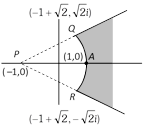
PQ and PR are two infinite rays. QAR is an arc. Point lying in the shaded region excluding the boundary satisfies [IIT Screening \[2005\]]
A) \[|z - 1| > 2;|arg(z - 1)| < \dfrac{\pi }{4}\]
B) \[|z - 1| > 2;|arg(z - 1)| < \dfrac{\pi }{2}\]
C) \[|z + 1| > 2;|arg(z + 1)| < \dfrac{\pi }{4}\]
D) \[|z + 1| > 2;|arg(z + 1)| < \dfrac{\pi }{2}\]
Answer
 Verified
232.8k+ views
Hint: In this question we have to find points lying in a shaded region excluding the boundaries. Find the length of two infinite rays using distance formula and on the basis of length try to find out the properties of arc QAR.
Formula used: If \[({x_{1,}}{y_1})\]and \[({x_{2,}}{y_2})\]are two end point of line then length of line is given by
\[D = \sqrt {{{({x_2} - {x_1})}^2} + {{({y_2} - {y_1})}^2}} \]
D is the distance between two points
Complete step by step solution: Given: coordinates of each points on the curve
Now
Equation of infinite ray PQ\[\arg (z + 1) = \dfrac{\pi }{4}\]
Equation of infinite ray PR \[\arg (z + 1) = - \dfrac{\pi }{4}\]
Boundary of shaded region is given as
\[ - \dfrac{\pi }{4} < \arg (z + 1) < \dfrac{\pi }{4}\]
Coordinate of point P is \[( - 1,0)\]
Coordinate of point Q is \[( - 1 + \sqrt 2 ,\sqrt 2 i)\]
Length of PQ is given by
\[D = \sqrt {{{({x_2} - {x_1})}^2} + {{({y_2} - {y_1})}^2}} \]
\[\arg (z + 1) < \dfrac{\pi }{4}\]\[\left| {PQ} \right| = \sqrt {{{(\sqrt 2 )}^2} + {{(\sqrt 2 )}^2}} = 2\]
Similarly PA and PR is also equal to \[2\]
Now length of each ray is equal there given arc is a part of circle having center at P and radius is \[2\]
So all points in the shaded region is outside the circle \[\left| {z + 1} \right| < 2\]
Thus, Option (C) is correct.
Note: Don’t try to put the value of z in a combination of real and imaginary form. We must remember that if the length of all lines from common point to any point on the arc is equal then arc is a part of a circle having that common point as center and radius equal to length of line.
Formula used: If \[({x_{1,}}{y_1})\]and \[({x_{2,}}{y_2})\]are two end point of line then length of line is given by
\[D = \sqrt {{{({x_2} - {x_1})}^2} + {{({y_2} - {y_1})}^2}} \]
D is the distance between two points
Complete step by step solution: Given: coordinates of each points on the curve
Now
Equation of infinite ray PQ\[\arg (z + 1) = \dfrac{\pi }{4}\]
Equation of infinite ray PR \[\arg (z + 1) = - \dfrac{\pi }{4}\]
Boundary of shaded region is given as
\[ - \dfrac{\pi }{4} < \arg (z + 1) < \dfrac{\pi }{4}\]
Coordinate of point P is \[( - 1,0)\]
Coordinate of point Q is \[( - 1 + \sqrt 2 ,\sqrt 2 i)\]
Length of PQ is given by
\[D = \sqrt {{{({x_2} - {x_1})}^2} + {{({y_2} - {y_1})}^2}} \]
\[\arg (z + 1) < \dfrac{\pi }{4}\]\[\left| {PQ} \right| = \sqrt {{{(\sqrt 2 )}^2} + {{(\sqrt 2 )}^2}} = 2\]
Similarly PA and PR is also equal to \[2\]
Now length of each ray is equal there given arc is a part of circle having center at P and radius is \[2\]
So all points in the shaded region is outside the circle \[\left| {z + 1} \right| < 2\]
Thus, Option (C) is correct.
Note: Don’t try to put the value of z in a combination of real and imaginary form. We must remember that if the length of all lines from common point to any point on the arc is equal then arc is a part of a circle having that common point as center and radius equal to length of line.
Recently Updated Pages
Geometry of Complex Numbers Explained

JEE General Topics in Chemistry Important Concepts and Tips
JEE Extractive Metallurgy Important Concepts and Tips for Exam Preparation
JEE Amino Acids and Peptides Important Concepts and Tips for Exam Preparation
JEE Atomic Structure and Chemical Bonding important Concepts and Tips
Electricity and Magnetism Explained: Key Concepts & Applications
Trending doubts
JEE Main 2026: Session 2 Registration Open, City Intimation Slip, Exam Dates, Syllabus & Eligibility
JEE Main 2026 Application Login: Direct Link, Registration, Form Fill, and Steps
JEE Main Marking Scheme 2026- Paper-Wise Marks Distribution and Negative Marking Details
Understanding the Angle of Deviation in a Prism
Hybridisation in Chemistry – Concept, Types & Applications
How to Convert a Galvanometer into an Ammeter or Voltmeter
Other Pages
JEE Advanced Marks vs Ranks 2025: Understanding Category-wise Qualifying Marks and Previous Year Cut-offs
NCERT Solutions For Class 11 Maths Chapter 12 Limits and Derivatives (2025-26)
NCERT Solutions For Class 11 Maths Chapter 10 Conic Sections (2025-26)
Understanding the Electric Field of a Uniformly Charged Ring
JEE Advanced Weightage 2025 Chapter-Wise for Physics, Maths and Chemistry
Derivation of Equation of Trajectory Explained for Students