




Nephridiopores presents over the body of earthworm belong to
A. Integumentary nephridia
B. Septal nephridia
C. Pharyngeal nephridia
D. Protonephridia
Answer
 Verified
632.4k+ views
Hint: For the disposal of metabolic waste of the body, excretory organs are helpful. Earthworms belong to the phylum Annelida and they are known for their metameric segmentation of the body. The metameric segmentation body is divided into segments both internally and externally and these segments are called metamers.
Complete answer:
The excretory organs in the earthworm are segmentally arranged coiled tubules. These coiled tubules are called nephridia. These regulate the volume and composition of body fluids. Integumentary nephridia are attached to the lining of segment 3 to the last that open on the body surface. Nephridiopores of the earthworm belong to integumentary nephridia.
Hence, the correct answer is option (A).
Additional information:
Nephridia are very much similar to the vertebrate kidney which expels the metabolic waste from the body. Earthworms have slightly more advanced excretory structures. Excluding the first two and last section of the body, each section contains nephridia.
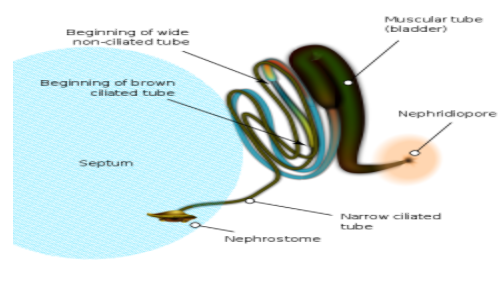
In earthworms nephridia are found in clusters around parts of the body of the earthworm. Each works as waste ducts but each has a distinctive function as well. Nephridium consists of an opening called nephrostome and there is a further opening called nephridiopore.
Body fluids are pumped by the nephrostomes in a complex tubular framework and then critical substances are absorbed and waste materials are returned to the lumen and then the subsequent body fluids are carried through nephridiopores.
Note: There are three types of nephridia present in earthworms, based on the location, septal nephridia, Pharyngeal nephridia, and integumentary nephridia. Septal nephridia attached to the septa, while pharyngeal nephridia attached to the gut and integumentary nephridia attached to the inner lining of the body wall.
Complete answer:
The excretory organs in the earthworm are segmentally arranged coiled tubules. These coiled tubules are called nephridia. These regulate the volume and composition of body fluids. Integumentary nephridia are attached to the lining of segment 3 to the last that open on the body surface. Nephridiopores of the earthworm belong to integumentary nephridia.
Hence, the correct answer is option (A).
Additional information:
Nephridia are very much similar to the vertebrate kidney which expels the metabolic waste from the body. Earthworms have slightly more advanced excretory structures. Excluding the first two and last section of the body, each section contains nephridia.
In earthworms nephridia are found in clusters around parts of the body of the earthworm. Each works as waste ducts but each has a distinctive function as well. Nephridium consists of an opening called nephrostome and there is a further opening called nephridiopore.
Body fluids are pumped by the nephrostomes in a complex tubular framework and then critical substances are absorbed and waste materials are returned to the lumen and then the subsequent body fluids are carried through nephridiopores.
Note: There are three types of nephridia present in earthworms, based on the location, septal nephridia, Pharyngeal nephridia, and integumentary nephridia. Septal nephridia attached to the septa, while pharyngeal nephridia attached to the gut and integumentary nephridia attached to the inner lining of the body wall.
Recently Updated Pages
Explain the structure of megasporangium class 12 biology CBSE

Why is chloroform kept in dark coloured bottles class 12 chemistry CBSE
Derive the balancing condition of a Wheatstone bri class 12 physics CBSE
Draw VI characteristics of a pn junction diode Explain class 12 physics CBSE
Is it possible to carry pride in ones language too class 12 english CBSE
In a population at Hardy Weinberg equilibrium the allele class 12 biology CBSE
Trending doubts
Draw a labelled sketch of the human eye class 12 physics CBSE
Which are the Top 10 Largest Countries of the World?
Draw ray diagrams each showing i myopic eye and ii class 12 physics CBSE
Which is the correct genotypic ratio of mendel dihybrid class 12 biology CBSE
Differentiate between homogeneous and heterogeneous class 12 chemistry CBSE
Which animal never drinks water in its entire life class 12 biology CBSE