




Let$D$ be the middle point of the side $BC$of a triangle $\vartriangle ABC$.if the triangle $\vartriangle ADC$is equilateral, then ${{a}^{2}}:{{b}^{2}}:{{c}^{2}}$ is equal to
A.$1:4:3$
B. $4:1:3$
C. $4:3:1$
D. $3:4:1$
Answer
 Verified
232.8k+ views
Hint:
To solve this question, we will find all the angles of the triangle $\vartriangle ABC$ using properties and theorems of the triangle. After this we will use Law of sine $\frac{a}{\sin A}=\frac{b}{\sin B}=\frac{c}{\sin C}$and equate it some constant and by substituting all the values of the angles we will find the value of $a,b$and $c$. We will put the value of $a,b$and $c$ in ${{a}^{2}}:{{b}^{2}}:{{c}^{2}}$and then find the ratio.
Complete step-by-step solution:
We are given a triangle $\vartriangle ABC$in which $D$ is the middle point on the side $BC$. We have to find the ratio ${{a}^{2}}:{{b}^{2}}:{{c}^{2}}$if the triangle $\vartriangle ADC$is equilateral.
In triangle $\vartriangle ABC$, the value of the sides will be,
$AB=c,BC=a$ and $AC=b$.
Now we will make the diagram of the triangle $\vartriangle ABC$ with $D$ being the middle point on the side $BC$forming an equilateral triangle $\vartriangle ADC$.
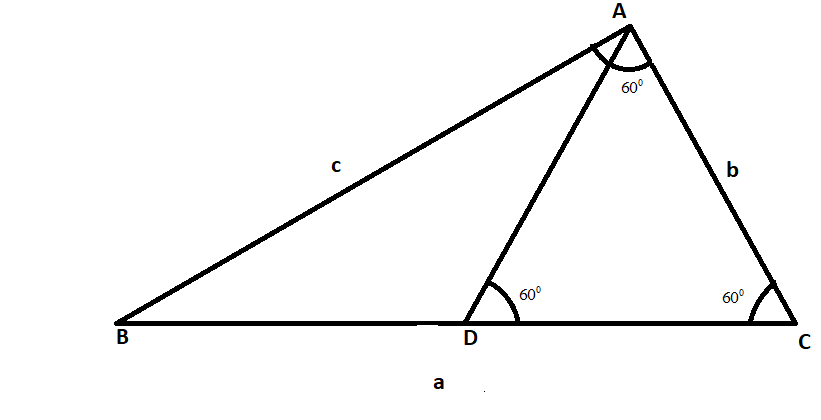
Because the triangle $\vartriangle ADC$is equilateral each of the angles in this triangle will be ${{60}^{0}}$ and all the sides will be also equal. That is
$AD=AC=DC$
And as $D$is the mid-point of side $BC$ so,
$BD=DC$
From here we can say that in triangle $\vartriangle ABD$, the sides \[BD\] and $AD$will be equal, that is $BD=AD$ making it an isosceles triangle. And by the theorem of an isosceles triangle we know that angles opposite to the equal sides of an isosceles triangle are also equal.
Hence,
$\angle ABD=\angle DAB$
Let this angle be $x$ so,
$\angle ABD=\angle DAB=x$
Now we know that the angle formed on the straight line is ${{180}^{0}}$. So to calculate the angle $\angle ADB$ we will subtract $\angle ADC$ from ${{180}^{0}}$.
$\begin{align}
& \angle ADB={{180}^{0}}-{{60}^{0}} \\
& ={{120}^{0}}
\end{align}$
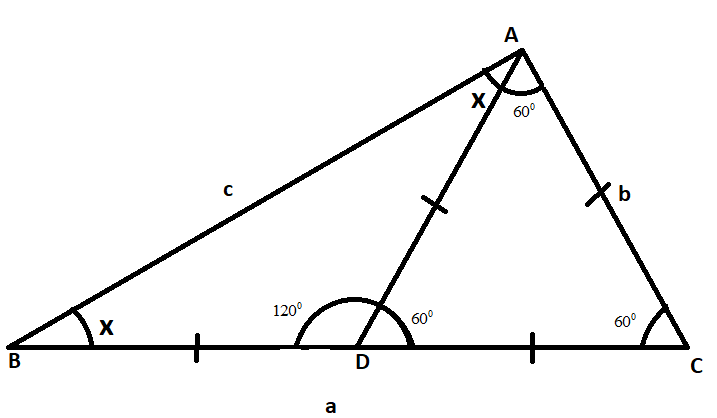
We will now find the value of angle $x$ using the angle sum property of the triangle.
$\begin{align}
& \angle BAD+\angle ADB+\angle ABD={{180}^{0}} \\
& x+x+{{120}^{0}}={{180}^{0}} \\
& 2x={{60}^{0}} \\
& x={{30}^{0}}
\end{align}$
We will now apply the Law of sine by equating to some constant $k$,
$\begin{align}
& \frac{a}{\sin A}=\frac{b}{\sin B}=\frac{c}{\sin C}=k \\
& \frac{a}{\sin ({{60}^{0}}+{{30}^{0}})}=\frac{b}{\sin {{30}^{0}}}=\frac{c}{\sin {{60}^{0}}}=k \\
& \frac{a}{1}=\frac{b}{\frac{1}{2}}=\frac{c}{\frac{\sqrt{3}}{2}}=k \\
& a=2b=\frac{2c}{\sqrt{3}}=k
\end{align}$
The values of $a,b$and $c$ will be,
$\begin{align}
& a=k \\
& b=\frac{k}{2} \\
& c=\frac{\sqrt{3}k}{2}
\end{align}$
Hence the value of ${{a}^{2}}:{{b}^{2}}:{{c}^{2}}$will be,
\[\ {{a}^{2}}:{{b}^{2}}:{{c}^{2}}=1:\frac{1}{4}:\frac{3}{4}\]
\[\ {{a}^{2}}:{{b}^{2}}:{{c}^{2}}=4:1:3\]
The triangle $\vartriangle ABC$ on which $D$ is the middle point on the side $BC$of a triangle forming an equilateral triangle$\vartriangle ADC$, then ${{a}^{2}}:{{b}^{2}}:{{c}^{2}}$ is equal to $4:1:3$.Hence the correct option is (B).
Note:
The angle sum property which we have used in the solution to find the value of $x$, is a property of a triangle which states that the sum of all the interior angles in a triangle is equal to {{180}^{0}}. This property applies on each and every type of triangle whether it is acute, obtuse or a right angled triangle.
To solve this question, we will find all the angles of the triangle $\vartriangle ABC$ using properties and theorems of the triangle. After this we will use Law of sine $\frac{a}{\sin A}=\frac{b}{\sin B}=\frac{c}{\sin C}$and equate it some constant and by substituting all the values of the angles we will find the value of $a,b$and $c$. We will put the value of $a,b$and $c$ in ${{a}^{2}}:{{b}^{2}}:{{c}^{2}}$and then find the ratio.
Complete step-by-step solution:
We are given a triangle $\vartriangle ABC$in which $D$ is the middle point on the side $BC$. We have to find the ratio ${{a}^{2}}:{{b}^{2}}:{{c}^{2}}$if the triangle $\vartriangle ADC$is equilateral.
In triangle $\vartriangle ABC$, the value of the sides will be,
$AB=c,BC=a$ and $AC=b$.
Now we will make the diagram of the triangle $\vartriangle ABC$ with $D$ being the middle point on the side $BC$forming an equilateral triangle $\vartriangle ADC$.
Because the triangle $\vartriangle ADC$is equilateral each of the angles in this triangle will be ${{60}^{0}}$ and all the sides will be also equal. That is
$AD=AC=DC$
And as $D$is the mid-point of side $BC$ so,
$BD=DC$
From here we can say that in triangle $\vartriangle ABD$, the sides \[BD\] and $AD$will be equal, that is $BD=AD$ making it an isosceles triangle. And by the theorem of an isosceles triangle we know that angles opposite to the equal sides of an isosceles triangle are also equal.
Hence,
$\angle ABD=\angle DAB$
Let this angle be $x$ so,
$\angle ABD=\angle DAB=x$
Now we know that the angle formed on the straight line is ${{180}^{0}}$. So to calculate the angle $\angle ADB$ we will subtract $\angle ADC$ from ${{180}^{0}}$.
$\begin{align}
& \angle ADB={{180}^{0}}-{{60}^{0}} \\
& ={{120}^{0}}
\end{align}$
We will now find the value of angle $x$ using the angle sum property of the triangle.
$\begin{align}
& \angle BAD+\angle ADB+\angle ABD={{180}^{0}} \\
& x+x+{{120}^{0}}={{180}^{0}} \\
& 2x={{60}^{0}} \\
& x={{30}^{0}}
\end{align}$
We will now apply the Law of sine by equating to some constant $k$,
$\begin{align}
& \frac{a}{\sin A}=\frac{b}{\sin B}=\frac{c}{\sin C}=k \\
& \frac{a}{\sin ({{60}^{0}}+{{30}^{0}})}=\frac{b}{\sin {{30}^{0}}}=\frac{c}{\sin {{60}^{0}}}=k \\
& \frac{a}{1}=\frac{b}{\frac{1}{2}}=\frac{c}{\frac{\sqrt{3}}{2}}=k \\
& a=2b=\frac{2c}{\sqrt{3}}=k
\end{align}$
The values of $a,b$and $c$ will be,
$\begin{align}
& a=k \\
& b=\frac{k}{2} \\
& c=\frac{\sqrt{3}k}{2}
\end{align}$
Hence the value of ${{a}^{2}}:{{b}^{2}}:{{c}^{2}}$will be,
\[\ {{a}^{2}}:{{b}^{2}}:{{c}^{2}}=1:\frac{1}{4}:\frac{3}{4}\]
\[\ {{a}^{2}}:{{b}^{2}}:{{c}^{2}}=4:1:3\]
The triangle $\vartriangle ABC$ on which $D$ is the middle point on the side $BC$of a triangle forming an equilateral triangle$\vartriangle ADC$, then ${{a}^{2}}:{{b}^{2}}:{{c}^{2}}$ is equal to $4:1:3$.Hence the correct option is (B).
Note:
The angle sum property which we have used in the solution to find the value of $x$, is a property of a triangle which states that the sum of all the interior angles in a triangle is equal to {{180}^{0}}. This property applies on each and every type of triangle whether it is acute, obtuse or a right angled triangle.
Recently Updated Pages
Geometry of Complex Numbers Explained

JEE General Topics in Chemistry Important Concepts and Tips
JEE Extractive Metallurgy Important Concepts and Tips for Exam Preparation
JEE Amino Acids and Peptides Important Concepts and Tips for Exam Preparation
JEE Atomic Structure and Chemical Bonding important Concepts and Tips
Electricity and Magnetism Explained: Key Concepts & Applications
Trending doubts
JEE Main 2026: Session 2 Registration Open, City Intimation Slip, Exam Dates, Syllabus & Eligibility
JEE Main 2026 Application Login: Direct Link, Registration, Form Fill, and Steps
JEE Main Marking Scheme 2026- Paper-Wise Marks Distribution and Negative Marking Details
Understanding the Angle of Deviation in a Prism
Hybridisation in Chemistry – Concept, Types & Applications
How to Convert a Galvanometer into an Ammeter or Voltmeter
Other Pages
JEE Advanced Marks vs Ranks 2025: Understanding Category-wise Qualifying Marks and Previous Year Cut-offs
NCERT Solutions For Class 11 Maths Chapter 12 Limits and Derivatives (2025-26)
NCERT Solutions For Class 11 Maths Chapter 10 Conic Sections (2025-26)
Understanding the Electric Field of a Uniformly Charged Ring
JEE Advanced Weightage 2025 Chapter-Wise for Physics, Maths and Chemistry
Derivation of Equation of Trajectory Explained for Students