




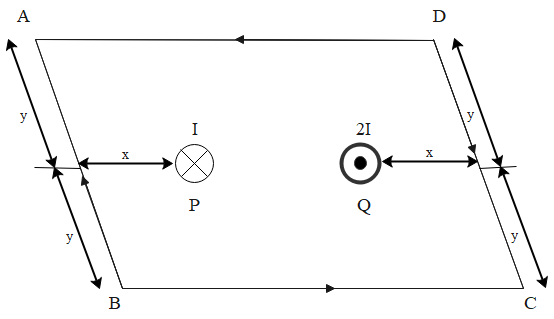
Let $\mathrm{B}_{\mathrm{P}}$ and $\mathrm{B}_{\mathrm{Q}}$ be the magnetic field produced by the wire $\mathrm{P}$ and $\mathrm{Q}$ which are placed symmetrically $\mathrm{i}$a rectangular loop ABCD as shown in figure. Current in wire $\mathrm{P}$ is directed inward and in $\mathrm{Q}$ is $2 \mathrm{I}$ directed outwards. if $\int_{\mathrm{A}}^{\mathrm{B}} \overrightarrow{\mathrm{B}} \mathrm{Q} \cdot \overrightarrow{\mathrm{d}} \ell=2 \mu_{0}$ tesla meter $, \int_{\mathrm{D}}^{\mathrm{A}} \overrightarrow{\mathrm{B}} \mathrm{p} \cdot \overrightarrow{\mathrm{d}} \ell=-2 \mu_{0}$
tesla meter $\int_{\mathbf{A}}^{\mathbf{B}}{\overrightarrow{{{\mathbf{B}}_{\mathbf{P}}}}}\cdot \overrightarrow{\mathbf{d}\ell }=-{{\mu }_{0}}$ tesla meter the value of I will be:
(A) 8 A
(B) 4 A
(C) 5 A
(D) 6 A
Answer
 Verified
249.6k+ views
Hint: We know that the magnetic field is a vector field that describes the magnetic influence on moving electric charges, electric currents, and magnetized materials. A charge that is moving in a magnetic field experiences a force perpendicular to its own velocity and to the magnetic field. The magnetic field is generated by electric currents due to the motion of convection currents of a mixture of molten iron and nickel in the Earth's outer core: these convection currents are caused by heat escaping from the core, a natural process called a geodynamic.
Complete step by step answer
We know that the principle of superposition states that every charge in space creates an electric field at a point independent of the presence of other charges in that medium. The resultant electric field is a vector sum of the electric field due to individual charges. The principle of superposition may be applied to waves whenever two (or more) waves travelling through the same medium at the same time. The waves pass through each other without being disturbed. The net displacement of the medium at any point in space or time, is simply the sum of the individual wave displacements.
$P \rightarrow A B, C D, D A, B C$
$Q \rightarrow A B, C D, D A, B C$
Given $\int_{A}^{B} \vec{B}_{Q} \cdot d \vec{l}=2 \mu_{0} T-m$
$\int_{D}^{B} \vec{B}_{P} \cdot d \vec{l}=-2 \mu_{0} T-m$
$\int_{A}^{B} \vec{B}_{P} \cdot d \vec{l}=-\mu_{0} T-m$
we know $\int \vec{B}_{n e t} \cdot D \vec{l}=\mu_{0}(2 I-I)=\mu_{0} I$
Using superposition taking wire $\mathrm{P}$ only $\int \vec{B}_{P} \cdot d \vec{l}=-\mu_{0} I$ and $\int \vec{B}_{Q} \cdot d \vec{l}=\mu_{0} 2 I$
$\int_{A}^{B} \vec{B}_{P} d \vec{l}+\int_{B}^{C} \vec{B}_{P} d \vec{l}+\int_{A}^{D} \vec{B}_{P} d \vec{l}+\int_{D}^{A} \vec{B}_{P} d \vec{l}=-\mu_{0} I$
From symmetry it is clear $\int_{B}^{C} \vec{B}_{P} d \vec{l}=\int_{D}^{A} \vec{B}_{P} d \vec{l}$
$\operatorname{As} \int_{A}^{B} \vec{B}_{Q} d \vec{l}=2 \mu_{0} I$
Hence, $\int_{B}^{C} \vec{B}_{P} d \vec{l}=-\mu_{0} I$
Also, $\int_{D}^{A} \vec{B}_{Q} d \vec{l}=-2 \mu_{0} I$
Then, $\int_{A}^{D} \vec{B}_{Q} d \vec{l}=4 \mu_{0} I=\int \vec{B}_{Q} d \vec{l}$
$\int_{A}^{B} \vec{B}_{P} d \vec{l}=-\mu_{0} I \Rightarrow \int_{D}^{C} \vec{B}_{Q} d \vec{l}=2 \mu_{0} I$
$\int \vec{B}_{\text {net }} d \vec{l}=\int \vec{B}_{P} d \vec{l}+\int \vec{B}_{Q} d \vec{l}=\mu_{0} I$
$=\left[-\mu_{0} I-\mu_{0} I-2 \mu_{0} I-2 \mu_{0} I\right]$
$+\left[2 \mu_{0} I+2 \mu_{0} I+4 \mu_{0} I+4 \mu_{0} I\right]$
$=-6 \mu_{0} I+12 \mu_{0} I=\mu_{0}(6 I)$
Hence, $I=6 A .$
So option D is correct.
Note:
We know that the superposition theorem states that for a linear system (notably including the subcategory of time-invariant linear systems) the response (voltage or current) in any branch of a bilateral linear circuit having more than one independent source equals the algebraic sum of the responses caused by each independent source. The application of superposition theorem is, we can employ only for linear circuits as well as the circuit which has more supplies. Equivalent section currents and voltages algebraically included discovering what they will perform with every power supply in effect. The total current in any part of a linear circuit equals the algebraic sum of the currents produced by each source separately. To evaluate the separate currents to be combined, replace all other voltage sources by short circuits and all other current sources by open circuits.
Complete step by step answer
We know that the principle of superposition states that every charge in space creates an electric field at a point independent of the presence of other charges in that medium. The resultant electric field is a vector sum of the electric field due to individual charges. The principle of superposition may be applied to waves whenever two (or more) waves travelling through the same medium at the same time. The waves pass through each other without being disturbed. The net displacement of the medium at any point in space or time, is simply the sum of the individual wave displacements.
$P \rightarrow A B, C D, D A, B C$
$Q \rightarrow A B, C D, D A, B C$
Given $\int_{A}^{B} \vec{B}_{Q} \cdot d \vec{l}=2 \mu_{0} T-m$
$\int_{D}^{B} \vec{B}_{P} \cdot d \vec{l}=-2 \mu_{0} T-m$
$\int_{A}^{B} \vec{B}_{P} \cdot d \vec{l}=-\mu_{0} T-m$
we know $\int \vec{B}_{n e t} \cdot D \vec{l}=\mu_{0}(2 I-I)=\mu_{0} I$
Using superposition taking wire $\mathrm{P}$ only $\int \vec{B}_{P} \cdot d \vec{l}=-\mu_{0} I$ and $\int \vec{B}_{Q} \cdot d \vec{l}=\mu_{0} 2 I$
$\int_{A}^{B} \vec{B}_{P} d \vec{l}+\int_{B}^{C} \vec{B}_{P} d \vec{l}+\int_{A}^{D} \vec{B}_{P} d \vec{l}+\int_{D}^{A} \vec{B}_{P} d \vec{l}=-\mu_{0} I$
From symmetry it is clear $\int_{B}^{C} \vec{B}_{P} d \vec{l}=\int_{D}^{A} \vec{B}_{P} d \vec{l}$
$\operatorname{As} \int_{A}^{B} \vec{B}_{Q} d \vec{l}=2 \mu_{0} I$
Hence, $\int_{B}^{C} \vec{B}_{P} d \vec{l}=-\mu_{0} I$
Also, $\int_{D}^{A} \vec{B}_{Q} d \vec{l}=-2 \mu_{0} I$
Then, $\int_{A}^{D} \vec{B}_{Q} d \vec{l}=4 \mu_{0} I=\int \vec{B}_{Q} d \vec{l}$
$\int_{A}^{B} \vec{B}_{P} d \vec{l}=-\mu_{0} I \Rightarrow \int_{D}^{C} \vec{B}_{Q} d \vec{l}=2 \mu_{0} I$
$\int \vec{B}_{\text {net }} d \vec{l}=\int \vec{B}_{P} d \vec{l}+\int \vec{B}_{Q} d \vec{l}=\mu_{0} I$
$=\left[-\mu_{0} I-\mu_{0} I-2 \mu_{0} I-2 \mu_{0} I\right]$
$+\left[2 \mu_{0} I+2 \mu_{0} I+4 \mu_{0} I+4 \mu_{0} I\right]$
$=-6 \mu_{0} I+12 \mu_{0} I=\mu_{0}(6 I)$
Hence, $I=6 A .$
So option D is correct.
Note:
We know that the superposition theorem states that for a linear system (notably including the subcategory of time-invariant linear systems) the response (voltage or current) in any branch of a bilateral linear circuit having more than one independent source equals the algebraic sum of the responses caused by each independent source. The application of superposition theorem is, we can employ only for linear circuits as well as the circuit which has more supplies. Equivalent section currents and voltages algebraically included discovering what they will perform with every power supply in effect. The total current in any part of a linear circuit equals the algebraic sum of the currents produced by each source separately. To evaluate the separate currents to be combined, replace all other voltage sources by short circuits and all other current sources by open circuits.
Recently Updated Pages
JEE Isolation, Preparation and Properties of Non-metals Important Concepts and Tips for Exam Preparation

Isoelectronic Definition in Chemistry: Meaning, Examples & Trends
Ionisation Energy and Ionisation Potential Explained
Iodoform Reactions - Important Concepts and Tips for JEE
Introduction to Dimensions: Understanding the Basics
Instantaneous Velocity Explained: Formula, Examples & Graphs
Trending doubts
Understanding the Angle of Deviation in a Prism
Understanding Centrifugal Force in Physics
Understanding Charging and Discharging of Capacitors
Understanding Electromagnetic Waves and Their Importance
Formula for number of images formed by two plane mirrors class 12 physics JEE_Main
Explain the construction and working of a GeigerMuller class 12 physics JEE_Main
Other Pages
Class 12 Physics Index 2024–25: Complete Syllabus & Chapters
A point charge is placed at the corner of a cube The class 12 physics JEE_Main
Germanium and silicon junction diodes are connected class 12 physics JEE_Main
A Zener diode having breakdown voltage equal to 15V class 12 physics JEE_Main
A B C D E and F are conducting plates each of area class 12 physics JEE_MAIN
Understanding Collisions: Types and Examples for Students