




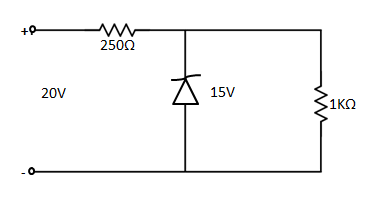
A Zener diode, having breakdown voltage equal to \[15V\] is used in a voltage regulator circuit shown in figure. The current through the diode is:
A) $10mA$
B) $15mA$
C) $20mA$
D) $5mA$
Answer
 Verified
300.3k+ views
Hint: Zener diode is a semiconductor diode in which a critical reverse voltage a large reverse current can flow. Zener diode is like a normal PN junction diode but it is operated in a reverse biased condition whereas PN junction diode operates only in the forward biased condition.
Formula used:
Ohm’s law, \[V = IR\]
Where,
\[V\]=voltage across the circuit
\[I\]=current flowing through the circuit
\[R\] =resistance across the circuit.
Complete step by step answer:
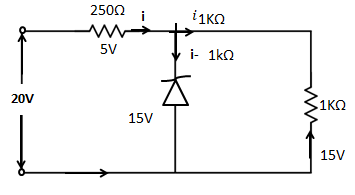
First, we have to find the current flows across the resistance \[250\Omega \].
$\Rightarrow$ \[{I_{250\Omega }} = \dfrac{{20 - 15}}{{250\Omega }}\]
$\Rightarrow$ \[{I_{250\Omega }} = \dfrac{5}{{250}}\]
$\Rightarrow$ \[{I_{250\Omega }} = 20mA\]
The current flows through the \[250\Omega \] resistance is $20mA$.
Next, we have to find the current across the resistance $1K\Omega $
$\Rightarrow$ ${I_{1K\Omega }} = \dfrac{{15}}{{1 \times {{10}^3}}}$
$\Rightarrow$ ${I_{1K\Omega }} = 15mA$
The current flows through the $1K\Omega $ resistance is $15mA$
The difference of these two current flows through the zener diode. Therefore, current flows through the zener diode is,
$\Rightarrow$ $I = 20mA - 15mA$
$\Rightarrow$ $I = 5mA$
Hence the current flow through the zener diode is $5mA$.Therefore the correct option is option D.
Additional information:
(i) A Zener diode is a single normal diode but connected in reverse bias. It is a specially designed high doped PN junction diode.
(ii) The Zener diode is reverse biasing. The reverse biasing means the n-type material of the diode is connected to the positive terminal of the supply and P-type is connected to the negative terminal of the supply. The depletion region of the diode is very thin because it is made of the heavily doped semiconductor material.
Note: The Zener diode is used in the voltage stabilizer in regulating the voltage. It provides constant voltage from the fluctuating voltage source to the load. The Zener diode is connected in parallel across the load and maintains the constant voltage and hence it stabilizes the voltage.
Formula used:
Ohm’s law, \[V = IR\]
Where,
\[V\]=voltage across the circuit
\[I\]=current flowing through the circuit
\[R\] =resistance across the circuit.
Complete step by step answer:
First, we have to find the current flows across the resistance \[250\Omega \].
$\Rightarrow$ \[{I_{250\Omega }} = \dfrac{{20 - 15}}{{250\Omega }}\]
$\Rightarrow$ \[{I_{250\Omega }} = \dfrac{5}{{250}}\]
$\Rightarrow$ \[{I_{250\Omega }} = 20mA\]
The current flows through the \[250\Omega \] resistance is $20mA$.
Next, we have to find the current across the resistance $1K\Omega $
$\Rightarrow$ ${I_{1K\Omega }} = \dfrac{{15}}{{1 \times {{10}^3}}}$
$\Rightarrow$ ${I_{1K\Omega }} = 15mA$
The current flows through the $1K\Omega $ resistance is $15mA$
The difference of these two current flows through the zener diode. Therefore, current flows through the zener diode is,
$\Rightarrow$ $I = 20mA - 15mA$
$\Rightarrow$ $I = 5mA$
Hence the current flow through the zener diode is $5mA$.Therefore the correct option is option D.
Additional information:
(i) A Zener diode is a single normal diode but connected in reverse bias. It is a specially designed high doped PN junction diode.
(ii) The Zener diode is reverse biasing. The reverse biasing means the n-type material of the diode is connected to the positive terminal of the supply and P-type is connected to the negative terminal of the supply. The depletion region of the diode is very thin because it is made of the heavily doped semiconductor material.
Note: The Zener diode is used in the voltage stabilizer in regulating the voltage. It provides constant voltage from the fluctuating voltage source to the load. The Zener diode is connected in parallel across the load and maintains the constant voltage and hence it stabilizes the voltage.
Recently Updated Pages
If the magnetizing field on a ferromagnetic material class 12 physics JEE_Main

A point charge is placed at the corner of a cube The class 12 physics JEE_Main
What changes occur if the monochromatic light used class 12 physics JEE_Main
The unit of specific conductance is A Ohm B Ohmmetre class 12 physics JEE_Main
Which lens is used in magnifying glass A Concave lens class 12 physics JEE_Main
Sir C V Raman won the Nobel Prize in which year A 1928 class 12 physics JEE_Main
Trending doubts
JEE Main 2026: Exam Dates, Session 2 Updates, City Slip, Admit Card & Latest News
Understanding the Electric Field of a Uniformly Charged Ring
Electron Gain Enthalpy and Electron Affinity Explained
Derivation of Equation of Trajectory Explained for Students
Understanding Atomic Structure for Beginners
How to Convert a Galvanometer into an Ammeter or Voltmeter
Other Pages
CBSE Class 12 Physics Question Paper 2026: Download SET-wise PDF with Answer Key & Analysis
JEE Advanced Percentile vs Marks 2026: JEE Main Cutoff, AIR & IIT Admission Guide
Understanding Uniform Acceleration in Physics
Hybridisation in Chemistry – Concept, Types & Applications
Effective Nuclear Charge for JEE
Understanding the Angle of Deviation in a Prism