




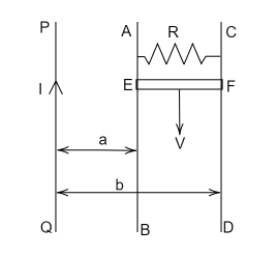
Infinite current-carrying conductor \[PQ\] . $AB$ and $CD$ are smooth conducting rods on which a conductor $EF$ moves with constant velocity $V$ as shown in the figure. The force needed to maintain a constant speed $EF$ is
Answer
 Verified
232.8k+ views
Hint: Find the magnetic field due to the current-carrying wire. Use this magnetic field equation to find the induced emf between $EF$ . Using Ohm’s law, find the current in the loop and hence find the force required to maintain the constant speed.
Complete Step by step solution:
The equation for the magnetic field around the current-carrying wire at a distance $r$ is given by
$\Rightarrow$ $B=\dfrac{{{\mu }_{o}}I}{2\pi r}$
Emf induced by the current-carrying rod $PQ$ on the rod $EF$ is given by
$\Rightarrow$ $emf=\int\limits_{a}^{b}{BVdr}$
Substituting the already written equation for the magnetic field into the above equation, we get
$\Rightarrow$ $emf=\int\limits_{a}^{b}{\dfrac{{{\mu }_{o}}I}{2\pi r}Vdr}$
After integration and substituting the lower and upper limit into the integrated term, we get
$\Rightarrow$ $emf=\dfrac{{{\mu }_{o}}IV}{2\pi }\ln \left( \dfrac{b}{a} \right)$
By Ohm's law,
$I=\dfrac{V}{R}$
Therefore, using OHM’s law, we get the current due to induced emf as
$i=\dfrac{emf}{R}$
By substituting the derived equation for emf in the above equation for current, we get
$\Rightarrow$ $i=\dfrac{{{\mu }_{o}}IV}{2\pi R}\ln \left( \dfrac{b}{a} \right)$
Now, the force on the induced current-carrying rod due to the magnetic field produced due to the current flowing through the rod $PQ$ is given by
$\Rightarrow$ $F=\int\limits_{a}^{b}{Bidr}$
By substituting the equations for the magnetic field and the induced current, we get
$F=\int\limits_{a}^{b}{\dfrac{{{\mu }_{o}}I}{2\pi r}\dfrac{{{\mu }_{o}}IV}{2\pi R}\ln \left( \dfrac{b}{a} \right)dr}$
Integrating the above equation and substituting the upper and lower limits to the integrated equation gives us
$\Rightarrow$ $F=\dfrac{V}{R}{{\left( \dfrac{{{\mu }_{o}}I}{2\pi }\ln \left( \dfrac{b}{a} \right) \right)}^{2}}$
This is the force required to move the rod $EF$ at a constant velocity $V$ .
Note:
Force on a current-carrying conductor is given by
$F=BIL\sin \theta $
Here, $\theta $ is the angle subtended between the conductor and the direction of the magnetic field. In the given question, the angle between the conductor and the magnetic field is found to be ${{90}^{\circ }}$ . So, $\sin \theta $ becomes $1$ and that is the reason we don’t see the sine term in the equation.
Complete Step by step solution:
The equation for the magnetic field around the current-carrying wire at a distance $r$ is given by
$\Rightarrow$ $B=\dfrac{{{\mu }_{o}}I}{2\pi r}$
Emf induced by the current-carrying rod $PQ$ on the rod $EF$ is given by
$\Rightarrow$ $emf=\int\limits_{a}^{b}{BVdr}$
Substituting the already written equation for the magnetic field into the above equation, we get
$\Rightarrow$ $emf=\int\limits_{a}^{b}{\dfrac{{{\mu }_{o}}I}{2\pi r}Vdr}$
After integration and substituting the lower and upper limit into the integrated term, we get
$\Rightarrow$ $emf=\dfrac{{{\mu }_{o}}IV}{2\pi }\ln \left( \dfrac{b}{a} \right)$
By Ohm's law,
$I=\dfrac{V}{R}$
Therefore, using OHM’s law, we get the current due to induced emf as
$i=\dfrac{emf}{R}$
By substituting the derived equation for emf in the above equation for current, we get
$\Rightarrow$ $i=\dfrac{{{\mu }_{o}}IV}{2\pi R}\ln \left( \dfrac{b}{a} \right)$
Now, the force on the induced current-carrying rod due to the magnetic field produced due to the current flowing through the rod $PQ$ is given by
$\Rightarrow$ $F=\int\limits_{a}^{b}{Bidr}$
By substituting the equations for the magnetic field and the induced current, we get
$F=\int\limits_{a}^{b}{\dfrac{{{\mu }_{o}}I}{2\pi r}\dfrac{{{\mu }_{o}}IV}{2\pi R}\ln \left( \dfrac{b}{a} \right)dr}$
Integrating the above equation and substituting the upper and lower limits to the integrated equation gives us
$\Rightarrow$ $F=\dfrac{V}{R}{{\left( \dfrac{{{\mu }_{o}}I}{2\pi }\ln \left( \dfrac{b}{a} \right) \right)}^{2}}$
This is the force required to move the rod $EF$ at a constant velocity $V$ .
Note:
Force on a current-carrying conductor is given by
$F=BIL\sin \theta $
Here, $\theta $ is the angle subtended between the conductor and the direction of the magnetic field. In the given question, the angle between the conductor and the magnetic field is found to be ${{90}^{\circ }}$ . So, $\sin \theta $ becomes $1$ and that is the reason we don’t see the sine term in the equation.
Recently Updated Pages
Circuit Switching vs Packet Switching: Key Differences Explained

JEE General Topics in Chemistry Important Concepts and Tips
JEE Extractive Metallurgy Important Concepts and Tips for Exam Preparation
JEE Amino Acids and Peptides Important Concepts and Tips for Exam Preparation
JEE Atomic Structure and Chemical Bonding important Concepts and Tips
Electricity and Magnetism Explained: Key Concepts & Applications
Trending doubts
JEE Main 2026: Session 2 Registration Open, City Intimation Slip, Exam Dates, Syllabus & Eligibility
JEE Main 2026 Application Login: Direct Link, Registration, Form Fill, and Steps
JEE Main Marking Scheme 2026- Paper-Wise Marks Distribution and Negative Marking Details
Understanding the Angle of Deviation in a Prism
Hybridisation in Chemistry – Concept, Types & Applications
How to Convert a Galvanometer into an Ammeter or Voltmeter
Other Pages
JEE Advanced Marks vs Ranks 2025: Understanding Category-wise Qualifying Marks and Previous Year Cut-offs
Dual Nature of Radiation and Matter Class 12 Physics Chapter 11 CBSE Notes - 2025-26
Understanding Uniform Acceleration in Physics
Understanding the Electric Field of a Uniformly Charged Ring
JEE Advanced Weightage 2025 Chapter-Wise for Physics, Maths and Chemistry
Derivation of Equation of Trajectory Explained for Students