




If \[\left( {a,{a^2}} \right)\] falls inside the angle made by the lines \[y = \dfrac{x}{2}, x > 0\] and \[y = 3x, x > 0\]. Then find the interval of \[a\].
A. \[\left( {3,\infty } \right)\]
B. \[\left( {\dfrac{1}{2},3} \right)\]
C. \[\left( { - 3, - \left( {\dfrac{1}{2}} \right)} \right)\]
D. \[\left( {0,\dfrac{1}{2}} \right)\]
Answer
 Verified
232.8k+ views
Hint In the given question, two equations of lines and a point are given. We substitute the coordinates of the point in both equations and apply the conditions of greater than 0 or less than 0. In the end, simplify both inequality equations and get the interval of \[a\].
Formula used
If a point \[\left( {{x_1},{y_1}} \right)\] lies above the line \[ax + by = c\], then the inequality equation is \[a{x_1} + b{y_1} > c\].
If a point \[\left( {{x_1},{y_1}} \right)\] lies below the line \[ax + by = c\], then the inequality equation is \[a{x_1} + b{y_1} < c\].
Complete step by step solution:
The given equations of lines are \[y = \dfrac{x}{2}, x > 0\] and \[y = 3x, x > 0\].
The point \[\left( {a,{a^2}} \right)\] lies inside the angle made by the given two lines.
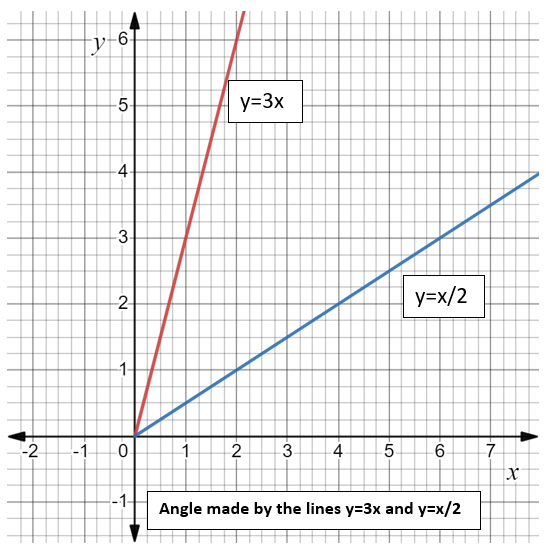
The point \[\left( {a,{a^2}} \right)\] lies above the line \[y - \dfrac{x}{2} = 0, x > 0\].
So, the inequality equation is
\[{a^2} - \dfrac{a}{2} > 0\]
\[ \Rightarrow \]\[a\left( {a - \dfrac{1}{2}} \right) > 0\]
\[ \Rightarrow \]\[a > 0\] and \[a > \dfrac{1}{2}\] \[.....\left( 1 \right)\]
The point \[\left( {a,{a^2}} \right)\] lies below the line \[y - 3x = 0, x > 0\].
So, the inequality equation is
\[{a^2} - 3a < 0\]
\[ \Rightarrow \]\[a\left( {a - 3} \right) < 0\]
\[ \Rightarrow \]\[a < 0\] and \[a < 3\] \[.....\left( 2 \right)\]
From equation \[\left( 1 \right)\] and \[\left( 2 \right)\], we get
\[a > \dfrac{1}{2}\] or \[a < 0\] and \[0 < a < 3\]
\[ \Rightarrow \]\[\dfrac{1}{2} < a < 3\]
\[ \Rightarrow \]\[a \in \left( {\dfrac{1}{2},3} \right)\]
Hence the correct option is B.
Note:The “and” word represents the intersection of two sets and the “or” word denotes the union of two sets. Students are often confused by these two words.
Students often get confused in the conversion of the inequality into an interval. Use the following rules to understand the conversion.
\[a < x < b \Rightarrow x \in \left( {a,b} \right)\]
\[a < x \le b \Rightarrow x \in \left( {a,b} \right]\]
\[a \le x < b \Rightarrow x \in \left[ {a,b} \right)\]
\[a \le x \le b \Rightarrow x \in \left[ {a,b} \right]\]
Formula used
If a point \[\left( {{x_1},{y_1}} \right)\] lies above the line \[ax + by = c\], then the inequality equation is \[a{x_1} + b{y_1} > c\].
If a point \[\left( {{x_1},{y_1}} \right)\] lies below the line \[ax + by = c\], then the inequality equation is \[a{x_1} + b{y_1} < c\].
Complete step by step solution:
The given equations of lines are \[y = \dfrac{x}{2}, x > 0\] and \[y = 3x, x > 0\].
The point \[\left( {a,{a^2}} \right)\] lies inside the angle made by the given two lines.
The point \[\left( {a,{a^2}} \right)\] lies above the line \[y - \dfrac{x}{2} = 0, x > 0\].
So, the inequality equation is
\[{a^2} - \dfrac{a}{2} > 0\]
\[ \Rightarrow \]\[a\left( {a - \dfrac{1}{2}} \right) > 0\]
\[ \Rightarrow \]\[a > 0\] and \[a > \dfrac{1}{2}\] \[.....\left( 1 \right)\]
The point \[\left( {a,{a^2}} \right)\] lies below the line \[y - 3x = 0, x > 0\].
So, the inequality equation is
\[{a^2} - 3a < 0\]
\[ \Rightarrow \]\[a\left( {a - 3} \right) < 0\]
\[ \Rightarrow \]\[a < 0\] and \[a < 3\] \[.....\left( 2 \right)\]
From equation \[\left( 1 \right)\] and \[\left( 2 \right)\], we get
\[a > \dfrac{1}{2}\] or \[a < 0\] and \[0 < a < 3\]
\[ \Rightarrow \]\[\dfrac{1}{2} < a < 3\]
\[ \Rightarrow \]\[a \in \left( {\dfrac{1}{2},3} \right)\]
Hence the correct option is B.
Note:The “and” word represents the intersection of two sets and the “or” word denotes the union of two sets. Students are often confused by these two words.
Students often get confused in the conversion of the inequality into an interval. Use the following rules to understand the conversion.
\[a < x < b \Rightarrow x \in \left( {a,b} \right)\]
\[a < x \le b \Rightarrow x \in \left( {a,b} \right]\]
\[a \le x < b \Rightarrow x \in \left[ {a,b} \right)\]
\[a \le x \le b \Rightarrow x \in \left[ {a,b} \right]\]
Recently Updated Pages
Geometry of Complex Numbers Explained

JEE General Topics in Chemistry Important Concepts and Tips
JEE Extractive Metallurgy Important Concepts and Tips for Exam Preparation
JEE Amino Acids and Peptides Important Concepts and Tips for Exam Preparation
JEE Atomic Structure and Chemical Bonding important Concepts and Tips
Electricity and Magnetism Explained: Key Concepts & Applications
Trending doubts
JEE Main 2026: Session 2 Registration Open, City Intimation Slip, Exam Dates, Syllabus & Eligibility
JEE Main 2026 Application Login: Direct Link, Registration, Form Fill, and Steps
JEE Main Marking Scheme 2026- Paper-Wise Marks Distribution and Negative Marking Details
Understanding the Angle of Deviation in a Prism
Hybridisation in Chemistry – Concept, Types & Applications
How to Convert a Galvanometer into an Ammeter or Voltmeter
Other Pages
JEE Advanced Marks vs Ranks 2025: Understanding Category-wise Qualifying Marks and Previous Year Cut-offs
NCERT Solutions For Class 11 Maths Chapter 12 Limits and Derivatives (2025-26)
NCERT Solutions For Class 11 Maths Chapter 10 Conic Sections (2025-26)
Understanding the Electric Field of a Uniformly Charged Ring
JEE Advanced Weightage 2025 Chapter-Wise for Physics, Maths and Chemistry
Derivation of Equation of Trajectory Explained for Students