




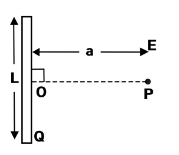
Find the electric field \[E\] at point \[P\] (as shown in the figure) on the perpendicular bisector of a uniformly charged thin wire of length \[L\] carrying a charge \[Q\]. The distance of the point \[P\] from the center of the rod is \[a = \left( {\frac{{\sqrt 3 }}{2}} \right)L\]
A. \[\frac{Q}{{2\sqrt 3 \pi {\varepsilon _o}{L^2}}}\]
B. \[\frac{{\sqrt 3 Q}}{{4\pi {\varepsilon _0}{L^2}}}\]
C. \[\frac{Q}{{3\pi {\varepsilon _o}{L^2}}}\]
D. \[\frac{Q}{{4\pi {\varepsilon _o}{L^2}}}\]
Answer
 Verified
232.5k+ views
Hint: Write down the potential resulting from a point charge first. To determine the potential at point \[P\], integration on the line charge must be done. Therefore, choose a wire element \[\left( {dx} \right)\] and calculate its potential using the same methods as for a point charge.
Formula Used:
\[{{\rm{E}}_{{\rm{net }}}} = \frac{{{\rm{K}}\lambda }}{{\rm{r}}}\left( {\sin {\theta _1} + \sin {\theta _2}} \right)\]
Where \[{\theta _1},{\theta _2}\] are angle making with point \[{\rm{P}}\] from end.
Charge per unit length is \[\lambda \]
Complete answer:
We have been given in the question that,
Length of the wire \[ = L\]
Charge in the wire \[ = Q\]
Distance of the point \[P\] from the center of the rod is \[a = \left( {\frac{{\sqrt 3 }}{2}} \right)L\]
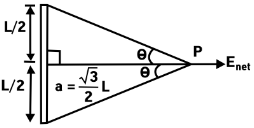
From the above diagram, we get
\[\tan \theta = \frac{{{\rm{ Perpendicular }}}}{{{\rm{ Base }}}}\]
Now, we have to observe the diagram and write the values in the above formula, we obtain\[\tan \theta = \frac{{\frac{L}{2}}}{{\frac{{\sqrt 3 }}{2}L}} = \frac{1}{{\sqrt 3 }}\]
On solving the above equation, we get
\[\theta = {30^\circ }\]
Now, we have to find electric field \[E\] at point \[P\]
Now,
\[{E_{net}} = \left( {\frac{{kQ}}{{\frac{{\sqrt 3 {L^2}}}{2}}}} \right)\left( {\sin {{30}^\circ } + \sin {{30}^\circ }} \right)\]
On solving the above equation by multiplying the terms inside the parentheses, we get
\[ = \left( {\frac{{2kQ}}{{\sqrt 3 {L^2}}}} \right)\left( {\frac{1}{2} + \frac{1}{2}} \right)\]
Now, we have to simplify the resultant equation, we have
\[ = \frac{1}{{4\pi {\varepsilon _0}}}\left( {\frac{{2Q}}{{\sqrt 3 {L^2}}}} \right)\]
On canceling the similar terms in the above expression, we get
\[ = \frac{Q}{{2\sqrt 3 \pi {\varepsilon _0}{L^2}}}\]
Where: The net electric field is \[{\rm{E}}\].
The constant is \[{\rm{K}}\].
The charge in the wire is \[{\rm{Q}}\].
The wire's length is \[{\rm{L}}\].
Absolute permittivity is \[{\varepsilon _0}\].
Therefore, the electric field \[E\] at point \[P\] (as shown in the figure) on the perpendicular bisector of a uniformly charged thin wire of length \[L\] carrying a charge \[Q\] is \[\frac{Q}{{2\sqrt 3 \pi {\varepsilon _0}{L^2}}}\].
Hence, the option A is correct.
Note: Students are likely to make mistake in these types of problems. In a brief, it can be claimed that because electric potential is a scalar number, it is zero at all points along the perpendicular bisector. The position of the force on a positive test charge is assumed to equal the position of the field.
Formula Used:
\[{{\rm{E}}_{{\rm{net }}}} = \frac{{{\rm{K}}\lambda }}{{\rm{r}}}\left( {\sin {\theta _1} + \sin {\theta _2}} \right)\]
Where \[{\theta _1},{\theta _2}\] are angle making with point \[{\rm{P}}\] from end.
Charge per unit length is \[\lambda \]
Complete answer:
We have been given in the question that,
Length of the wire \[ = L\]
Charge in the wire \[ = Q\]
Distance of the point \[P\] from the center of the rod is \[a = \left( {\frac{{\sqrt 3 }}{2}} \right)L\]
From the above diagram, we get
\[\tan \theta = \frac{{{\rm{ Perpendicular }}}}{{{\rm{ Base }}}}\]
Now, we have to observe the diagram and write the values in the above formula, we obtain\[\tan \theta = \frac{{\frac{L}{2}}}{{\frac{{\sqrt 3 }}{2}L}} = \frac{1}{{\sqrt 3 }}\]
On solving the above equation, we get
\[\theta = {30^\circ }\]
Now, we have to find electric field \[E\] at point \[P\]
Now,
\[{E_{net}} = \left( {\frac{{kQ}}{{\frac{{\sqrt 3 {L^2}}}{2}}}} \right)\left( {\sin {{30}^\circ } + \sin {{30}^\circ }} \right)\]
On solving the above equation by multiplying the terms inside the parentheses, we get
\[ = \left( {\frac{{2kQ}}{{\sqrt 3 {L^2}}}} \right)\left( {\frac{1}{2} + \frac{1}{2}} \right)\]
Now, we have to simplify the resultant equation, we have
\[ = \frac{1}{{4\pi {\varepsilon _0}}}\left( {\frac{{2Q}}{{\sqrt 3 {L^2}}}} \right)\]
On canceling the similar terms in the above expression, we get
\[ = \frac{Q}{{2\sqrt 3 \pi {\varepsilon _0}{L^2}}}\]
Where: The net electric field is \[{\rm{E}}\].
The constant is \[{\rm{K}}\].
The charge in the wire is \[{\rm{Q}}\].
The wire's length is \[{\rm{L}}\].
Absolute permittivity is \[{\varepsilon _0}\].
Therefore, the electric field \[E\] at point \[P\] (as shown in the figure) on the perpendicular bisector of a uniformly charged thin wire of length \[L\] carrying a charge \[Q\] is \[\frac{Q}{{2\sqrt 3 \pi {\varepsilon _0}{L^2}}}\].
Hence, the option A is correct.
Note: Students are likely to make mistake in these types of problems. In a brief, it can be claimed that because electric potential is a scalar number, it is zero at all points along the perpendicular bisector. The position of the force on a positive test charge is assumed to equal the position of the field.
Recently Updated Pages
Circuit Switching vs Packet Switching: Key Differences Explained

JEE General Topics in Chemistry Important Concepts and Tips
JEE Extractive Metallurgy Important Concepts and Tips for Exam Preparation
JEE Amino Acids and Peptides Important Concepts and Tips for Exam Preparation
JEE Atomic Structure and Chemical Bonding important Concepts and Tips
Electricity and Magnetism Explained: Key Concepts & Applications
Trending doubts
JEE Main 2026: Session 2 Registration Open, City Intimation Slip, Exam Dates, Syllabus & Eligibility
JEE Main 2026 Application Login: Direct Link, Registration, Form Fill, and Steps
JEE Main Marking Scheme 2026- Paper-Wise Marks Distribution and Negative Marking Details
Understanding the Angle of Deviation in a Prism
Hybridisation in Chemistry – Concept, Types & Applications
How to Convert a Galvanometer into an Ammeter or Voltmeter
Other Pages
JEE Advanced Marks vs Ranks 2025: Understanding Category-wise Qualifying Marks and Previous Year Cut-offs
Dual Nature of Radiation and Matter Class 12 Physics Chapter 11 CBSE Notes - 2025-26
Understanding Uniform Acceleration in Physics
Understanding the Electric Field of a Uniformly Charged Ring
JEE Advanced Weightage 2025 Chapter-Wise for Physics, Maths and Chemistry
Derivation of Equation of Trajectory Explained for Students