




How many different genotypes are possible to form a cross between the parent's RR and rr?
(A)Four
(B)One
(C)Three
(D)Two
Answer
 Verified
605.4k+ views
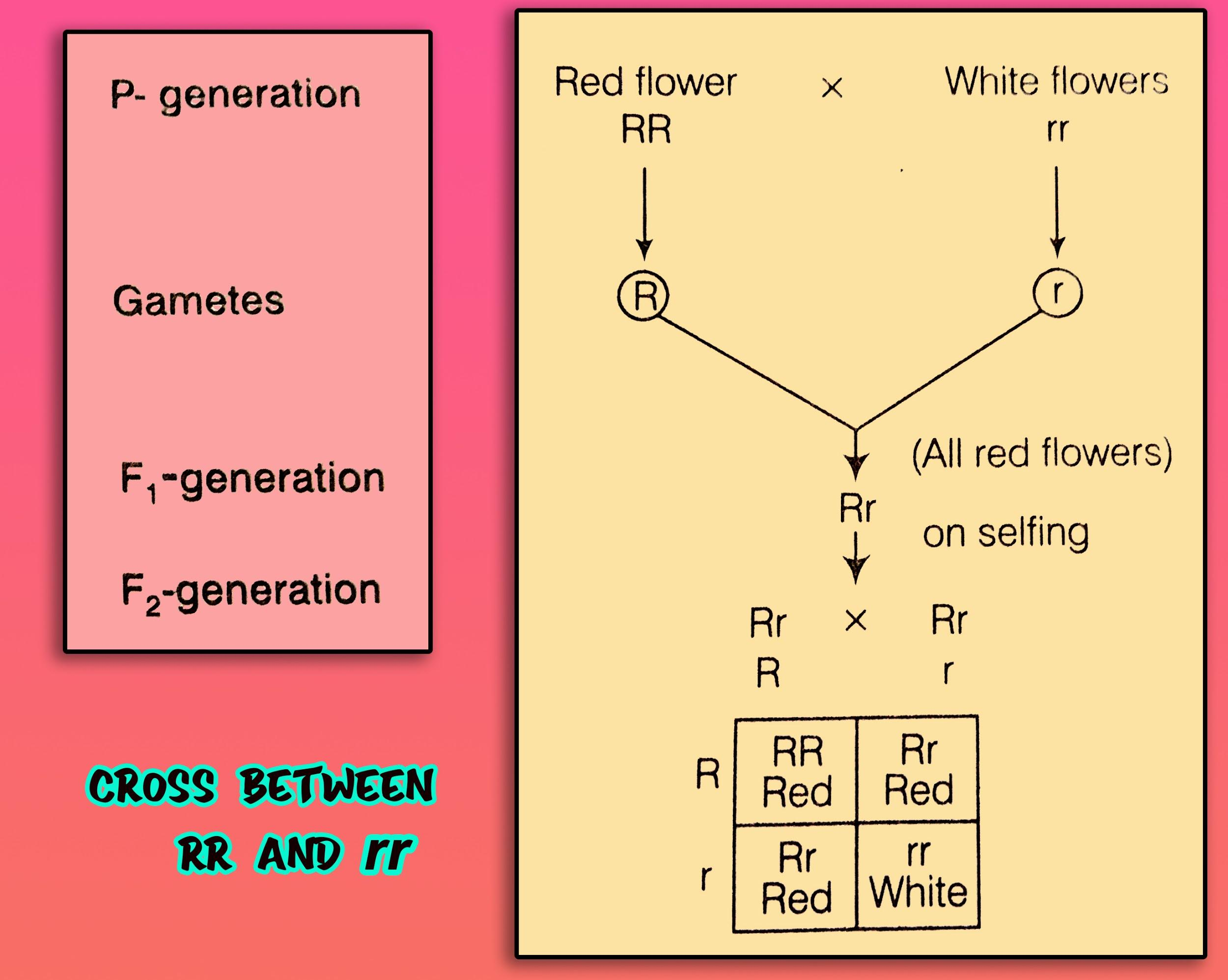
Hint: The genotypic ratio of a cross between the parent's RR and rr is found to be 1:2:1. This genotype is defined as a complete set of the heritable genes of an organism, or in a simpler way the genes that will be passed down from parents to offspring.
Complete answer:
Three different genotypes are possible to form a cross between the parents RR and rr. This cross between RR and rr is defined as a monohybrid cross. The heterozygous F1 offspring produces two types of gametes, which after selfing produce offspring which have a genotypic ratio of 1:2:1.
Additional Information: Alleles are often either dominant or recessive. Dominant alleles show their
effect even though the individual only has one copy of the allele (also referred to as being
heterozygous). As an example, the allele for brown eyes is dominant, therefore you simply need one
copy of the brown eye allele to possess brown eyes (although, with two copies you'll still have brown
eyes). When the individuals have two copies of alleles then only the effects of recessive alleles are
shown. As an example, the allele for blue eyes is recessive, therefore to possess blue eyes you would like
to possess two copies. Here in this question, the ‘R’ is dominant and ‘r’ is recessive.
So, the correct answer is ‘Three’.
Note: Many of us get confused between genotype and phenotype. The sum of an organism’s characteristics which are observable in their phenotype. The basic difference between phenotype and genotype is that, whilst genotype is inherited from an organism’s parents, the phenotype is not.
Complete answer:
Three different genotypes are possible to form a cross between the parents RR and rr. This cross between RR and rr is defined as a monohybrid cross. The heterozygous F1 offspring produces two types of gametes, which after selfing produce offspring which have a genotypic ratio of 1:2:1.
Additional Information: Alleles are often either dominant or recessive. Dominant alleles show their
effect even though the individual only has one copy of the allele (also referred to as being
heterozygous). As an example, the allele for brown eyes is dominant, therefore you simply need one
copy of the brown eye allele to possess brown eyes (although, with two copies you'll still have brown
eyes). When the individuals have two copies of alleles then only the effects of recessive alleles are
shown. As an example, the allele for blue eyes is recessive, therefore to possess blue eyes you would like
to possess two copies. Here in this question, the ‘R’ is dominant and ‘r’ is recessive.
So, the correct answer is ‘Three’.
Note: Many of us get confused between genotype and phenotype. The sum of an organism’s characteristics which are observable in their phenotype. The basic difference between phenotype and genotype is that, whilst genotype is inherited from an organism’s parents, the phenotype is not.
Recently Updated Pages
Master Class 12 Economics: Engaging Questions & Answers for Success

Master Class 12 English: Engaging Questions & Answers for Success
Master Class 12 Social Science: Engaging Questions & Answers for Success
Master Class 12 Maths: Engaging Questions & Answers for Success
Master Class 12 Physics: Engaging Questions & Answers for Success
Master Class 12 Business Studies: Engaging Questions & Answers for Success
Trending doubts
Which are the Top 10 Largest Countries of the World?
Draw a labelled sketch of the human eye class 12 physics CBSE
Differentiate between homogeneous and heterogeneous class 12 chemistry CBSE
Why is the cell called the structural and functional class 12 biology CBSE
Draw ray diagrams each showing i myopic eye and ii class 12 physics CBSE
Which is the correct genotypic ratio of mendel dihybrid class 12 biology CBSE