




What is the current flowing in the circuit?
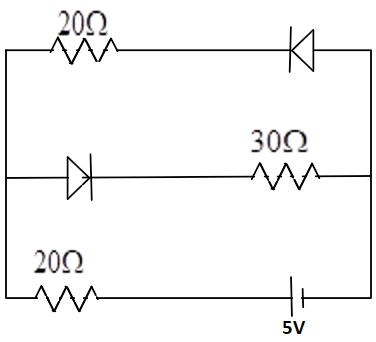
(A) $\dfrac{5}{{40}}A$
(B) $\dfrac{5}{{50}}A$
(C) $\dfrac{5}{{10}}A$
(D) $\dfrac{5}{{20}}A$
Answer
 Verified
233.1k+ views
Hint: We will use the combination of resistances theory to solve this problem. The resistors can be combined in series, parallel or mixed grouping. The voltage of the circuit is already given, after we determine the equivalent resistance of the circuit we will have to apply Ohm’s law to calculate the current flowing through the circuit.
Complete step by step solution:
Let’s start with the direction of flow of current in the given circuit. Current always flows from higher potential to lower potential in the circuit which is in this case from the positive terminal of the battery to the negative terminal.
Noticed the presence of semiconductor diodes in the circuit? Semiconductor diodes when connected to the circuit such that they are forward biased, conduct electricity and when they are present in reverse biased state they block the flow of electricity.
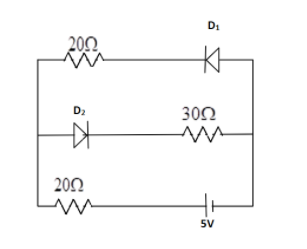
In this case the diode D1 is reverse biased and the diode D2 is forward biased. This implies that the top portion of the circuit will carry no current.
Thus the effective circuit will be like the following representation.
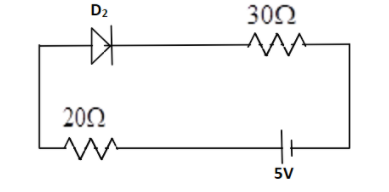
For this circuit the equivalent resistance will be calculated as per series connection of resistances.
So, $R = {R_1} + {R_2}$
Where $R$ is the equivalent resistance of the circuit containing resistances ${R_1}$ and ${R_2}$ connected in series.
Putting their respective values we get,
$ \Rightarrow R = 30 + 20 = 50\Omega $
As we have determined the equivalent resistance of the circuit, let’s apply Ohm’s law.
So the net current flowing through the circuit will be,
$I = \dfrac{V}{R}$
Where $V$ is the potential difference of the circuit.
Putting the respective values we get
$ \Rightarrow I = \dfrac{5}{{50}}A$
So the correct answer is option B.
Note:
Forward biasing of a junction diode or semiconductor diode means that the positive terminal of the diode is connected to the positive terminal of the circuit. Reverse biasing also simply means that the positive terminal is connected to the negative terminal of the circuit and as we have discussed, reverse biased junction diode blocks the flow of current in the circuit.
Complete step by step solution:
Let’s start with the direction of flow of current in the given circuit. Current always flows from higher potential to lower potential in the circuit which is in this case from the positive terminal of the battery to the negative terminal.
Noticed the presence of semiconductor diodes in the circuit? Semiconductor diodes when connected to the circuit such that they are forward biased, conduct electricity and when they are present in reverse biased state they block the flow of electricity.
In this case the diode D1 is reverse biased and the diode D2 is forward biased. This implies that the top portion of the circuit will carry no current.
Thus the effective circuit will be like the following representation.
For this circuit the equivalent resistance will be calculated as per series connection of resistances.
So, $R = {R_1} + {R_2}$
Where $R$ is the equivalent resistance of the circuit containing resistances ${R_1}$ and ${R_2}$ connected in series.
Putting their respective values we get,
$ \Rightarrow R = 30 + 20 = 50\Omega $
As we have determined the equivalent resistance of the circuit, let’s apply Ohm’s law.
So the net current flowing through the circuit will be,
$I = \dfrac{V}{R}$
Where $V$ is the potential difference of the circuit.
Putting the respective values we get
$ \Rightarrow I = \dfrac{5}{{50}}A$
So the correct answer is option B.
Note:
Forward biasing of a junction diode or semiconductor diode means that the positive terminal of the diode is connected to the positive terminal of the circuit. Reverse biasing also simply means that the positive terminal is connected to the negative terminal of the circuit and as we have discussed, reverse biased junction diode blocks the flow of current in the circuit.
Recently Updated Pages
Circuit Switching vs Packet Switching: Key Differences Explained

JEE General Topics in Chemistry Important Concepts and Tips
JEE Extractive Metallurgy Important Concepts and Tips for Exam Preparation
JEE Amino Acids and Peptides Important Concepts and Tips for Exam Preparation
JEE Atomic Structure and Chemical Bonding important Concepts and Tips
Electricity and Magnetism Explained: Key Concepts & Applications
Trending doubts
JEE Main 2026: Session 2 Registration Open, City Intimation Slip, Exam Dates, Syllabus & Eligibility
JEE Main 2026 Application Login: Direct Link, Registration, Form Fill, and Steps
JEE Main Marking Scheme 2026- Paper-Wise Marks Distribution and Negative Marking Details
Understanding the Angle of Deviation in a Prism
Hybridisation in Chemistry – Concept, Types & Applications
How to Convert a Galvanometer into an Ammeter or Voltmeter
Other Pages
JEE Advanced Marks vs Ranks 2025: Understanding Category-wise Qualifying Marks and Previous Year Cut-offs
Dual Nature of Radiation and Matter Class 12 Physics Chapter 11 CBSE Notes - 2025-26
Understanding Uniform Acceleration in Physics
Understanding the Electric Field of a Uniformly Charged Ring
JEE Advanced Weightage 2025 Chapter-Wise for Physics, Maths and Chemistry
Derivation of Equation of Trajectory Explained for Students