




A voltmeter is connected in parallel with a variable resistance which is in series with an ammeter and a cell. For one value of $R$, meters read $0.3{\text{A}}$ and $0.9{\text{V}}$. For another value of $R$ the readings are $0.25{\text{A}}$ and $1{\text{V}}$. Find the internal resistance of the cell.
A) $0.5\Omega $
B) $2\Omega $
C) $1.2\Omega $
D) $1\Omega $
Answer
 Verified
232.8k+ views
Hint: Here the variable resistance is connected in series with the cell having an internal resistance. Then the voltage across the variable resistance will be the difference between the emf of the cell and the potential drop across the internal resistance of the cell. Using the given meter readings for two different values of resistances, we can form two equations for the potential difference across the variable resistor.
Formula used:
The potential difference across a resistor is given by, $V = IR$ where $I$ is the current through the resistor and $R$ is the resistance of the resistor.
Complete step by step answer:
Step 1: Sketch a circuit diagram of the given arrangement.
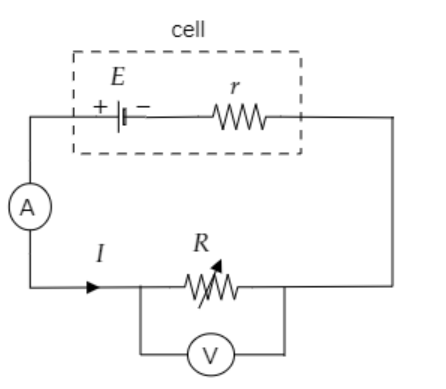
Here the resistance of the variable resistor is denoted by $R$ and the internal resistance of the cell is $r$.
Let $E$ be the emf of the cell and let $I$ be the current through the circuit.
Also, let $V$ be the potential difference across the variable resistor.
Step 2: Express the potential drop across the variable resistor for the different meter readings.
The potential difference across the variable resistor can be expressed as $V = E - \left( {I \times r} \right)$
$ \Rightarrow E = V + \left( {I \times r} \right)$ ------ (1)
Substituting for $I = 0.3{\text{A}}$ and $V = 0.9{\text{V}}$ in equation (1) we get, $E = 0.9 + 0.3r$ ------- (2)
Substituting for $I = 0.25{\text{A}}$ and $V = 1{\text{V}}$ in equation (1) we get, $E = 1 + 0.25r$ ------- (3)
Step 3: Using equations (2) and (3) obtain the internal resistance of the cell.
We can equate the R.H.S of equations (2) and (3) to obtain the internal resistance of the cell.
i.e., $0.9 + 0.3r = 1 + 0.25r$
$ \Rightarrow r = \dfrac{{0.1}}{{0.05}} = 2\Omega $
Thus the internal resistance of the cell is $r = 2\Omega $ .
So the correct option is (B).
Note: Here the internal resistance of the cell and the variable resistor are essentially connected in series. In a series connection between two resistors, the current through each resistor will be the same. However, the potential drop across the internal resistance and the variable resistance are different. The term $I \times r$ in equation (1) is the potential drop across the internal resistance of the cell. Equation (1) can also be referred to as the voltage equation of the given circuit.
Formula used:
The potential difference across a resistor is given by, $V = IR$ where $I$ is the current through the resistor and $R$ is the resistance of the resistor.
Complete step by step answer:
Step 1: Sketch a circuit diagram of the given arrangement.
Here the resistance of the variable resistor is denoted by $R$ and the internal resistance of the cell is $r$.
Let $E$ be the emf of the cell and let $I$ be the current through the circuit.
Also, let $V$ be the potential difference across the variable resistor.
Step 2: Express the potential drop across the variable resistor for the different meter readings.
The potential difference across the variable resistor can be expressed as $V = E - \left( {I \times r} \right)$
$ \Rightarrow E = V + \left( {I \times r} \right)$ ------ (1)
Substituting for $I = 0.3{\text{A}}$ and $V = 0.9{\text{V}}$ in equation (1) we get, $E = 0.9 + 0.3r$ ------- (2)
Substituting for $I = 0.25{\text{A}}$ and $V = 1{\text{V}}$ in equation (1) we get, $E = 1 + 0.25r$ ------- (3)
Step 3: Using equations (2) and (3) obtain the internal resistance of the cell.
We can equate the R.H.S of equations (2) and (3) to obtain the internal resistance of the cell.
i.e., $0.9 + 0.3r = 1 + 0.25r$
$ \Rightarrow r = \dfrac{{0.1}}{{0.05}} = 2\Omega $
Thus the internal resistance of the cell is $r = 2\Omega $ .
So the correct option is (B).
Note: Here the internal resistance of the cell and the variable resistor are essentially connected in series. In a series connection between two resistors, the current through each resistor will be the same. However, the potential drop across the internal resistance and the variable resistance are different. The term $I \times r$ in equation (1) is the potential drop across the internal resistance of the cell. Equation (1) can also be referred to as the voltage equation of the given circuit.
Recently Updated Pages
Elastic Collisions in One Dimension Explained

Elastic Collision in Two Dimensions Explained Simply
Wheatstone Bridge – Principle, Formula, Diagram & Applications
Circuit Switching vs Packet Switching: Key Differences Explained
Effective Nuclear Charge - Important Concepts and Tips for JEE
Mass vs Weight: Key Differences Explained for Students
Trending doubts
JEE Main 2026: Session 2 Registration Open, City Intimation Slip, Exam Dates, Syllabus & Eligibility
JEE Main 2026 Application Login: Direct Link, Registration, Form Fill, and Steps
JEE Main Marking Scheme 2026- Paper-Wise Marks Distribution and Negative Marking Details
Understanding the Angle of Deviation in a Prism
Hybridisation in Chemistry – Concept, Types & Applications
How to Convert a Galvanometer into an Ammeter or Voltmeter
Other Pages
JEE Advanced Marks vs Ranks 2025: Understanding Category-wise Qualifying Marks and Previous Year Cut-offs
Dual Nature of Radiation and Matter Class 12 Physics Chapter 11 CBSE Notes - 2025-26
Understanding Uniform Acceleration in Physics
Understanding the Electric Field of a Uniformly Charged Ring
JEE Advanced Weightage 2025 Chapter-Wise for Physics, Maths and Chemistry
Derivation of Equation of Trajectory Explained for Students