




A particle is moving unidirectionally on a horizontal plane under the action of a constant power-supplying energy source. Which of the following graphs accurately represents the motion of the particle in the displacement (s) – time (t) graph? (Graphs are drawn schematically and are not to scale)
A. 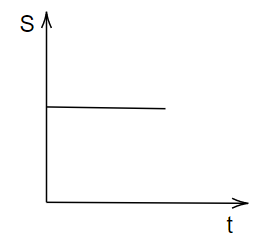
B. 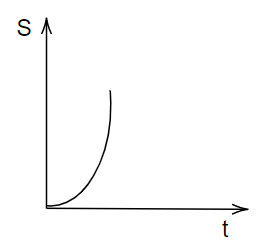
C. 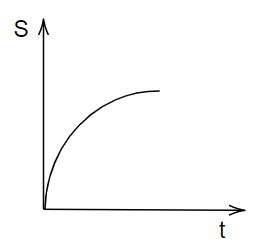
D. 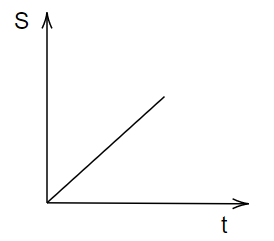
Answer
 Verified
232.8k+ views
Hint:Before solving this problem let’s understand the term displacement. When a force is applied, the object changes its position which is known as displacement. Since it is a vector quantity it has both direction and magnitude. The power supplied to the particle is the product of the force applied and the velocity at which it travels.
Formula Used:
The power supplied to the particle is,
\[P = FV\]
Where, F is force applied and V is velocity.
Complete step by step solution:
Consider a particle that is moving in one direction on a horizontal plane under the action of a constant power-supplying energy source. We need to find which of the following graphs accurately represents the motion of the particle in the displacement- time graph. We know that the power supplied to the particle is,
\[P = FV\]
We know that, \[F = m\dfrac{{dV}}{{dt}}\]
\[P = m\dfrac{{dV}}{{dt}} \times V\]
\[\Rightarrow VdV = \dfrac{P}{m}dt\]
On integrating we get the expression for V
\[\dfrac{{{V^2}}}{2} = \dfrac{P}{m}t\]
This clearly says that,
\[{V^2} \propto t\] or \[V \propto {t^{\dfrac{1}{2}}}\]
Here, velocity is,
\[V = \dfrac{\text{displacement}}{\text{time}}\]
\[ \Rightarrow V = \dfrac{S}{t}\]
Then,
\[\dfrac{S}{t} \propto {t^{\dfrac{1}{2}}}\]
\[\therefore S \propto {t^{\dfrac{3}{2}}}\]
Therefore, we represent this equation in the displacement time graph as shown in option B.
Hence, Option B is the correct answer.
Note:The displacement-time graphs show how the displacement of a moving object changes with time. If a displacement-time graph is a sloping line then it shows that the object is moving. In this graph, the slope or gradient of the line is equal to the velocity of the object.
Formula Used:
The power supplied to the particle is,
\[P = FV\]
Where, F is force applied and V is velocity.
Complete step by step solution:
Consider a particle that is moving in one direction on a horizontal plane under the action of a constant power-supplying energy source. We need to find which of the following graphs accurately represents the motion of the particle in the displacement- time graph. We know that the power supplied to the particle is,
\[P = FV\]
We know that, \[F = m\dfrac{{dV}}{{dt}}\]
\[P = m\dfrac{{dV}}{{dt}} \times V\]
\[\Rightarrow VdV = \dfrac{P}{m}dt\]
On integrating we get the expression for V
\[\dfrac{{{V^2}}}{2} = \dfrac{P}{m}t\]
This clearly says that,
\[{V^2} \propto t\] or \[V \propto {t^{\dfrac{1}{2}}}\]
Here, velocity is,
\[V = \dfrac{\text{displacement}}{\text{time}}\]
\[ \Rightarrow V = \dfrac{S}{t}\]
Then,
\[\dfrac{S}{t} \propto {t^{\dfrac{1}{2}}}\]
\[\therefore S \propto {t^{\dfrac{3}{2}}}\]
Therefore, we represent this equation in the displacement time graph as shown in option B.
Hence, Option B is the correct answer.
Note:The displacement-time graphs show how the displacement of a moving object changes with time. If a displacement-time graph is a sloping line then it shows that the object is moving. In this graph, the slope or gradient of the line is equal to the velocity of the object.
Recently Updated Pages
Circuit Switching vs Packet Switching: Key Differences Explained

JEE General Topics in Chemistry Important Concepts and Tips
JEE Extractive Metallurgy Important Concepts and Tips for Exam Preparation
JEE Amino Acids and Peptides Important Concepts and Tips for Exam Preparation
JEE Atomic Structure and Chemical Bonding important Concepts and Tips
Electricity and Magnetism Explained: Key Concepts & Applications
Trending doubts
JEE Main 2026: Session 2 Registration Open, City Intimation Slip, Exam Dates, Syllabus & Eligibility
JEE Main 2026 Application Login: Direct Link, Registration, Form Fill, and Steps
JEE Main Marking Scheme 2026- Paper-Wise Marks Distribution and Negative Marking Details
Understanding the Angle of Deviation in a Prism
Hybridisation in Chemistry – Concept, Types & Applications
How to Convert a Galvanometer into an Ammeter or Voltmeter
Other Pages
JEE Advanced Marks vs Ranks 2025: Understanding Category-wise Qualifying Marks and Previous Year Cut-offs
Dual Nature of Radiation and Matter Class 12 Physics Chapter 11 CBSE Notes - 2025-26
Understanding Uniform Acceleration in Physics
Understanding the Electric Field of a Uniformly Charged Ring
JEE Advanced Weightage 2025 Chapter-Wise for Physics, Maths and Chemistry
Derivation of Equation of Trajectory Explained for Students