




A loop ABCDEFA of straight edges has six corner points A (0,0,0), B (5,0,0), C (5,5,0), D (0,5,0), E (0,5,5) and F (0,0,5). The magnetic field in this region is \[\overrightarrow B = \left( {3\widehat i + 4\widehat {k}} \right)T\]. The quantity of flux through the loop ABCDEFA (in Wb) is ______.
Answer
 Verified
232.8k+ views
Hint: The number of magnetic field lines passing through the given closed surface is called Magnetic flux. It is denoted by $\phi $ and the unit is Weber. The magnetic flux indicates the strength of magnetic lines that are produced by a magnet.
Complete step by step solution:
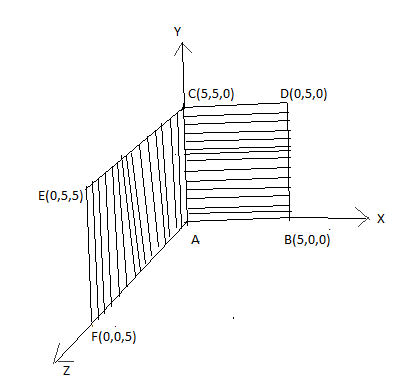
Given six corners are A (0,0,0), B (5,0,0), C (5,5,0), D (0,5,0), E (0,5,5) and F (0,0,5).
The Magnetic field, \[\overrightarrow B = \left( {3\widehat i + 4\widehat k} \right)T\]
The Magnetic flux =?
We know that magnetic flux is given by the formula, $\phi = \overrightarrow B .\overrightarrow A $
Then \[\overrightarrow A = \] (Area of ABCD) $\left( {\widehat k} \right)$+ (Area of ADEF) \[\left( {\widehat i} \right)\]
\[ \Rightarrow \overrightarrow A = 25\widehat k + 25\widehat i\]
Substituting the values of $\overrightarrow A $ and $\overrightarrow B $, we get,
\[\Rightarrow \phi = \left( {3\widehat i + 4\widehat k} \right)\left( {25\widehat i + 25\widehat k} \right)\]
\[\Rightarrow \phi = 75 + 100 = 175\]
$\therefore \phi = 175Wb$
Thus the quantity of flux through the loop ABCDEFA is 175 Wb.
Additional Information:
1. A closed path in a circuit is called a loop. It is used for executing a set of statements repeatedly, till a particular condition is satisfied.
2. Within the human body, the low-frequency magnetic fields induce the circulating currents.
Note: 1. Magnetic flux starts from the north pole and ends at the south pole and they will never intersect each other. The lines of forces that are parallel to each other and in the same direction will repel each other.
2. The magnetic flux in the open surface is not zero and through a closed surface is zero always. It always forms a closed loop. The magnetic flux depends on the area and the magnetic strength of the magnet.
3. The region around a magnet where the moving charge experiences a force is called a magnetic field. It depends on the magnet.
Complete step by step solution:
Given six corners are A (0,0,0), B (5,0,0), C (5,5,0), D (0,5,0), E (0,5,5) and F (0,0,5).
The Magnetic field, \[\overrightarrow B = \left( {3\widehat i + 4\widehat k} \right)T\]
The Magnetic flux =?
We know that magnetic flux is given by the formula, $\phi = \overrightarrow B .\overrightarrow A $
Then \[\overrightarrow A = \] (Area of ABCD) $\left( {\widehat k} \right)$+ (Area of ADEF) \[\left( {\widehat i} \right)\]
\[ \Rightarrow \overrightarrow A = 25\widehat k + 25\widehat i\]
Substituting the values of $\overrightarrow A $ and $\overrightarrow B $, we get,
\[\Rightarrow \phi = \left( {3\widehat i + 4\widehat k} \right)\left( {25\widehat i + 25\widehat k} \right)\]
\[\Rightarrow \phi = 75 + 100 = 175\]
$\therefore \phi = 175Wb$
Thus the quantity of flux through the loop ABCDEFA is 175 Wb.
Additional Information:
1. A closed path in a circuit is called a loop. It is used for executing a set of statements repeatedly, till a particular condition is satisfied.
2. Within the human body, the low-frequency magnetic fields induce the circulating currents.
Note: 1. Magnetic flux starts from the north pole and ends at the south pole and they will never intersect each other. The lines of forces that are parallel to each other and in the same direction will repel each other.
2. The magnetic flux in the open surface is not zero and through a closed surface is zero always. It always forms a closed loop. The magnetic flux depends on the area and the magnetic strength of the magnet.
3. The region around a magnet where the moving charge experiences a force is called a magnetic field. It depends on the magnet.
Recently Updated Pages
Circuit Switching vs Packet Switching: Key Differences Explained

JEE General Topics in Chemistry Important Concepts and Tips
JEE Extractive Metallurgy Important Concepts and Tips for Exam Preparation
JEE Amino Acids and Peptides Important Concepts and Tips for Exam Preparation
JEE Atomic Structure and Chemical Bonding important Concepts and Tips
Electricity and Magnetism Explained: Key Concepts & Applications
Trending doubts
JEE Main 2026: Session 2 Registration Open, City Intimation Slip, Exam Dates, Syllabus & Eligibility
JEE Main 2026 Application Login: Direct Link, Registration, Form Fill, and Steps
JEE Main Marking Scheme 2026- Paper-Wise Marks Distribution and Negative Marking Details
Understanding the Angle of Deviation in a Prism
Hybridisation in Chemistry – Concept, Types & Applications
How to Convert a Galvanometer into an Ammeter or Voltmeter
Other Pages
JEE Advanced Marks vs Ranks 2025: Understanding Category-wise Qualifying Marks and Previous Year Cut-offs
Dual Nature of Radiation and Matter Class 12 Physics Chapter 11 CBSE Notes - 2025-26
Understanding Uniform Acceleration in Physics
Understanding the Electric Field of a Uniformly Charged Ring
JEE Advanced Weightage 2025 Chapter-Wise for Physics, Maths and Chemistry
Derivation of Equation of Trajectory Explained for Students