




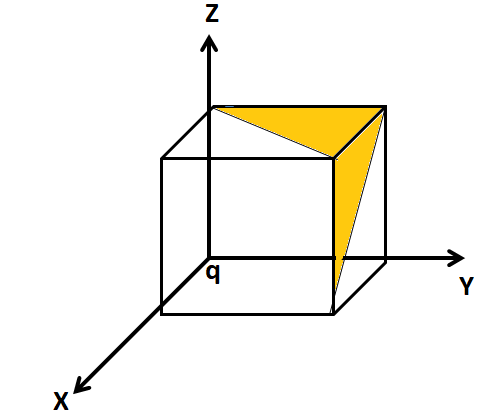
A charge ‘\[q\]’ is placed at one corner of a cube as shown in the figure. The flux of electrostatic field \[\vec E\] through the shaded area is:
A. \[q/48{\varepsilon _0}\]
B. \[q/8{\varepsilon _0}\]
C. \[q/24{\varepsilon _0}\]
D. \[q/4{\varepsilon _0}\]
Answer
 Verified
232.8k+ views
Hint: In this question, we need to find the flux of electrostatic field \[\vec E\] through the shaded area. For this, the total flux through the cube and the total flux through one outer face of the cube. With the help of this, we have to find the total flux through the shaded area.
Complete step by step solution:
Consider the following figure.
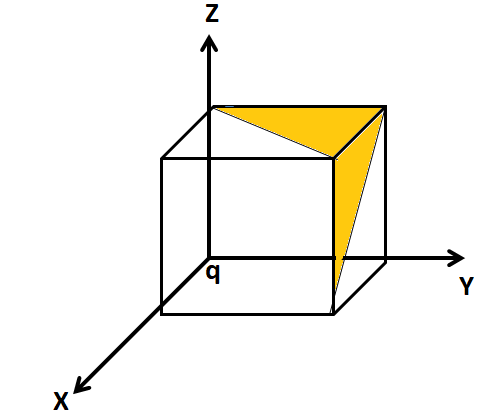
We know whenever a charge q is positioned at the cube-corner; it is distributed evenly by eight cubes.
The total flux through the cube is given by,
\[{T_C} = \left( {q/{\varepsilon _0}} \right) \times \dfrac{1}{8}\]
\[{T_C} = \dfrac{q}{{8{\varepsilon _0}}}\]
However, there is only flux across three faces.
Thus, the total flux through one external face of the cube \[ = \left( {\dfrac{q}{{8{\varepsilon _0}}}} \right) \times \dfrac{1}{3}\]
This gives the total flux through one external face of the cube \[ = \left( {\dfrac{q}{{24{\varepsilon _0}}}} \right)\]
So, the total flux through shaded region is given by,
\[{T_S} = \left( {\dfrac{q}{{24{\varepsilon _0}}} + \dfrac{q}{{24{\varepsilon _0}}}} \right) \times \dfrac{1}{2}\]
By simplifying, we get
\[{T_S} = \dfrac{q}{{24{\varepsilon _0}}}\]
Here, half of every face is shaded by a cube.
Therefore, the correct option is (C).
Additional Information: We can say that the electric flux is described as the tally of the amount of electric field lines that penetrate a region. Here, the electric field lines are thought to start with positive charges and end with negative charges. We can denote it mathematically as \[\phi = E \times A\] where, \[\phi ,E\] and \[A\] are the electric flux, magnitude of electric field and area of the surface through which the electric flux is to be determined respectively.
Note: Many students make mistakes in finding the total flux through the shaded region. Also, we may get false results due to wrong calculations. This is the only way through which we can solve this example in a simplified way.
Complete step by step solution:
Consider the following figure.
We know whenever a charge q is positioned at the cube-corner; it is distributed evenly by eight cubes.
The total flux through the cube is given by,
\[{T_C} = \left( {q/{\varepsilon _0}} \right) \times \dfrac{1}{8}\]
\[{T_C} = \dfrac{q}{{8{\varepsilon _0}}}\]
However, there is only flux across three faces.
Thus, the total flux through one external face of the cube \[ = \left( {\dfrac{q}{{8{\varepsilon _0}}}} \right) \times \dfrac{1}{3}\]
This gives the total flux through one external face of the cube \[ = \left( {\dfrac{q}{{24{\varepsilon _0}}}} \right)\]
So, the total flux through shaded region is given by,
\[{T_S} = \left( {\dfrac{q}{{24{\varepsilon _0}}} + \dfrac{q}{{24{\varepsilon _0}}}} \right) \times \dfrac{1}{2}\]
By simplifying, we get
\[{T_S} = \dfrac{q}{{24{\varepsilon _0}}}\]
Here, half of every face is shaded by a cube.
Therefore, the correct option is (C).
Additional Information: We can say that the electric flux is described as the tally of the amount of electric field lines that penetrate a region. Here, the electric field lines are thought to start with positive charges and end with negative charges. We can denote it mathematically as \[\phi = E \times A\] where, \[\phi ,E\] and \[A\] are the electric flux, magnitude of electric field and area of the surface through which the electric flux is to be determined respectively.
Note: Many students make mistakes in finding the total flux through the shaded region. Also, we may get false results due to wrong calculations. This is the only way through which we can solve this example in a simplified way.
Recently Updated Pages
JEE Isolation, Preparation and Properties of Non-metals Important Concepts and Tips for Exam Preparation

Isoelectronic Definition in Chemistry: Meaning, Examples & Trends
Ionisation Energy and Ionisation Potential Explained
Iodoform Reactions - Important Concepts and Tips for JEE
Introduction to Dimensions: Understanding the Basics
Instantaneous Velocity Explained: Formula, Examples & Graphs
Trending doubts
JEE Main 2026: Session 2 Registration Open, City Intimation Slip, Exam Dates, Syllabus & Eligibility
JEE Main 2026 Application Login: Direct Link, Registration, Form Fill, and Steps
JEE Main Marking Scheme 2026- Paper-Wise Marks Distribution and Negative Marking Details
Understanding the Angle of Deviation in a Prism
Hybridisation in Chemistry – Concept, Types & Applications
How to Convert a Galvanometer into an Ammeter or Voltmeter
Other Pages
JEE Advanced Marks vs Ranks 2025: Understanding Category-wise Qualifying Marks and Previous Year Cut-offs
Dual Nature of Radiation and Matter Class 12 Physics Chapter 11 CBSE Notes - 2025-26
Understanding Uniform Acceleration in Physics
Understanding the Electric Field of a Uniformly Charged Ring
JEE Advanced Weightage 2025 Chapter-Wise for Physics, Maths and Chemistry
Derivation of Equation of Trajectory Explained for Students