



Class 9 Maths Chapter 3 The World of Numbers Exercise 3.5 Solutions PDF


Think and Reflect
Can √2 be written as a rational number p/q?
Answer:
No, √2 cannot be written as a rational number in the form p/q, where p and q are integers and q ≠ 0.
Think and Reflect
Try to prove the irrationality of √3 using the approach of proof by contradiction. Will the same approach work for √5, √7 or √10?
Answer:
Assume that √3 is a rational number.
√3 = p/q
where p and q are coprime integers and q ≠ 0.
Squaring both sides:
3 = p²/q²
p² = 3q²
This means p² is divisible by 3, so p is also divisible by 3.
Let:
p = 3k
Substituting:
(3k)² = 3q²
9k² = 3q²
q² = 3k²
So, q² is also divisible by 3, which means q is divisible by 3.
Therefore, both p and q are divisible by 3, which contradicts the fact that p and q are coprime.
Hence, our assumption is wrong.
Therefore, √3 is an irrational number.
The same method works for √5, √7, and √10 because their prime factors create the same contradiction. Hence, √5, √7, and √10 are also irrational numbers.
Think and Reflect
We have seen how to obtain a line whose length is a rational number. How do we obtain lines whose lengths are irrational?
Solution:
Do it yourself.
Think and Reflect
Try to extend this method for constructing line segments of lengths 3 and 5 using a ruler and a compass. Generalise this method to construct a line segment of any length of the form n , where n is a positive integer.
Solution:
For √3:
Start with the construction of √2. From the endpoint of √2, draw a perpendicular of 1 unit and join the new point to O.
By the Baudhayana-Pythagoras theorem:
(√2)² + 1² = 2 + 1 = 3
Therefore, the new hypotenuse is √3. Using this length as the radius, locate √3 on the number line.
For √5:
First, construct √4 = 2 on the number line. At point 2, draw a perpendicular of 1 unit and join the new point to O.
Then:
2² + 1² = 4 + 1 = 5
Therefore, the new hypotenuse is √5. Using this length as the radius, locate √5 on the number line.
Generalisation for √n:
Take the previously constructed length √(n − 1). Draw a perpendicular of 1 unit and join the new point to O.
Then:
(√(n − 1))² + 1² = (n − 1) + 1 = n
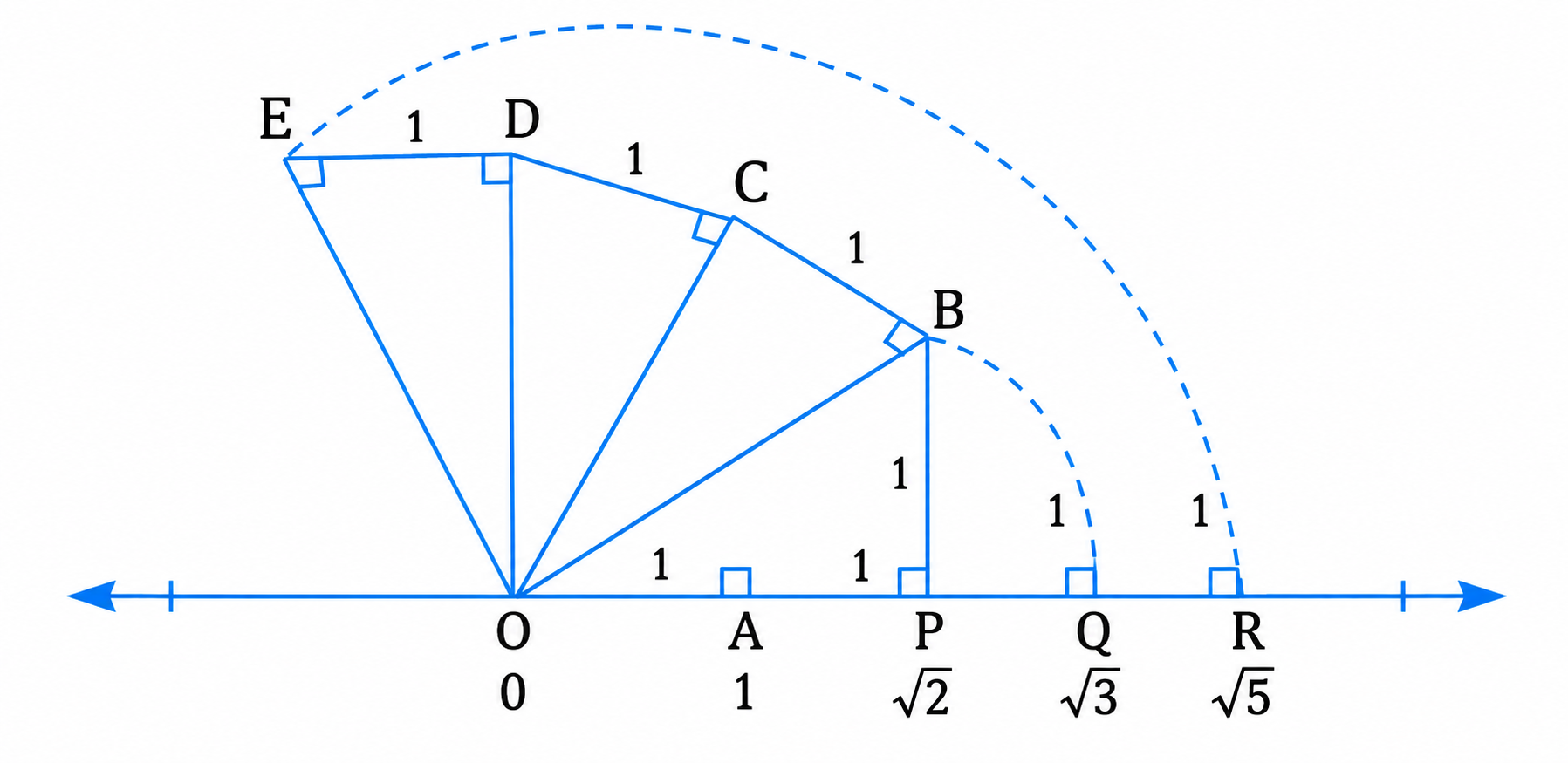
Thus, the new hypotenuse gives √n. Repeating this process, we can construct √2, √3, √4, √5, … and hence √n, where n is a positive integer.
Think and Reflect
Try to find the decimal expansions of 10/3 and 11/12. What do you observe about the repetition of the digits after the decimal point?
Solution:
Here,
10/3 = 3.3333... = 3.3̅
and
11/12 = 0.916666... = 0.916̅
We observe that in 10/3, the digit 3 repeats continuously after the decimal point. In 11/12, the digit 6 repeats continuously after the initial digits 91.
Hence, both decimal expansions are non-terminating but repeating.
Think and Reflect
The decimal expansion of p/q will be terminating precisely when the prime factors of q are only 2, only 5, or both 2 and 5. Can you explain why?
Solution:
A rational number p/q has a terminating decimal expansion when the denominator q has no prime factors other than 2 and 5.
This is because our decimal system is based on 10, and
10 = 2 × 5.
For example,
1/2 = 0.5
1/5 = 0.2
1/20 = 0.05
All these decimals terminate because the denominators contain only the prime factors 2 and 5.
If q has any other prime factor, such as 3 or 7, the decimal expansion will be non-terminating and repeating.
Hence, the decimal expansion of p/q terminates precisely when the prime factors of q are only 2, only 5, or both 2 and 5.
Exercise Set 3.5
1. Without performing long division, determine which of the following rational numbers will have terminating decimals and which will be repeating: 7/20,4/15 and 13/250. Then check your answers by explicitly performing the long divisions and expressing these rational numbers as decimals.
Solution:
For 7/20:
20 = 2² × 5
Only 2 and 5 appear in the denominator, so the decimal terminates.
Now check by long division:
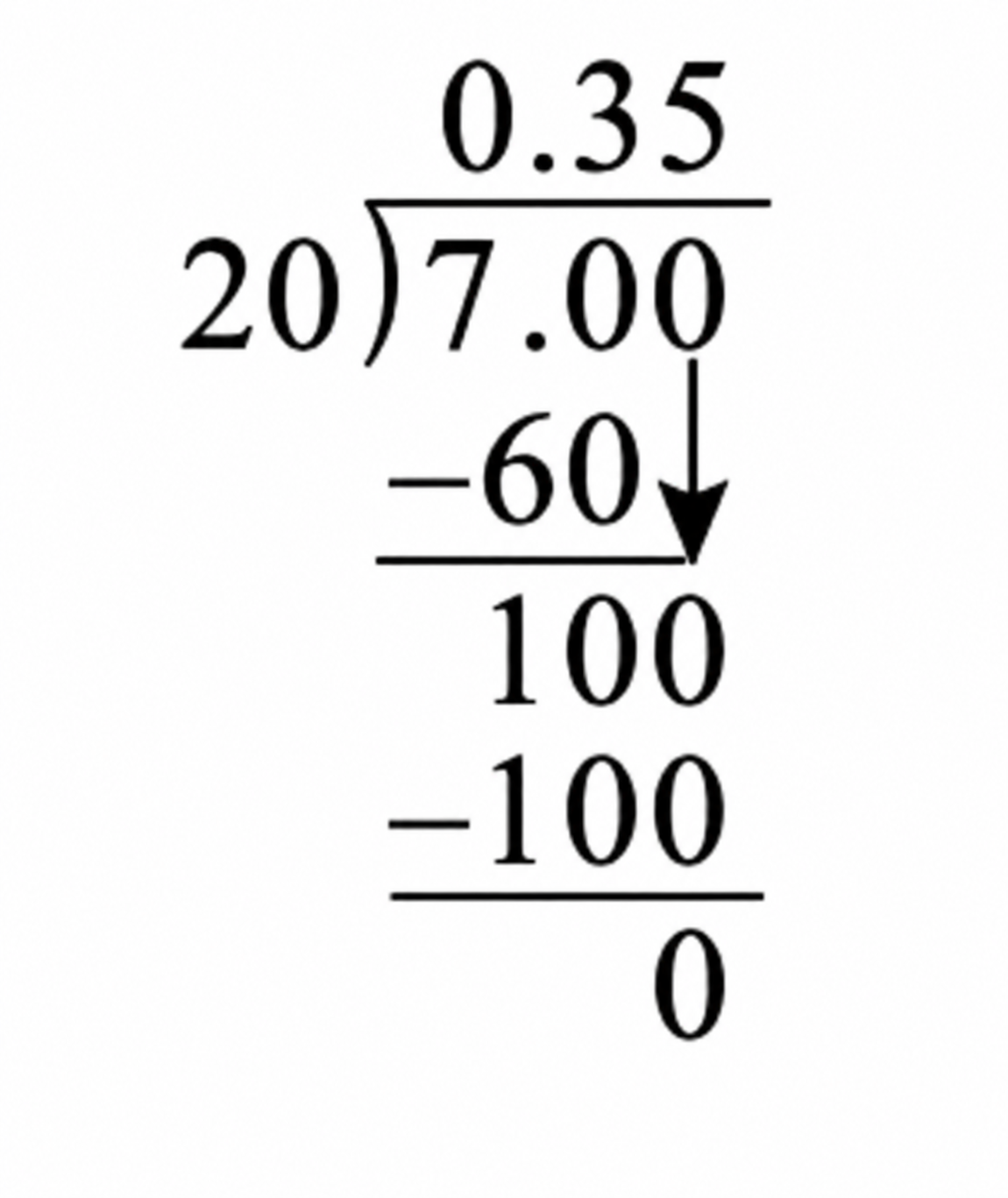
Therefore,
7/20 = 0.35
For 4/15:
15 = 3 × 5
Since 3 appears in the denominator, the decimal will be repeating.
Now check by long division:
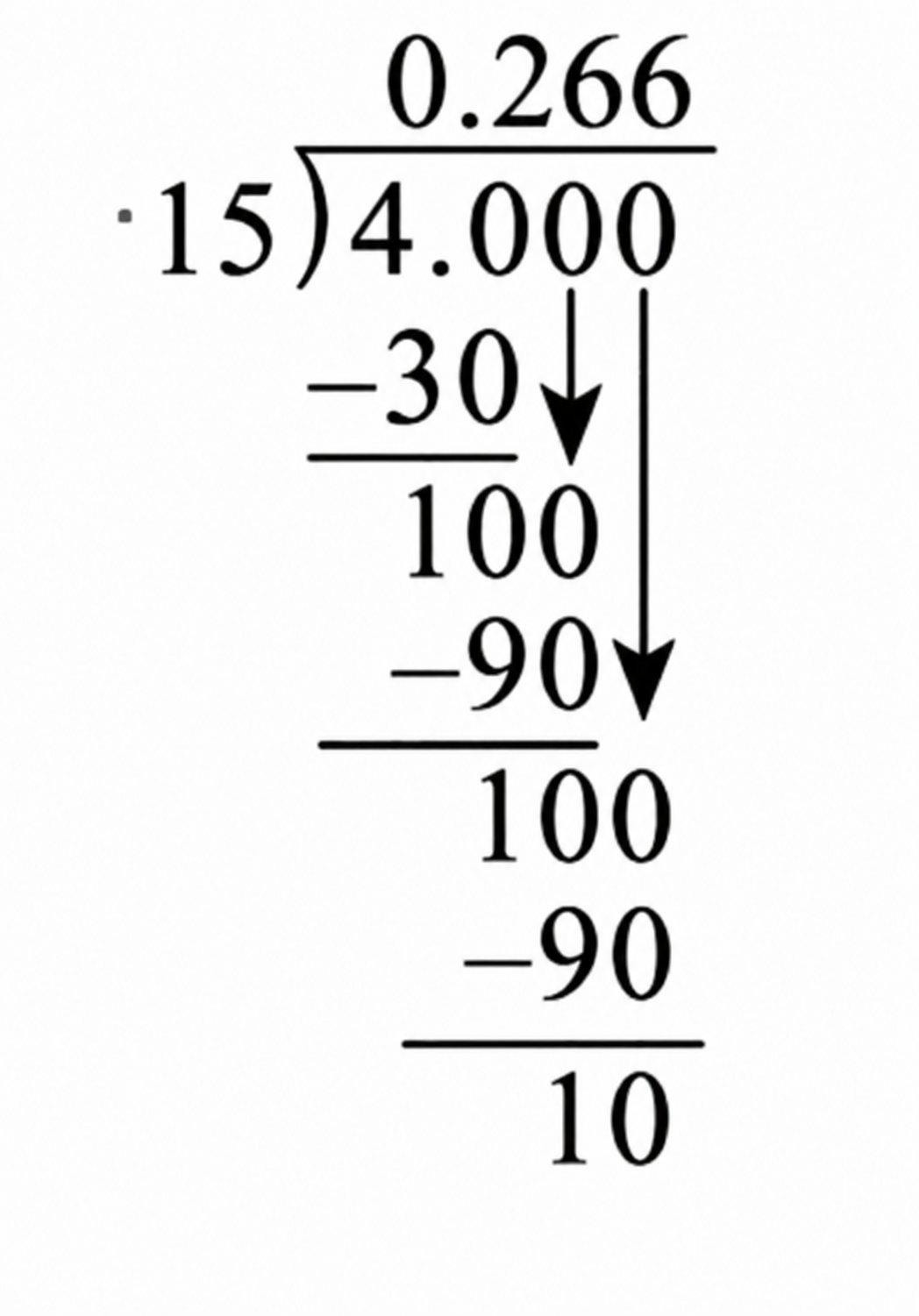
Therefore,
4/15 = 0.266...
For 13/250:
250 = 2 × 5³
Only 2 and 5 appear in the denominator, so the decimal terminates.
Now check by long division:
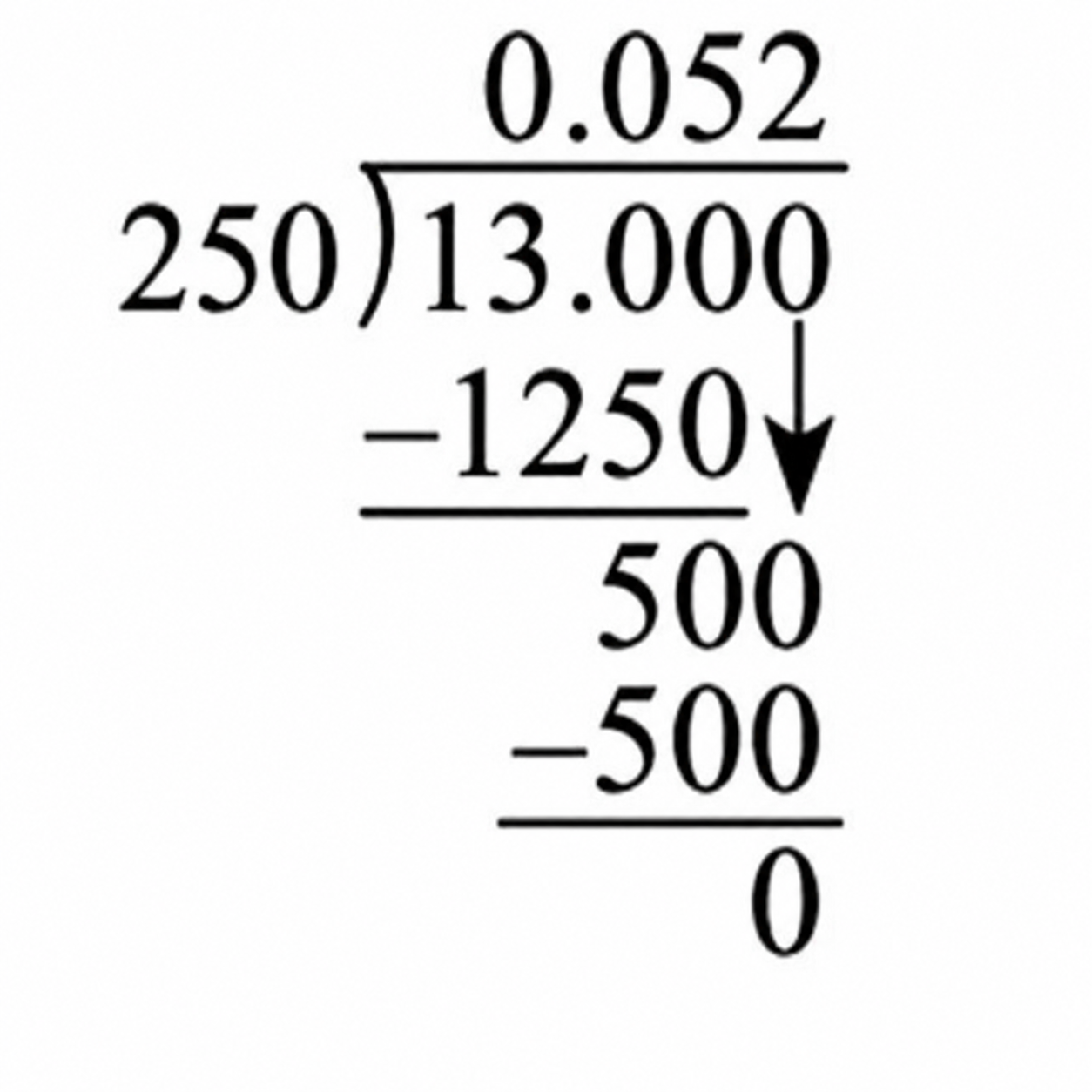
Therefore,
13/250 = 0.052
Hence, 7/20 and 13/250 have terminating decimals, while 4/15 has a non-terminating repeating decimal.
2. Perform the long division for 1/13. Identify the repeating block of digits. Does it show cyclic properties if you evaluate 2/13? Now compute 3/13, 4/13, etc. What do you notice?
Solution:
Long division for 1/13:
So, the repeating block is: 0.07692
repeating digits are the product of 2, 3, 4, 5, … to the repeating digit of 1/13.
3. Classify the following numbers as rational or irrational:
(i) √81
(ii) √12
(iii) 0.33333...
(iv) 0.123451234512345...
(v) 1.01001000100001 ... (Notice the pattern: Is it repeating a single block?)
(vi) 23.560185612239874790120
Find the explicit fractions in case they are rational.
Solution:
Classify the following numbers as rational or irrational:
(i) √81
√81 = 9
Since 9 is an integer, √81 is rational.
9 = 9/1
Therefore, √81 is rational.
(ii) √12
√12 = 2√3
Since √3 is irrational, √12 is irrational.
Therefore, √12 is irrational.
(iii) 0.33333...
The digit 3 repeats continuously.
Therefore, it is a non-terminating repeating decimal and is rational.
0.33333... = 1/3
Therefore, 0.33333... is rational.
(iv) 0.123451234512345...
The block 12345 repeats continuously.
Therefore, it is a non-terminating repeating decimal and is rational.
Let x = 0.123451234512345...
100000x = 12345.1234512345...
Subtracting,
100000x − x = 12345
99999x = 12345
x = 12345/99999
Therefore, 0.123451234512345... is rational.
(v) 1.01001000100001 ...
The digits do not repeat as a single fixed block. The number of zeros between the 1s keeps increasing.
Therefore, it is a non-terminating, non-repeating decimal.
Hence, 1.01001000100001... is irrational.
(vi) 23.560185612239874790120
This is a terminating decimal, so it is rational.
As a fraction:
= 23560185612239874790120/10²¹
This may also be simplified to:
589004640305996869753/250000000000000000000
4. The number 0.9 (which means 0.99999…) is a rational number. Using algebra (let x = 0.9, multiply by 10, and subtract), explain why 0.9 is exactly equal to 1.
Solution:
Let x = 0.9999…
Multiply both sides by 10:
10x = 9.9999…
Now subtract the original equation from this:
10x – x = 9.9999…-0.9999…
9x = 9
Divide both sides by 9: x = 1
But we assumed x = 0.9999…,
So 0.9999… = 1
Hence, 0.9 (i.e., 0.9999…) is exactly equal to 1. \
5. We have seen that the repeating block of 1/7 is a cyclic number. Try to find more numbers (n) whose reciprocals (1/n) produce decimals with repeating blocks that are cyclic.
Solution:
A cyclic number is one where its repeating digits rotate when multiplied by numbers.
We already know:
1/7 = 0.142857̅
The block 142857 is cyclic because multiplying it by 2, 3, 4, 5, or 6 gives rotations of the same digits.
Now, to find more such numbers, we look for values of n where:
The decimal expansion of 1/n is repeating.
The repeating block has special rotation properties.
These usually occur when:
n is a prime number.
The length of the repeating cycle is n − 1 (called a full reptend prime).
Examples:
1/17 = 0.0588235294117647̅
The repeating block has 16 digits and shows cyclic-like properties.
1/19 = 0.052631578947368421̅
A number n (more precisely, a prime p) has this cyclic property when the decimal expansion of 1/p repeats with the maximum possible length, which is p − 1. Such primes are called full reptend primes. These primes generate repeating decimals where the digit block cycles under multiplication, forming cyclic numbers.
Key Benefits of Vedantu’s NCERT Class 9 Maths Chapter 3 Exercise 3.5 Solutions
Step-by-step solutions: Helps students understand how to solve each question systematically.
Clear explanation of rational and irrational numbers: Makes concepts such as terminating and repeating decimals easier to understand.
Easy understanding of decimal expansions: Helps students identify and classify different types of decimal representations.
Supports construction-based questions: Explains the steps involved in constructing required line segments using a ruler and compass.
Useful for exam preparation: Helps students revise important concepts and write answers with the correct steps.
Access Exercise-wise NCERT Solutions for Chapter 3 Maths Class 9
Other Study Material for CBSE Class 9 Maths Chapter 3
Additional Study Materials for Class 9 Maths
FAQs on NCERT Solutions for Class 9 Maths Chapter 3 Exercise 3.5 | 2026-27
1. What concepts are covered in Class 9 Maths Chapter 3 Exercise 3.5?
Class 9 Maths Chapter 3 Exercise 3.5 covers questions related to rational and irrational numbers, decimal expansions, terminating and non-terminating repeating decimals, and cyclic numbers. The exercise also includes questions based on identifying rational numbers and understanding repeating decimal patterns.
2. How do NCERT Class 9 Maths Chapter 3 Exercise 3.5 Solutions help students?
NCERT Class 9 Maths Chapter 3 Exercise 3.5 Solutions provide clear, step-by-step methods for solving the exercise questions. They help students understand how to classify numbers, identify decimal patterns, and apply the properties of rational and irrational numbers.
3. How can I identify whether a decimal expansion is terminating or repeating?
A decimal expansion is terminating when it ends after a finite number of digits. A decimal is non-terminating repeating when a digit or group of digits repeats continuously. For a rational number p/q in its simplest form, the decimal terminates when the prime factors of q are only 2, 5, or both.
4. What type of questions are asked about cyclic numbers in Exercise 3.5?
Exercise 3.5 includes questions that explore repeating blocks in decimal expansions and their cyclic behaviour. For example, the repeating block of 1/7 = 0.142857... is used to understand how the digits rotate when you multiply the block by suitable numbers.
5. Can I download Class 9 Maths Chapter 3 Exercise 3.5 Solutions PDF for revision?
Yes, students can download the Class 9 Maths Chapter 3 Exercise 3.5 Solutions PDF from Vedantu for convenient practice.
The PDF provides the solutions in an organised format, making it easier to review exercise questions and their solving methods before exams.
6. Are Class 9 Maths NCERT Solutions Chapter 3 Exercise 3.5 useful for exam preparation?
Yes, Class 9 Maths NCERT Solutions Chapter 3 Exercise 3.5 help students revise important concepts and understand the correct steps used in different types of questions. Practising these solutions can also help improve accuracy when answering questions on rational and irrational numbers.
7. How does Vedantu help students with Class 9 Maths Chapter 3 Exercise 3.5?
Vedantu provides Maths NCERT Solutions for Class 9 Chapter 3 Exercise 3.5 with simple explanations and step-by-step solutions. Students can use them to revise decimal expansions, rational and irrational numbers, cyclic numbers, and other concepts covered in the exercise.
