



Exploring Numbers in Class 9 Maths Chapter 3 Exercise 3.4


Question 1: Represent the rational numbers 2/3, -5/4 and 1 1/2 on a single number line.
Solution:
We need to show all three rational numbers on the same number line.
The given numbers are:
2/3, -5/4 and 1 1/2
First, understand where each number lies.
2/3 is positive and lies between 0 and 1.
-5/4 can be written as -1 1/4. So, it lies between -2 and -1.
1 1/2 can be written as 3/2. So, it lies between 1 and 2.
Now draw a number line and mark the integers:
-2, -1, 0, 1, and 2
To mark -5/4:
-5/4 = -1 1/4
So, divide the interval between -2 and -1 into 4 equal parts.
Mark the first part to the left of -1.
That point represents -5/4.
To mark 2/3:
Divide the interval between 0 and 1 into 3 equal parts.
Mark the second part from 0.
That point represents 2/3.
To mark 1 1/2:
1 1/2 lies halfway between 1 and 2.
So, divide the interval between 1 and 2 into 2 equal parts.
The midpoint represents 1 1/2.
Final Answer:
On the number line:
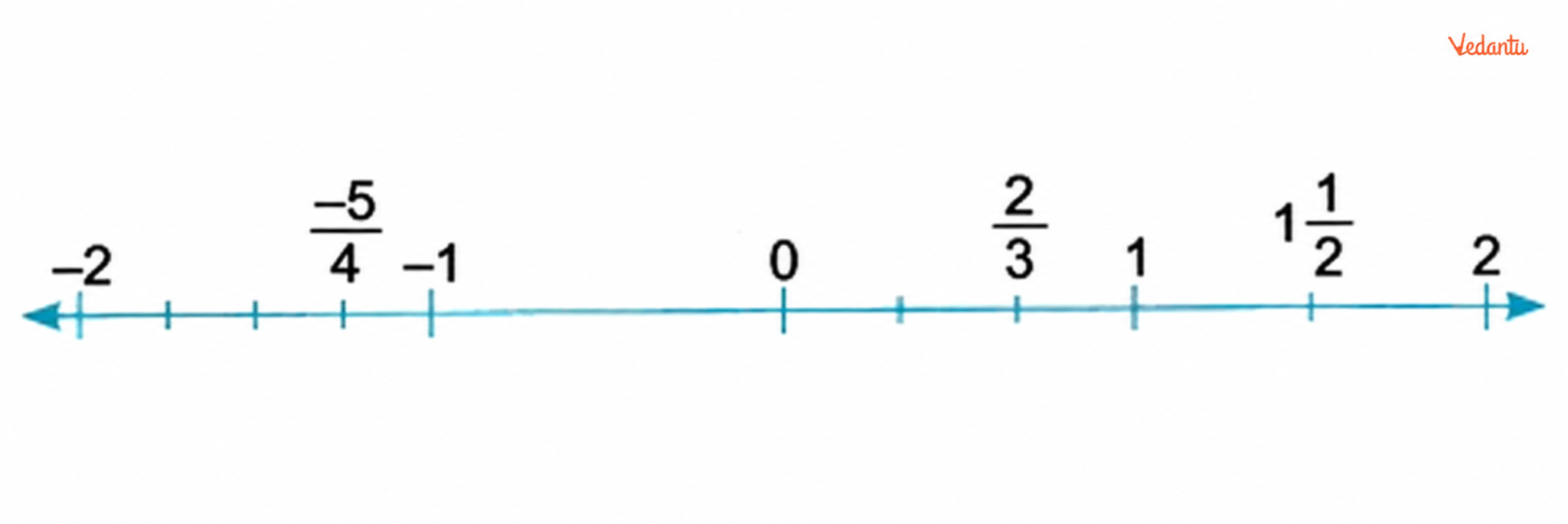
-5/4 lies between -2 and -1.
2/3 lies between 0 and 1.
1 1/2 lies between 1 and 2.
Question 2: Find three distinct rational numbers that lie strictly between -1/2 and 1/4.
Solution:
We need to find three rational numbers greater than -1/2 and less than 1/4.
One simple way is to use the average method.
First, find the average of -1/2 and 1/4.
Average = (-1/2 + 1/4) ÷ 2
Now add -1/2 and 1/4.
LCM of 2 and 4 is 4.
-1/2 = -2/4
So:
-1/2 + 1/4 = -2/4 + 1/4 = -1/4
Now divide by 2:
-1/4 ÷ 2 = -1/8
So, -1/8 lies between -1/2 and 1/4.
Now find another rational number between -1/2 and -1/8.
Average = (-1/2 + -1/8) ÷ 2
Convert -1/2 to a denominator of 8.
-1/2 = -4/8
So:
-4/8 + -1/8 = -5/8
Now divide by 2:
-5/8 ÷ 2 = -5/16
So, -5/16 lies between -1/2 and -1/8.
Now find a rational number between -1/8 and 1/4.
Average = (-1/8 + 1/4) ÷ 2
Convert 1/4 to a denominator of 8.
1/4 = 2/8
So:
-1/8 + 2/8 = 1/8
Now divide by 2:
1/8 ÷ 2 = 1/16
So, 1/16 lies between -1/8 and 1/4.
Final Answer:
Three rational numbers strictly between -1/2 and 1/4 are:
-5/16, -1/8 and 1/16
Question 3: Simplify the expression -1/4 + 5/12.
Solution:
We need to simplify:
-1/4 + 5/12
The denominators are 4 and 12.
LCM of 4 and 12 is 12.
Now convert -1/4 into a fraction with a denominator of 12.
-1/4 = -3/12
Now add:
-3/12 + 5/12 = 2/12
Simplify 2/12.
Both 2 and 12 are divisible by 2.
2/12 = 1/6
Final Answer:
-1/4 + 5/12 = ⅙
Question 4: A tailor has 15 3/4 metres of fine silk. If making one kurta requires 2 1/4 metres of silk, exactly how many kurtas can he make?
Solution:
Total silk available = 15 3/4 metres
Silk required for one kurta = 2 1/4 metres
To find the number of kurtas, divide the total silk by the silk required for one kurta.
First, convert the mixed fractions into improper fractions.
15 3/4 = (15 × 4 + 3) / 4
= (60 + 3) / 4
= 63/4
Now:
2 1/4 = (2 × 4 + 1) / 4
= (8 + 1) / 4
= 9/4
Now divide:
63/4 ÷ 9/4
To divide by a fraction, multiply by its reciprocal.
So:
63/4 × 4/9
Now cancel 4 from the numerator and denominator.
We get:
63/9 = 7
Therefore, the tailor can make 7 kurtas.
Final Answer:
The tailor can make exactly 7 kurtas.
Question 5: Find three rational numbers between 3.1415 and 3.1416.
Solution:
We need to find three rational numbers that lie between 3.1415 and 3.1416.
First, write both numbers with the same number of decimal places.
3.1415 = 3.14150
3.1416 = 3.14160
Now choose any three decimal numbers between 3.14150 and 3.14160.
For example:
3.14151
3.14152
3.14153
These numbers are greater than 3.14150 and smaller than 3.14160.
They are also terminating decimals, so they are rational numbers.
Final Answer:
Three rational numbers between 3.1415 and 3.1416 are:
3.14151, 3.14152, and 3.14153
Question 6: Can you think of other ways to find a rational number between any two rational numbers?
Solution:
Yes, there are many ways to find a rational number between two rational numbers.
One useful method is the common denominator method.
Suppose we need to find a rational number between 1/3 and 1/2.
First, write both fractions with a common denominator.
LCM of 3 and 2 is 6.
So:
1/3 = 2/6
1/2 = 3/6
No integer numerator lies between 2 and 3.
So, we can make the denominator bigger.
Multiply both fractions by 2/2.
1/3 = 4/12
1/2 = 6/12
Now 5/12 lies between 4/12 and 6/12.
Therefore, 5/12 lies between 1/3 and 1/2.
Another method is the average method.
The average of any two rational numbers always lies between them.
For example:
Average of 1/3 and 1/2
= (1/3 + 1/2) ÷ 2
= (2/6 + 3/6) ÷ 2
= 5/6 ÷ 2
= 5/12
So, 5/12 lies between 1/3 and 1/2.
We can also use decimal form.
1/3 = 0.333...
1/2 = 0.5
A number like 0.4 lies between them.
Since 0.4 = 4/10 = 2/5, it is also a rational number between 1/3 and 1/2.
Final Answer:
Yes, you can find rational numbers between two rational numbers using the common denominator method, average method, or decimal method.
Think and Reflect
1. Try and represent 8/5 and -7/4 on a number line.
Solution:
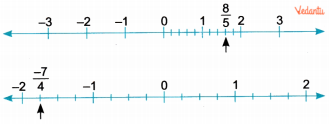
To represent 8/5 and -7/4 on a number line, first understand where they lie.
8/5 is a positive rational number.
8/5 = 1 3/5
So, 8/5 lies between 1 and 2.
To mark 8/5, divide the interval between 1 and 2 into 5 equal parts. Then count 3 parts to the right of 1. That point represents 8/5.
Now consider -7/4.
-7/4 = -1 3/4
So, -7/4 lies between -2 and -1.
To mark -7/4, divide the interval between -2 and -1 into 4 equal parts. Since -7/4 equals -1 3/4, it is closer to -2 than to -1. It can be marked as the first division to the right of -2, or the third division to the left of -1.
Thus, on the number line:
8/5 is between 1 and 2.
-7/4 is between -2 and -1.
Key Takeaways from Vedantu’s Class 9 Maths Exercise 3.4
Learn how to locate positive and negative rational numbers accurately on a number line.
Practise finding rational numbers between two given values using different methods.
Strengthen your skills in adding and simplifying rational-number expressions.
Convert mixed fractions into improper fractions when needed for calculations.
Use decimal values to identify rational numbers within a very small interval.
Understand how the average method and common-denominator method can help find numbers between two rational numbers.
Apply rational-number concepts to everyday situations, such as calculating how much material is needed.
Access Exercise-wise NCERT Solutions for Chapter 3 Maths Class 9
Other Study Material for CBSE Class 9 Maths Chapter 3
Additional Study Materials for Class 9 Maths
FAQs on Class 9 Maths Chapter 3 Exercise 3.4 Solutions | 2026-27
1. What is Exercise 3.4 in Class 9 Maths Chapter 3 about?
Exercise 3.4 of The World of Numbers deals mainly with representing rational numbers, finding rational numbers between two values, and applying operations on rational numbers.
2. How do I know where a fraction should be placed on a number line?
Convert the fraction into a mixed number or identify the integers between which it lies. Then divide that interval into equal parts according to the denominator and mark the required point.
3. How can I find a rational number between any two rational numbers?
You can take their average. If the two numbers are aa and bb, then (a+b)/2(a+b)/2 gives a rational number lying between them.
4. Why are there always more rational numbers between two rational numbers?
Rational numbers are dense on the number line. This means that between any two distinct rational numbers, another rational number—and in fact infinitely many—can be found.
5. How do you find three numbers between -1/2 and 1/4?
One possible set is:
−5/16, −1/8, 1/16
Each of these values is greater than −1/2-1/2 and less than 1/41/4.
6. What is the answer to Question 3 of Exercise 3.4?
For the expression
−1/4 + 5/12
the result is:
1\6
7. How is the tailor problem solved in Exercise 3.4?
Convert 15(¾) and 2(¼) into improper fractions and divide:
(63/4) ÷ (9/4) =7
Hence, the tailor can make 7 kurtas.
8. How can I find rational numbers between 3.1415 and 3.1416?
Add extra decimal places and choose values within the interval. For example, 3.14151, 3.14152, and 3.14153 are rational numbers between the two given values.
9. What different methods are shown for finding a rational number between two numbers?
Exercise 3.4 discusses the common-denominator method, average method, and decimal method. Choosing the method depends on the form of the numbers given.
10. Why is 5/12 between 1/3 and 1/2?
Writing both fractions with denominator 12 gives:
1/3=4/12, 1/2=6/12.
Since 5/12 lies between 4/12 and 6/12, it lies between 1/3 and 1/2.
11. What do Class 9 Maths Chapter 3 Exercise 3.4 solutions help students understand?
They make it easier to follow the reasoning behind number-line questions, fraction calculations, and methods for finding rational numbers between given values.
12. What should I revise before attempting Exercise 3.4?
Revise rational numbers, fractions, mixed numbers, equivalent fractions, LCM, decimal representation, and basic operations on fractions.
13. Why is -7/4 between -2 and -1?
Since
−7/4=−1(¾),
its value is greater than -2 and smaller than -1. Therefore, it falls between these two integers on the number line.
14. How can I use the Class 9 maths chapter 3 exercise 3.4 solutions for exam preparation?
Solve the questions first without looking at the answers. Then use the solutions to check your working, especially your fraction conversions, calculations, and number-line placement.
15. What type of Class 9 Maths Chapter 3 solutions exercise 3.4 questions should I practise?
Focus on number-line representation, finding numbers between two rational numbers, simplifying fractions, dividing mixed numbers, and explaining different methods of finding rational numbers.
16. Where can I check Maths NCERT solutions class 9 chapter 3 exercise 3.4?
You can use the step-by-step solutions provided on this Vedantu page to review the questions and methods covered in Exercise 3.4.
17. What can I learn from the NCERT solutions for Class 9 Maths Chapter 3 Exercise 3.4?
You can learn how to represent rational numbers, perform calculations with them, and find other rational numbers between given values using suitable methods.
18. Are Class 9 Maths Chapter 3 Exercise 3.4 question answers useful for revision?
Yes. You can use them after solving the exercise yourself to verify answers and catch calculation or sign errors before a test.
19. Why does Exercise 3.4 use both fractions and decimals?
Using both forms helps you understand that rational numbers can be represented in different ways and can still be compared or located on the number line.
20. Is there more than one correct answer when finding rational numbers between two given numbers?
Yes. Since infinitely many rational numbers can lie between two distinct rational numbers, different sets of valid answers may be possible.
