



How to Write Step-by-Step Answers for Class 4 EVS Chapter 6?
Activity 1 (Page 85)
Question.
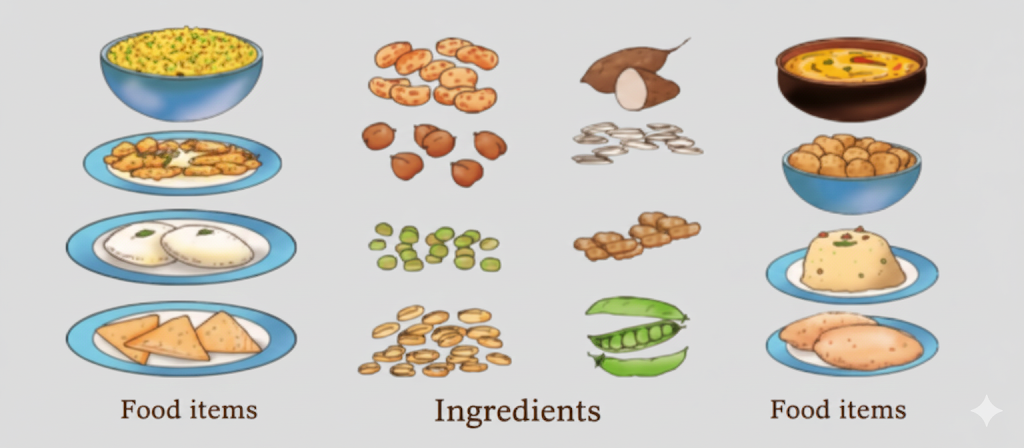
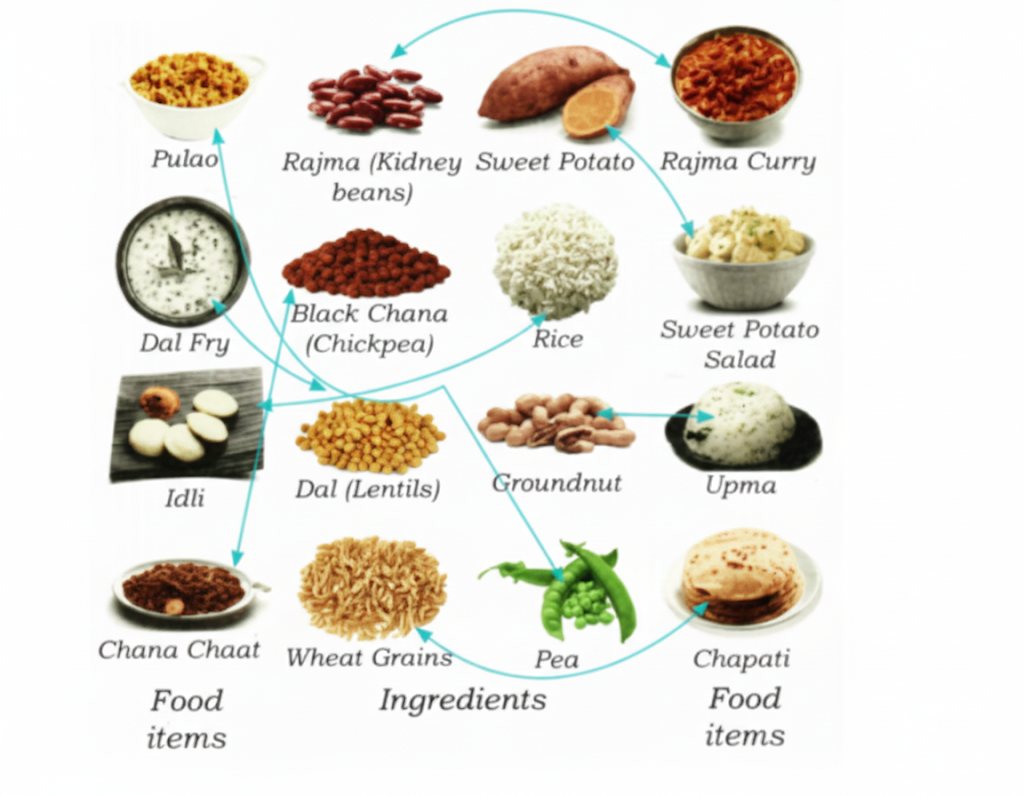
Connect the food items shown below with the ingredients used to make them.
Answer:
Activity 2 (Page 88)
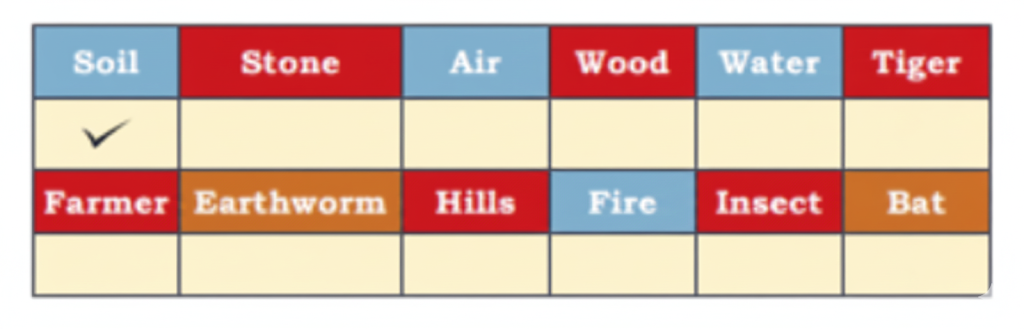
Observe the pictures and answer the following questions.
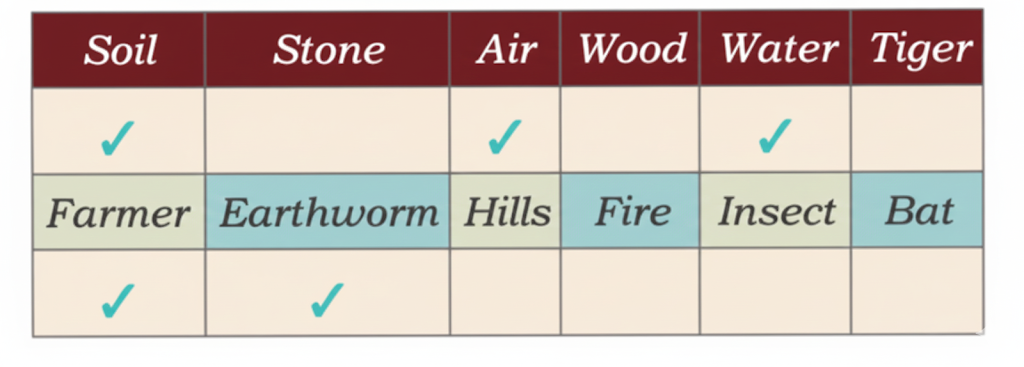
1. Put a tick (✓) on the elements that assist a grain in its journey.
Answer:
Write (Pages 88-49)
Question 1.
What is the role of farmers in this process?
Answer:
Farmers play a key role in bringing grains from the farm to our plates.
First, the farmer prepares the soil by loosening it. Then, suitable crops are chosen based on the climate of the region, and seeds are sown in the fields. Fertilisers and manure are added to help the plants grow well. The crops are watered regularly through irrigation to ensure they get enough water. Once the crops are fully grown, they are harvested, stored safely, and transported to shopkeepers.
Question 2.
List out the missing elements in the table above.
From the time a seed is sown, to the point when food reaches our plate, it is a remarkable journey. Can you list the roles of the different elements involved in this journey?
(a) Soil: _____
(b) Water: _____
(c) Farmer: _____
(d) Cattle: _____
(e) Shopkeeper: _____
(J Family members: _____
(g) Any other: _____
Answer:
The missing items in the table are sunlight, seeds, manure, and fertilisers.
(a) Soil: Gives support to the seed, helps it grow, and supplies essential nutrients.
(b) Water: Helps the seed grow into a strong and healthy plant.
(c) Farmer: Looks after the crops from sowing the seeds to harvesting them.
(d) Cattle: Provide manure to enrich the soil and also help farmers in ploughing the fields.
(e) Shopkeeper: Sells grains and food items in the market for people to purchase.
(f) Family members: Buy the food, cook it, and serve it with care and love.
(g) Any other (Protection and care): Protect crops from birds and insects, remove unwanted plants, and ensure proper storage of grains.
Activity 3 (Page 89)
Thank You Everyone?
Whom would you like to thank for the food you eat? Please write your answers in the following space.
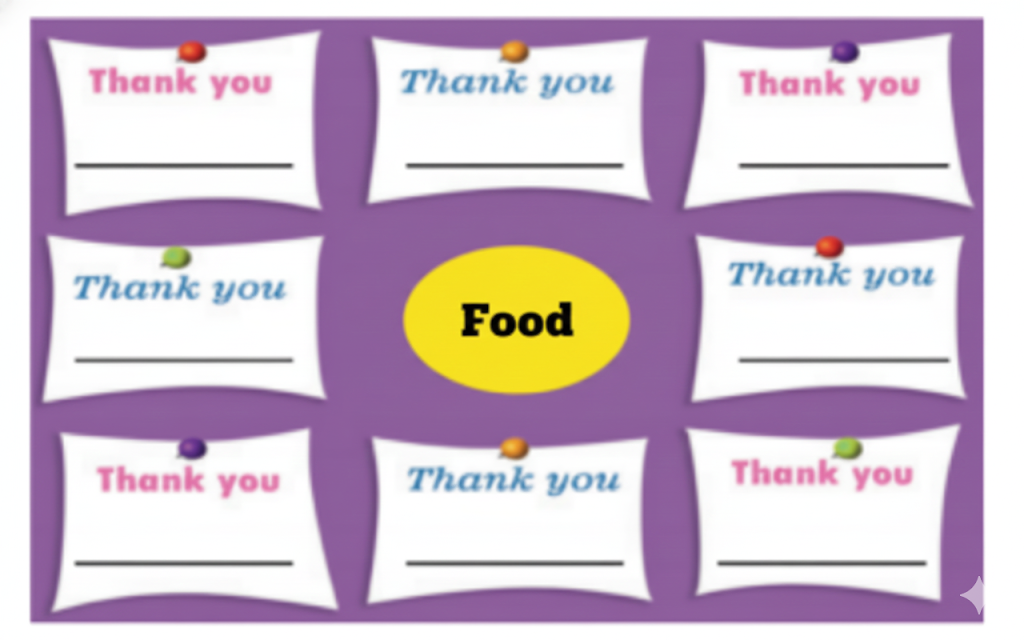
Answer:
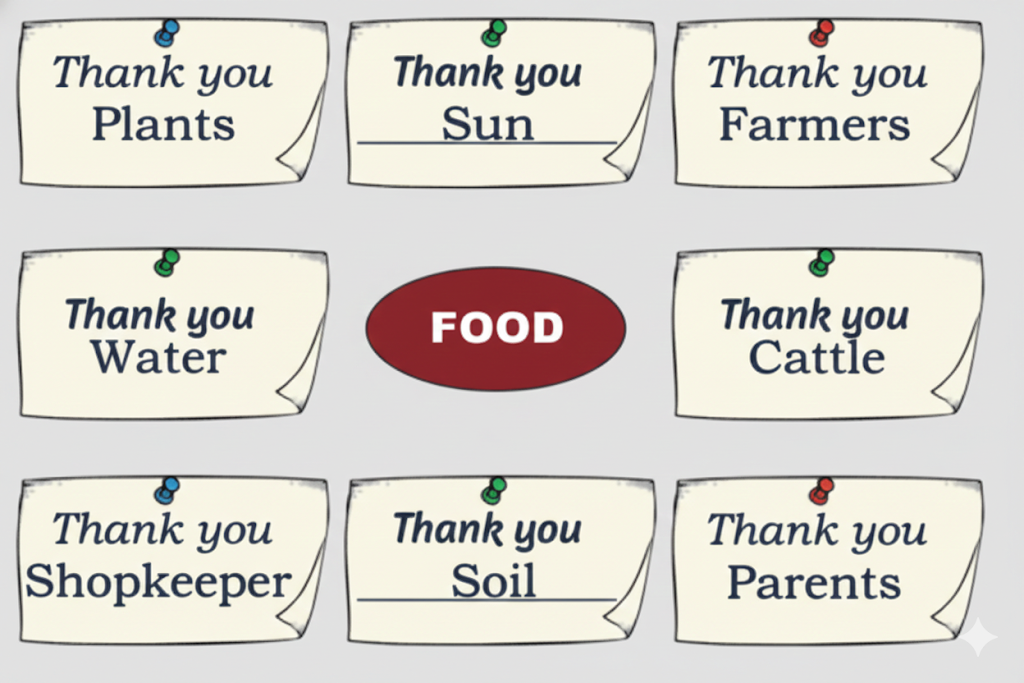
Discuss (Page 92)
Question 1.
What role does your tongue play in this process?
Answer:
Our tongue plays an important role in digestion in the following ways:
It helps break down the food in the mouth.
It mixes the food with saliva to make it soft and easy to swallow.
It allows us to taste different flavours with the help of taste buds.
It pushes the food towards the food pipe, helping us swallow it easily.
Question 2.
What do your teeth do to the food?
Answer:
Teeth help in chewing food and breaking large pieces into smaller parts, making digestion easier.
Question 3.
What happens to the food inside your mouth during this process?
Answer:
Inside the mouth, food is chewed by the teeth to break large pieces into smaller ones. The food then mixes with saliva, which helps in digestion. After that, the tongue helps in swallowing the food.
Activity 4 (Page 93)
For a week, keep a record of the food you eat for breakfast, lunch and dinner. After every meal, make an entry in the following table. If you ate everything, write ‘Yes’ and add a happy smiley. If you left some food, write ‘No’ and add a sad face.
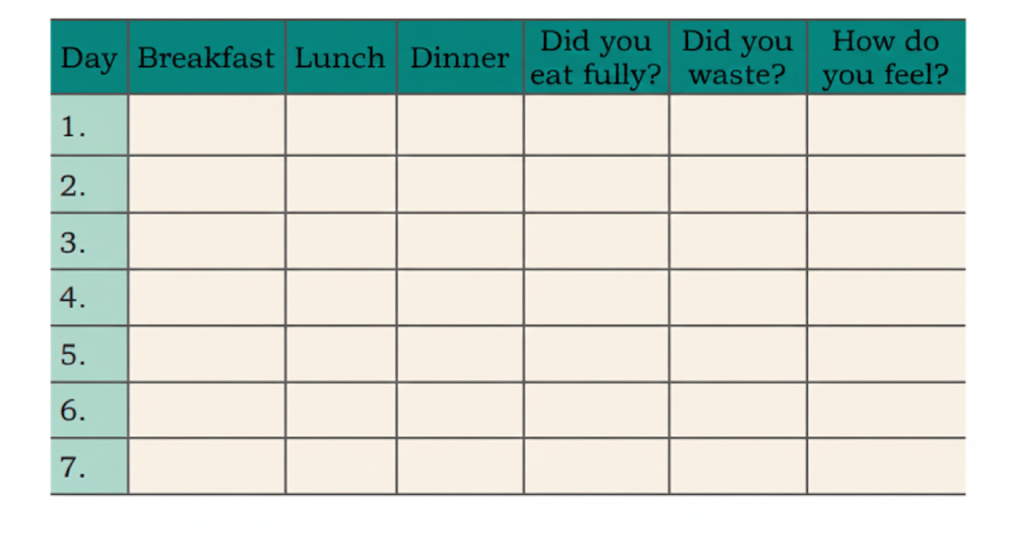
Answer:
Students should do it by themselves.
Write (Page 93)
What will you do —
Question 1.
If someone offers you food more than you need?
Answer:
If someone offers me more food than I can eat, I will politely decline the extra food.
Question 2.
If you do not like a food item on your plate?
Answer: Even if I do not like a food item on my plate, I will try to finish my meal. Leaving food uneaten leads to wastage, and it also shows disrespect to the hard work of everyone involved in bringing the food to our plate.
Write (Page 94)
Look at the picture below.
Identify the activities people are engaged in.
Answer:
Cycling, playing badminton, sliding, swinging, playing handball, playing football, reading a book, playing with a ball, sitting on a bench, and walking.
Discuss (Page 95)
Question 1.
Which physical activities do you do in your daily life?
Answer:
I go running, do cycling, and play games such as football and badminton.
Question 2.
How do you feel on a day when you play a lot?
Answer: On days when I play a lot, I feel exhausted.
Find Out (Page 95)
Can you name the games depicted in the pictures below?
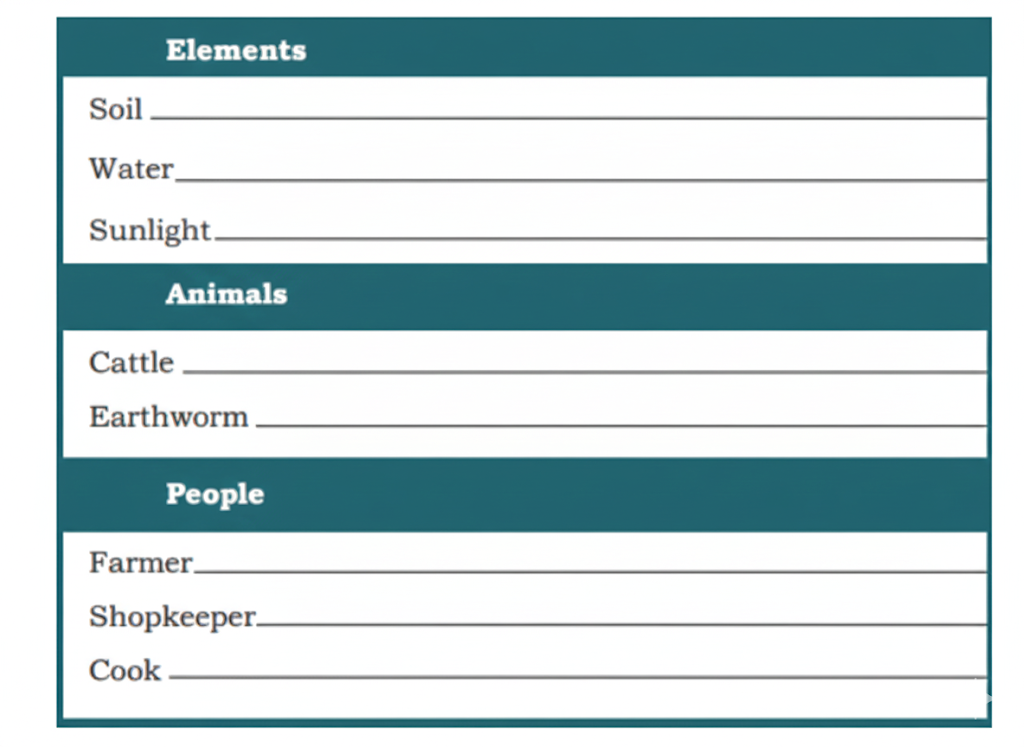
Answer:
Elements
Soil: Without soil, seeds cannot grow into plants.
Water: Without water, plants will dry up and die.
Sunlight: Without sunlight, plants cannot prepare their food and will not grow properly.
Animals
Cattle: Without cattle, farmers would find it difficult to plough fields and obtain natural manure.
Earthworms: Without earthworms, the soil would lose its richness and fertility, affecting plant growth.
People
Farmer: Without farmers, crops would not be grown or cared for.
Shopkeeper: Without shopkeepers, we would not be able to buy grains or food from the market.
Cook: Without a cook, grains could not be turned into tasty and nutritious meals.
Question 2.
Design your own favourite plate of balanced diet with the food items you like. (Remember we should not waste food)
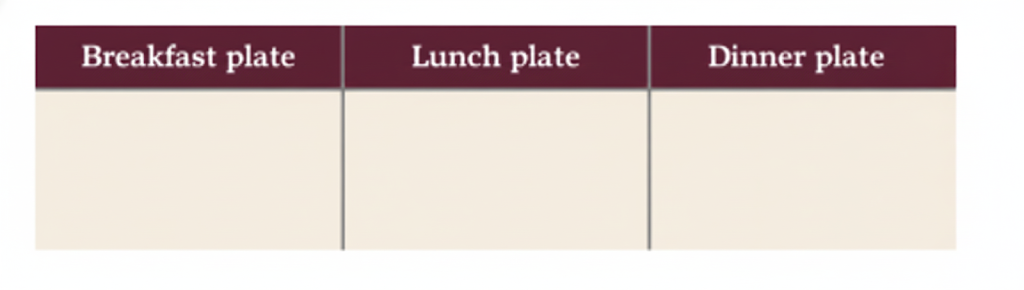
Answer:
Question 3.
Which activities did you enjoy during your ‘mindful eating’?
Answer:
While eating, I pay attention to what I eat and how I feel while eating. I enjoy eating slowly and focusing on each bite. It helps me to enjoy the taste and appreciate the food that I get.
Question 4.
How can you keep your body strong?
Write down the names of the exercises and games you would practice.
Exercises: ____________________
Games: ___________________
Answer:
We can keep our body healthy and strong by exercising regularly, playing outdoor games, eating nutritious food, and getting proper rest.
Exercises: Running, skipping rope, stretching, and yoga.
Games: Cycling, football, badminton, basketball, and kho-kho.
Question 5.
Which habits would you practice daily? Indicate your plans.
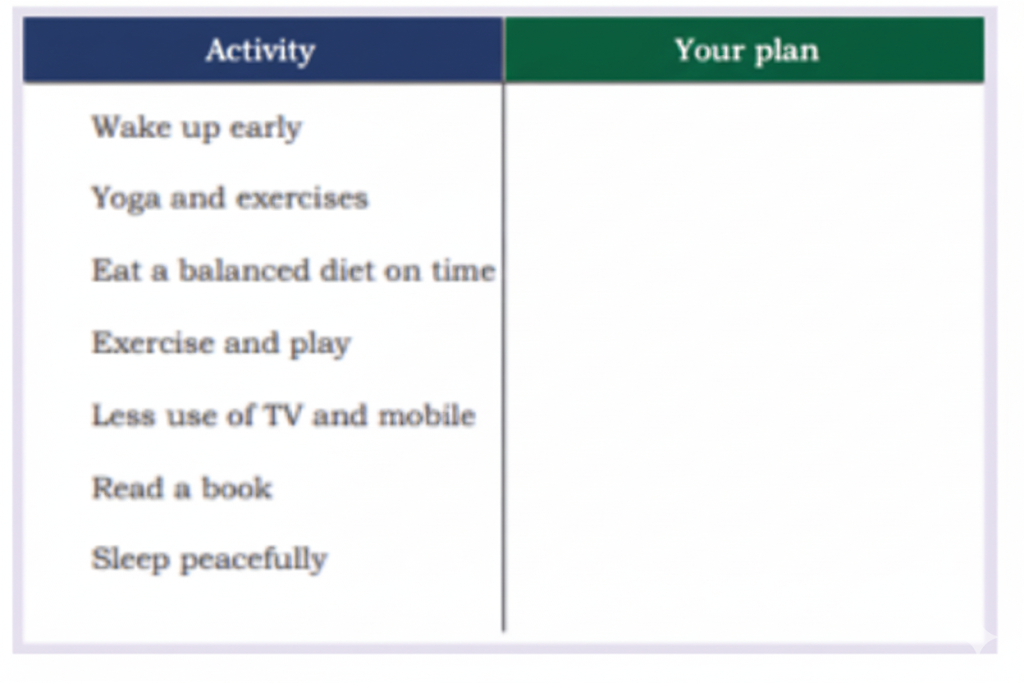
Answer:
Students should do it by themselves.
Class 4 EVS Chapter 6: Importance of Healthy Living
Learning about Happy and Healthy Living helps Class 4 students build good habits early on. This chapter teaches the value of balanced diets, regular exercise, and the importance of staying safe and grateful for our food.
With easy-to-follow explanations and real-life examples, students can understand why mindful eating and respecting everyone involved in getting food to our plate matter for a healthy, happy life.
Practicing the tips in this chapter boosts overall well-being. Focus on healthy daily routines — from eating all meals, regular sleep, to enjoying outdoor games. These are the keys to staying strong and energetic throughout the year!
FAQs on NCERT Solutions For Class 4 Our Wonderous World Chapter 6 Happy And Healthy Living - 2026-27 Free PDF Download (Sign-in Required)
1. What are NCERT Solutions for Class 4 EVS Chapter 6: Happy and Healthy Living?
NCERT Solutions for Class 4 EVS Chapter 6: Happy and Healthy Living provide stepwise answers to all chapter exercises, ensuring full coverage of the CBSE syllabus.
- Include chapterwise answers, key definitions, and diagrams.
- Designed as per the CBSE marking scheme for 2026–27.
- Helps students understand important concepts like healthy habits, cleanliness, and balanced living.
2. How to write stepwise NCERT answers to score full marks in Class 4 EVS?
To score full marks, follow a stepwise approach as recommended for CBSE exams.
- Write each step or point clearly and in sequence.
- Use key terms and definitions from the textbook.
- Present answers neatly, and draw labelled diagrams when needed.
- Structure long answers with introduction, main points, and conclusion.
3. Is a PDF of Class 4 EVS Chapter 6 solutions available for free download?
Yes, a free PDF download of the NCERT Solutions for Class 4 EVS Chapter 6 is usually provided by leading education platforms.
- Look for a clear download button or link on the solution page.
- PDFs help with offline revision and exam practice.
4. How do I structure long answers for better marks in Class 4 EVS?
For maximum marks, structure long answers clearly and logically.
- Start with a short introduction about the topic.
- List important points using bullet points or numbered lists.
- Include definitions, examples, and labelled diagrams if required.
- End with a summary or conclusion.
5. Are diagrams or definitions mandatory when answering EVS Chapter 6 questions?
Including diagrams and definitions is highly recommended and often required for CBSE marking.
- Neatly labelled diagrams can fetch extra marks.
- Correct definitions show clear understanding of key terms like health, hygiene, and balanced diet.
6. What are the most important topics in Class 4 EVS Chapter 6: Happy and Healthy Living?
The most important topics include:
- Healthy eating habits and balanced diet
- Personal hygiene and cleanliness
- Importance of exercise and outdoor activities
- Avoiding harmful habits for good health
7. How can I learn and draw diagrams or maps for Happy and Healthy Living?
To learn diagrams for EVS Chapter 6:
- Practice drawing neatly and accurately on plain paper.
- Label all parts clearly using a pencil and ruler.
- Use examples from NCERT textbook or solution PDFs for reference.
- Revisit common diagrams like food groups, daily hygiene routines, and balanced meals.
8. Are NCERT Solutions enough for Class 4 EVS exams?
NCERT Solutions for Class 4 EVS cover all exercise questions as per CBSE, making them sufficient for most school exams.
- Follow the stepwise format and marking scheme.
- For extra practice, refer to sample papers, MCQs, and exemplar questions as well.
9. What are common mistakes to avoid when answering EVS Chapter 6 questions?
To avoid losing marks in CBSE exams:
- Do not skip definitions or neat diagrams.
- Avoid writing answers in one big paragraph—use points.
- Don’t forget to label and title diagrams.
- Always follow the stepwise approach as given in solutions.
10. Where can I find all chapterwise solutions and important questions for Class 4 EVS?
Chapterwise NCERT solutions and important questions for Class 4 EVS are available on major educational platforms.
- Look for directories labelled “All Chapters NCERT Solutions” or “Important Questions – Class 4 EVS”.
- These help in systematic preparation and revision for the CBSE 2026–27 syllabus.
